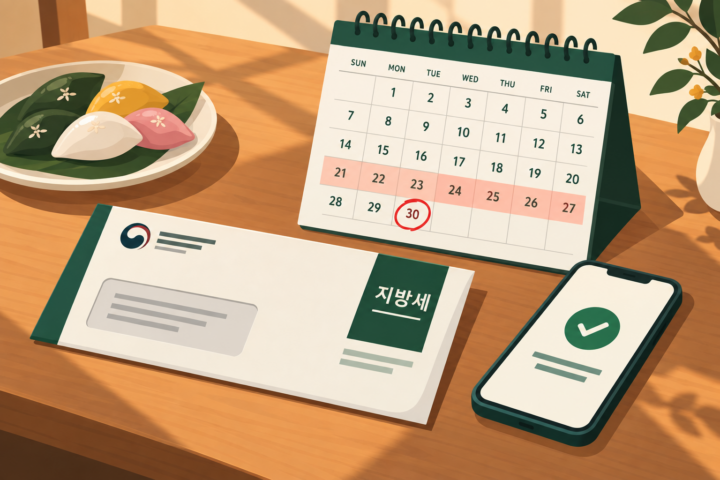
When offices reopen on Monday, September 28 after the Chuseok (추석) holiday, only three working days are left in the month. If your property tax bill is still unpaid when those three days run out, a 3% late-payment penalty is added on October 1. This year’s September bill is due on Wednesday, September 30, and the four days just before that final stretch, September 24 to 27, are public holidays and a Sunday. (※ As of September 2026 · Last updated 2026-09-20)
The bottom line: pay your property tax by Wednesday, September 23, the last working day before the holiday, and if your bill is above KRW 2.5 million and you want to split it, file the installment request by that same day. Online payment keeps working through the holiday, but anything a tax officer has to handle, such as approving an installment request or answering a question about your bill, only moves during office hours.
If your bill is KRW 2.5 million or less, the legal installment option is closed to you, which leaves a single payment or a credit card installment plan. A card plan is free only when it is a fully interest-free offer that actually covers tax payments.
Who pays property tax in September, and by when
Property tax in Korea, called jaesanse (재산세), is a local tax charged for the whole year to whoever actually owns real estate on June 1. Unlike acquisition tax, which you pay once when you buy, it comes back every year you hold the property. The payment window depends on the type of property and is fixed by law. The September bill carries the second half of the housing portion plus the land portion (Easy-to-Find Practical Law (찾기쉬운 생활법령정보), property tax page, in Korean).
- Housing: half of the annual tax is due July 16 to 31 and the other half September 16 to 30. If the annual amount is KRW 200,000 or less, local ordinances let the city bill it all in July, so no September bill arrives.
- Land: billed in full once a year, September 16 to 30.
- Buildings: non-residential buildings such as shops and offices are billed in full once a year, July 16 to 31.
Chuseok squeezes the calendar: the hours you can actually use
This year’s Chuseok holiday runs from Thursday, September 24 to Saturday, September 26, and the 27th is a Sunday. Monday the 28th is not a substitute holiday, so the only working days between the end of the holiday and the deadline are the 28th, 29th and 30th (Maeil Shinmun (매일신문), September 18, in Korean).
When the Seoul Metropolitan Government (서울시) sent out its September bills, it also asked residents to pay early because banks get crowded and online traffic climbs on the last day (Seoul’s September property tax announcement, in Korean).
The good news is that Wetax (위택스), the Smart Wetax app and simple-pay apps accept property tax payments on public holidays and at night (Incheon City’s September notice, in Korean). Each channel does close for part of the day, though. If you have been thinking of the deadline as “midnight on September 30”, replace that with the times below (Wetax payment methods guide, in Korean).
| Payment channel | Hours you can pay | Good to know |
|---|---|---|
| Wetax and Smart Wetax | 00:30 to 23:30 | Account transfer, credit card or simple pay; bill lookup works 24 hours |
| Virtual account printed on the bill | 00:30 to 22:00 | Any transfer fee from another bank is on you |
| Bank counter | 09:00 to 16:00 | Bank business days only |
| Bank CD/ATM | Each bank’s machine hours | A credit card from a different bank group may carry a fee |
| Automatic payment | Sign-up on bank business days, 06:00 to 22:00 | Only sign-ups made by the end of the previous month count, so it is too late for this September bill |
Work done by people follows a different clock. Gov24 (정부24) lists the processing time for a property tax installment request as “immediate (within 3 hours during working hours)”, so it is safer to assume that a request filed online during the holiday will not be handled until the 28th or later. The same goes for questions about a bill that looks wrong: the district tax office answers on working days only.
In practice there are two deadlines this year. September 23 still leaves room to fix a problem, and the night of September 30 leaves none.
Lump sum, installments or card: your bill size decides how you pay property tax
Once the bill is in your hands there are three ways to pay it, and the fork in the road is a base property tax of KRW 2.5 million (250만 원). Above that line the law lets you pay in installments. Below it, you either pay in one go or lean on your card issuer’s installment plan.
| Method | Who can use it | How much can be pushed back | Cost | Keep in mind |
|---|---|---|---|---|
| Single payment | Anyone | Nothing | None | Paying online by card carries no processing fee either |
| Installment payment (분할납부) | Owners whose base property tax exceeds KRW 2.5 million | Up to KRW 5 million: the part above KRW 2.5 million. Above KRW 5 million: up to 50% of the tax | No application fee | Apply by September 30; the rest is due within 3 months after the deadline passes |
| Card installment plan | Credit card holders | Within your card limit and the number of months chosen | Installment interest (none only under a fully interest-free offer) | The approval cannot be cancelled after payment |
With the legal installment option, how much you pay in September and how much you can defer depends on the size of the base tax.
| Base property tax | Due by September 30 | Can be deferred within 3 months |
|---|---|---|
| KRW 2.0 million | KRW 2.0 million (installments not available) | Nothing |
| KRW 3.0 million | KRW 2.5 million | KRW 0.5 million |
| KRW 4.8 million | KRW 2.5 million | KRW 2.3 million |
| KRW 8.0 million | KRW 4.0 million or more | KRW 4.0 million or less |
Four rules are worth knowing before you apply.
- The test is the base tax: Wetax says you can apply when the base property tax on your bills adds up to more than KRW 2.5 million. The local education tax (지방교육세) printed on the same bill is split automatically in the same ratio, while the regional resource facility tax (지역자원시설세) is split only if that tax alone exceeds KRW 2.5 million (Wetax answer on the Government Call Center 110 site, in Korean).
- Apply by the payment deadline: requests are taken online, in person or by post, and there is no fee. Online requests must be made by the taxpayer in person; an agent cannot file online (Gov24: property tax installment request, in Korean).
- You get two new bills: once the request is accepted, the office reissues the bill as one part due within the original deadline and one part due within the installment period. Pay the remainder by the date on the new bill.
- The first part cannot be lowered: when the base tax is KRW 5 million or less, the minimum due in September is KRW 2.5 million, and you can only adjust it upward.
Card payment has two separate cost questions. The first is the processing fee. Property tax is a local tax, and paying a local tax online by credit card carries no fee. That differs from national taxes paid by card through the National Tax Service (국세청), where the taxpayer bears a processing fee of 0.4% to 0.8% of the tax (0.15% to 0.5% for debit cards). The second is installment interest, which belongs to the card company and is charged separately.
Do not assume that a general interest-free shopping promotion covers taxes. Before paying, check that the offer is specifically for “national and local tax payments” and that it is not a partial interest-free plan, where you still pay interest on some of the monthly instalments (Daehan Daily (대한데일리), September 14, in Korean).
A local tax paid by card cannot be cancelled once approved, so decide which card and how many months before you press the button. Tax payments are also excluded from the year-end income deduction for credit card spending, and they may not count toward your card’s monthly spending target or points. The card-choice logic in our credit card vs debit card guide applies to everyday spending only, not to this bill.
One day late costs 3%: how the late-payment penalty builds
Property tax that misses the deadline picks up a late-payment penalty (납부지연가산세) in the following order (Gimpo City arrears guide, Yeoncheon County guide, both in Korean).
- 3% the day after the deadline: 3% of the unpaid tax is charged once. It is the same amount whether you are one day or one month late.
- 0.66% a month from KRW 450,000: if the tax, counted per bill and per tax item, is KRW 450,000 or more, another 0.66% is added each time a full month passes after the deadline.
- Up to 60 months: the monthly charge can keep running for 60 months.
Leave a bill with KRW 1,000,000 of base property tax untouched and KRW 30,000 is added on October 1, then KRW 6,600 more for every month that passes. After a full year the penalty alone is KRW 109,200, or 10.92% of the original tax. If the tax is KRW 400,000, it sits below the KRW 450,000 line, so the penalty stops at the 3%, which is KRW 12,000.
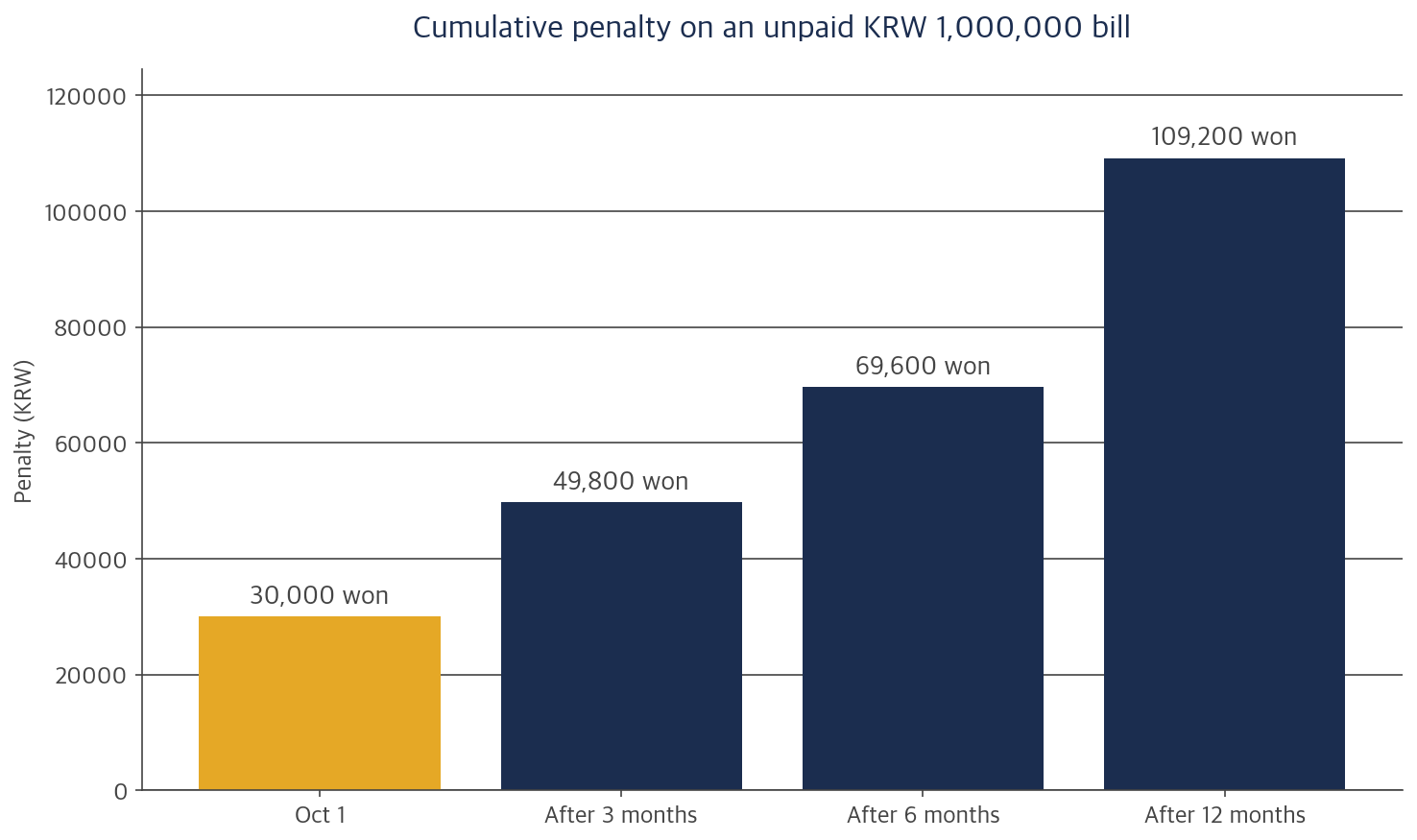
The message in these numbers is simple. The legal installment option costs nothing, a fully interest-free card plan costs nothing, and the only choice that costs 3% is letting the day pass without doing anything. If you expect to be short of cash, restructure the payment through installments or a card plan before the deadline rather than after it. When arrears drag on and a reminder notice is also ignored, the next step can be seizure of assets.
What to do now, based on your bill and your situation
I would settle this September property tax bill before the holiday. Waiting earns a few days of deposit interest at best, while a single login delay or an unanswered question during the three days after the holiday tips you toward a 3% charge. When the upside is tiny and the downside is large, moving early is the rational call. What exactly you should hurry, though, depends on the size of your bill and your circumstances.
If your base property tax is KRW 2.5 million or less
You do not qualify for property tax installments, so a single payment is the default. Account transfer or a one-time card payment both come without a fee online, so use whichever is easier. If Chuseok spending has left you short, a card installment plan is the fallback, but as shown above it is free only when it is a fully interest-free offer that covers tax payments.
If the plan charges interest, the right comparison is not that interest against the 3% penalty. Start by asking whether there is any other way to pay before September 30.
If your base property tax is above KRW 2.5 million
An installment request lets you push part of the bill back by close to three months at no cost, so if cash flow is even slightly tight there is little reason not to use it. There is one condition: both the request and the first payment must be finished by September 30. Because processing needs office hours, the safest flow is to apply by September 23 and pay the first part as soon as the new bill is issued.
If you also pay the comprehensive real estate holding tax (종합부동산세), plan for a crowded December. The second installment can fall as late as the end of December, and the holding tax payment window runs from December 1 to 15 every year.
If you bought or sold a home around June 1
The property tax payer is whoever owned the property on June 1. Even if you sold on June 2, this September’s bill comes to you as the seller, and the buyer becomes the taxpayer from next year’s tax, provided they still own the home on June 1 next year.
A private agreement to share the tax does not change whom the city looks for: it is the person named on the bill. You can settle up with the other party later, but the person who received the bill has to pay within the deadline to avoid the penalty.
If the bill never reached you or you cannot read it
You can pay property tax without the paper bill. Wetax shows the amount 24 hours a day, and a bank CD/ATM can look up and pay the bill with your own card or bankbook. For family members who are not comfortable online, the nationwide ARS number is 142211, and for property in Seoul it is 1599-3900. If you signed up for electronic bills, the alert is easy to lose among other messages, so look it up yourself this week.
Seoul encloses a translated guide in six languages, including English and Chinese, for foreign taxpayers who are not comfortable with Korean, and the city’s Seoul ETAX English pages include a menu for paying by the payment code printed on the bill. If anything on the bill is unclear, ask the district tax office before the 23rd rather than after the holiday.
Dates to watch
- Wednesday, September 23: the last working day before the holiday. Aim to finish installment requests and any questions about the bill by then.
- Wednesday, September 30: bank counters close at 16:00, virtual accounts at 22:00 and Wetax at 23:30.
- Second installment date: the legal limit is within 3 months after the deadline passes, and the actual date is printed on the reissued bill. Miss that date and the penalty starts from there.
- December 1 to 15: payment window for the comprehensive real estate holding tax. Check whether it overlaps with your second property tax installment.
- June 1 next year: the next assessment date. If you plan a sale or purchase with the final payment in May or June, whether that day falls before or after June 1 decides who pays the whole year’s property tax.
The most common mistake is thinking, “I will just pay part of it now without filing an installment request.” Installments only exist once the request is accepted and the bill is reissued in two parts. Pay part of the original bill without a request and the rest is simply unpaid, with 3% of that amount added on October 1. Owners with a property tax bill above KRW 2.5 million who transfer half and relax are the typical case.
Finish before the holiday and September 30 becomes just another day
At this stage you cannot change the amount of your property tax. All that is left is when and how to pay it, which keeps the decision simple: choose the method before the holiday and, if you can, finish that same day. The same routine returns every July and September, so setting tax money aside each month with a multi-account money system makes next September much lighter.
Some cities also reward paperless habits. In Seoul, signing up for both electronic delivery and automatic payment takes up to KRW 1,600 off each bill. It applies from the month after you sign up, so setting it up right after this payment means the discount starts with next July’s bill.
- The September property tax deadline is Wednesday, September 30, and only the 28th, 29th and 30th are working days after the holiday.
- With a base tax above KRW 2.5 million, you can apply by September 30 to defer part of the bill for up to 3 months.
- Paying property tax online by card carries no fee, but installment interest is separate and the payment cannot be cancelled.
- One day late costs 3%, and a tax item of KRW 450,000 or more adds 0.66% a month for up to 60 months.
Related reading
- Acquisition Tax: Essential Guide to 5 Key Rates by Home Count and Price
- Car Tax in Korea 2026: Essential Acquisition to Insurance Guide
- Credit Card vs Debit Card 2026: A Smart & Easy Comparison Guide
Disclaimer: This article is for general information and is not individual tax advice. The property tax deadline, installment rules and penalty rates are as of September 20, 2026, and your actual tax, installment approval and any discount for automatic payment or electronic delivery can differ by the city, county or district where the property is located. Before paying, check Wetax, Gov24 and your district tax office directly, and confirm interest-free installment terms with your own card company’s latest notice.