The sticker price isn’t the end of the story when you buy a car in Korea. From acquisition tax and individual consumption tax at purchase, to annual car tax and insurance every year, to fuel taxes built into every liter at the pump, car ownership taxes can add up to 25–30% of a vehicle’s lifetime cost. Without a clear picture of the structure, the bills that arrive every June and December feel arbitrary. This guide pulls together everything that applies in 2026: the new 3% annual-payment discount (down from 5%), the end of hybrid acquisition-tax breaks, the ongoing fuel-tax cut, the 1.3–1.4% insurance premium hike, and the revived No-Driving-Day program.
One-line summary for a non-commercial passenger car in Korea: purchase-phase taxes add roughly 13–15% on top of the showroom price (7% acquisition tax + 5% individual consumption tax + 30% education tax on the ICT + 10% VAT on the total). Annual car tax runs roughly KRW 80–200 per cc plus a 30% education surtax. Fuel tax is currently discounted by ~KRW 65/L on gasoline (15% off), ~KRW 87/L on diesel (25% off), and ~KRW 51/L on LPG butane (25% off) as of May 2026 — the cut was expanded in early 2026. Auto insurance went up 1.3–1.4% in February 2026. Green-vehicle tax breaks expire December 31, 2026.
Car ownership taxes at a glance — three phases, seven items
Korea’s car-related taxes break into three phases: purchase, ownership, and operation. Each phase carries different obligations.
| Phase | Tax / Fee | 2026 Rate | When paid |
|---|---|---|---|
| Purchase | Acquisition tax (local) | Non-commercial 7% / Kei 4% / Commercial 4% | Within 60 days of registration |
| Individual consumption tax + education tax | 5% + 30% of ICT | Bundled into showroom price | |
| VAT | 10% | Bundled into showroom price | |
| Ownership | Annual car tax + local education tax | KRW 80–200 per cc + 30% | June & December |
| Auto insurance (quasi-tax) | +1.3–1.4% YoY in 2026 | Annual renewal | |
| Operation | Fuel tax (traffic + energy + environment + education) | Gasoline KRW 57/L discounted (temp.) | At the pump |
| Parking, tolls, fines | Varies by municipality | As incurred |
For a KRW 30M non-commercial sedan above 1,600cc, purchase-phase taxes alone come to roughly KRW 4–4.5M. Ownership phase adds about KRW 500K/yr in car tax and KRW 700K–1.2M in insurance. Operation-phase fuel taxes vary with mileage but typically amount to KRW 800K–1M per year of driving for a gasoline car at 10,000 km/yr. Cumulatively, car ownership taxes represent a meaningful chunk of total vehicle cost over the life of the car.
Car tax phase 1 — Acquisition tax (due within 60 days)
The single largest one-time tax at the point of purchase is acquisition tax. 2026 rates by vehicle type:
| Vehicle type | Rate | On KRW 30M car |
|---|---|---|
| Non-commercial passenger (> 1,000cc) | 7% | ~ KRW 2.1M |
| Kei (≤ 1,000cc) | 4% | Typically n/a (Kei priced KRW 15–20M) |
| Commercial (taxi, rental) | 4% | ~ KRW 1.2M |
| Truck / van | 5% | ~ KRW 1.5M |
Pay within 60 days of registration to avoid penalties. The mechanics resemble real-estate acquisition tax — see our Korea acquisition tax guide for the property-side equivalent.
EV and hybrid acquisition tax — 2026 is the deadline
EVs qualify for an acquisition-tax exemption: if the calculated tax is ≤ KRW 1.4M, it is fully waived; above that, KRW 1.4M is deducted from the tax owed. This applies through December 31, 2026. A KRW 40M EV with a KRW 2.8M tax bill therefore pays KRW 1.4M.
Hybrid acquisition-tax exemption ended in 2025 — after 15 years of being available, it has expired. Hybrids purchased in 2026 pay the full 7%. The individual-consumption-tax reduction of up to KRW 700K continues through end-2026, but the acquisition-tax side is gone.
Car tax phase 2 — Individual consumption, education, and VAT
Showroom prices already include the next three taxes — they don’t show up as a separate line, which makes them easy to overlook.
- Individual Consumption Tax (ICT) 3.5%: temporarily reduced from 5% to 3.5% (30% off) through June 30, 2026, capped at KRW 1M of relief per vehicle. The combined effect with education tax and VAT is up to KRW 1.43M of saving.
- Education tax 30%: 30% of the ICT.
- VAT 10%: 10% of (ex-tax price + ICT + education tax).
Green-vehicle ICT reductions (valid through December 31, 2026):
- EV: ICT reduction up to KRW 3M
- Hybrid: ICT reduction up to KRW 700K
- Hydrogen: ICT reduction up to KRW 4M
All three caps expire at the end of 2026 — buyers leaning toward a green car typically benefit from making the purchase within this calendar year.
Phase 3 — Annual car tax (June and December)
Annual car tax is the local tax you pay simply for owning a car. 2026 non-commercial passenger rates:
| Engine displacement | Non-commercial / cc | Commercial / cc | Example (non-commercial) |
|---|---|---|---|
| ≤ 1,000cc | KRW 80 | KRW 18 | Kei (1,000cc) → KRW 80K |
| 1,000–1,600cc | KRW 140 | KRW 19–22 | Compact (1,500cc) → KRW 210K |
| > 1,600cc | KRW 200 | KRW 22–24 | Mid (2,000cc) → KRW 400K |
A 30% local education surtax is added on top, so a 2,000cc car’s actual bill is KRW 400K + KRW 120K = KRW 520K. Half is billed in June, half in December; cars under KRW 100K of annual tax get a single June bill.
Age-based reduction — 5% per year from year 3, up to 50%
Non-commercial passenger cars receive a 5% annual reduction starting in year 3, capped at 50% from year 12 onward. Newer cars carry the full rate; older cars effectively pay half. EVs and hydrogen vehicles fall under a flat-rate regime instead of the cc-based scale — Korean EVs typically pay around KRW 130K per year.
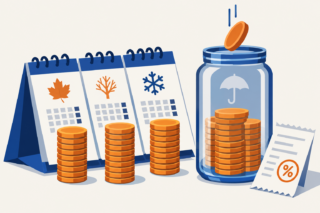
Car tax savings — the 3% January prepayment discount
Paying the full year’s car tax in January earns a discount, but the rate was 5% for 2026, calculated as annual tax × (334/365) × 5% when paid in January, yielding an effective saving of about 4.58% of the annual liability. Prepay in January and the 11 remaining months get the 5% discount, which is why the effective relief is ~4.58% of the full year’s bill.
| Prepayment month | Discount | Savings on KRW 520K bill |
|---|---|---|
| January (Jan 16–31) | Eff. 4.58% (rate 5%) | ~ KRW 23,800 |
| March | Eff. ~3.75% | ~ KRW 19,500 |
| June | Eff. ~2.5% | ~ KRW 13,000 |
| September | Eff. ~1.25% | ~ KRW 6,500 |
Apply through Wetax or your local district office. Most municipalities offer auto-renewal once you opt in the first time.
Car tax operation phase — fuel and insurance
Fuel tax (as of May 2026)
The temporary fuel-tax cut that started in November 2021 remains in place as of May 2026, having been extended multiple times. As of May 2026 the discount is 15% on gasoline, 25% on diesel, and 25% on LPG butane — expanded from the prior 7%/10%/10%. Per-liter savings are approximately KRW 65 off gasoline (763 → 698), KRW 87 off diesel (523 → 436), and KRW 51 off LPG butane.
Roughly half of every liter of gasoline in Korea is tax (traffic-energy-environment tax + education tax + driving tax bundled). When the temporary cut sunsets, retail prices typically jump KRW 50–60/L overnight, so check the latest extension before any big fill-up planning.
Auto insurance — 1.3–1.4% hike in 2026
Major insurers (Samsung Fire, DB, KB, Meritz, Hyundai M&F) raised auto insurance premiums by an average of 1.3–1.4% starting February 2026. There are two core layers:
- Compulsory insurance: Bodily injury liability I + minimum KRW 20M property damage. Driving without it carries fines and is illegal.
- Comprehensive insurance: Compulsory + bodily injury II + extended property + own-vehicle damage + personal accident + uninsured motorist. Covers your own vehicle’s repair too.
The single most effective discount is the mileage rider: drive under 15,000 km/year and get up to 46% refunded or discounted. Other riders worth stacking:
- Safe-driving score discount via T-map or Kakao Navi (5–15% by score)
- Dashcam installation (3–5%)
- Children rider (5–7% if you have minor children)
- Connected-car rider (telematics data sharing consent)
Stacking three or four well-chosen riders typically saves KRW 100–300K per year. Always quote at least 3–4 insurers at each renewal — and when paying the premium, consider our credit card vs debit card guide for the most efficient payment method given your annual deduction position.
2026 No-Driving-Day revival — car tax impact analysis
From March 25, 2026, Korea revived the No-Driving-Day system for public-sector vehicles after a 15-year break, in response to oil-supply-security concerns. It restricts driving on one designated weekday per car based on the last digit of the license plate.
- Exempt: EVs and hydrogen vehicles (zero-petroleum), vehicles for registered persons with disabilities (driver or passenger), vehicles transporting pregnant women (carrying a maternal-health booklet) or pre-school children, and emergency vehicles (fire, ambulance, police) plus those of registered national-merit recipients.
- Subject: Gasoline, diesel, LPG, AND hybrids (hybrids still burn petroleum). Unlike past programs, sub-compact (Kei) cars and hybrids are not exempt this time.
- Current scope: Mandatory for public agencies (escalated to an alternate-day 2-rotation from April 8); public parking lots applying 5-rotation to private vehicles too. General private cars are voluntary.
No direct tax effect, but if the program expands to private vehicles, lower driving days strengthen the mileage-rider economics for insurance and add yet another structural advantage to green vehicles.
Five practical car tax savings tips for 2026
- Set up January auto-prepayment: the 3% discount is small individually but auto-renews. Five minutes on Wetax sets it for life.
- Time a green-car purchase to 2026: EV acquisition tax KRW 1.4M, ICT KRW 3M, and the flat-rate annual tax all expire December 31, 2026 — 2027 treatment is not yet defined.
- Watch the age-based annual tax reduction: car tax drops 5% per year from year 3. By year 12 you’re at 50% — useful when deciding between keeping or replacing an older car.
- Stack mileage + safe-driving insurance riders: up to 46% mileage discount plus 5–15% via T-map score can sum to 30–50% off.
- Never lapse on compulsory insurance: even a one-day gap carries fines and exposes you to full personal liability in case of accident. Use automatic renewal.
Closing — car tax adds 25–30% to lifetime cost
It’s tempting to think of car ownership taxes as just the June and December annual-car-tax bills, but the full picture from acquisition to fuel adds up to roughly 25–30% of a car’s lifetime cost. 2026 happens to be the last full year for current green-car incentives, and the annual-prepayment discount has shrunk from 5% to 3%, so the January habit matters more — not less. Smart insurance rider stacking is the easiest year-over-year saving most owners ignore.
Within a broader personal-finance plan, a vehicle is one of the more volatile cost lines. Lock down your emergency fund first, model the full TCO (monthly fuel + insurance + tax + maintenance), and let that number drive the choice of car — not the showroom sticker.
Disclaimer: This article is for informational purposes only and is not a purchase recommendation for any specific vehicle or insurance product, nor is it tax advice. Acquisition tax, annual car tax, green-car incentives, fuel-tax adjustments, and insurance rates change with government policy and market conditions. Verify the latest numbers with General Insurance Association of Korea, the Korea Energy Agency green-vehicle portal, and your local jurisdiction or insurer before purchase or filing. Tax examples in this article use May 2026 rates and may not match every individual vehicle.