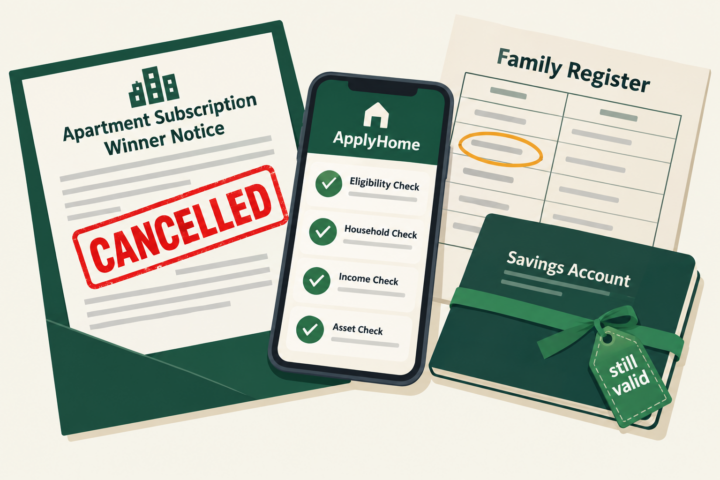
Between January 2024 and August 2026, about 13,000 people in Korea won an apartment in the cheongyak (청약) lottery and then lost it before signing a contract. Some 3,527 of those cases were cheongyak disqualification reasons that ApplyHome (청약홈), the national application portal, could already see in its own administrative data. Picking the wrong residence region or counting yourself as your own dependent turned into a cancelled win and up to a one-year ban. (※ As of September 2026 · Last updated 2026-09-26)
Bottom line: the four most common cheongyak disqualification reasons (owning a home, miscounting your non-ownership period, miscounting dependents, and choosing the wrong residence region) can all be checked on ApplyHome before you apply, and even if you are disqualified after winning, your subscription account does not disappear. A disqualified winner cannot be selected for another new apartment for one year in the Seoul metropolitan area or six months elsewhere, but the same account works again for projects announced after that period. Giving up a win voluntarily is different: that account is spent. So if a notice arrives, use the appeal window of at least seven days, and do not close the account.
Cheongyak disqualification hits one winner in fifteen
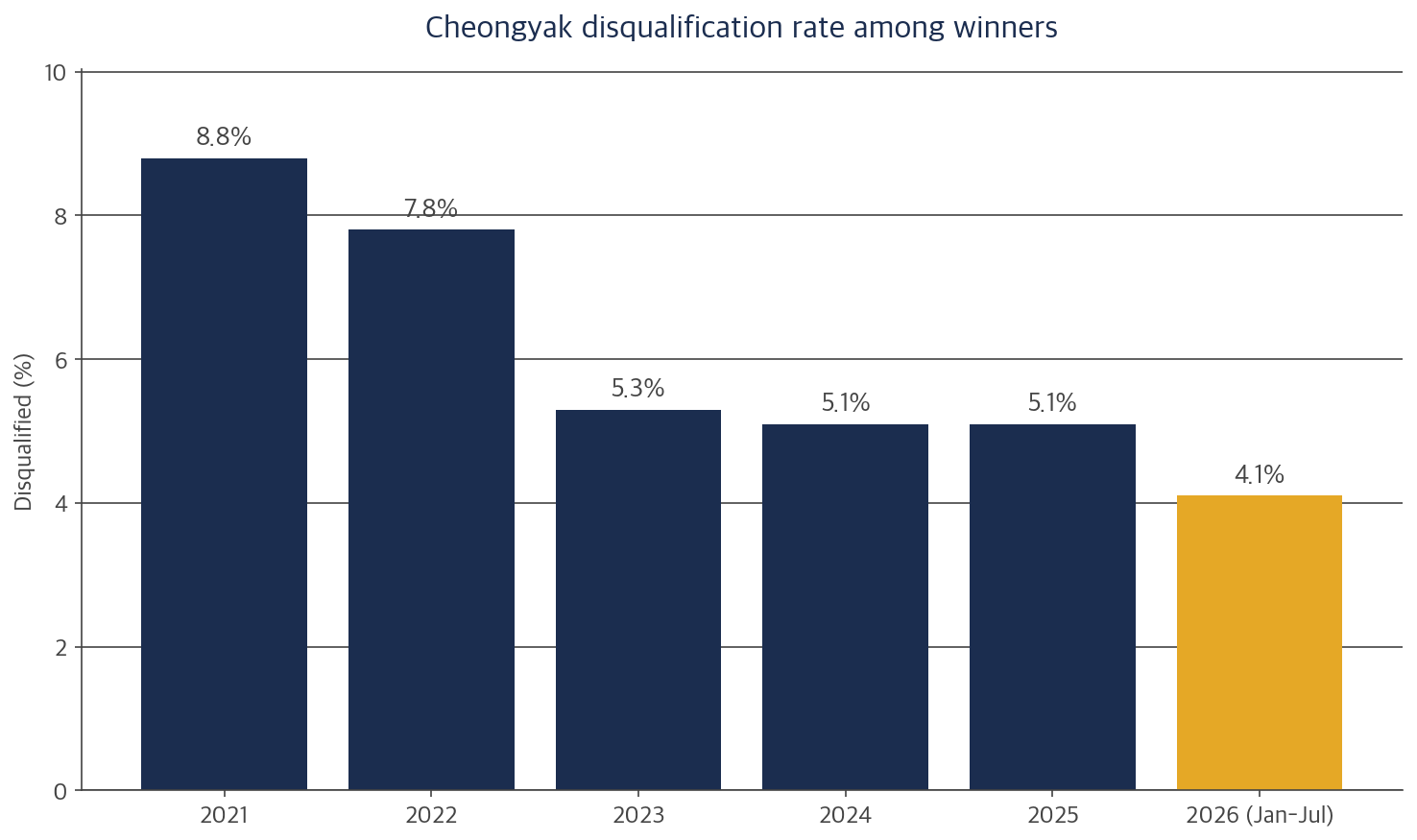
From 2021 to July 2026, 791,856 people won an apartment through cheongyak nationwide and 53,867 of them were later hit by cheongyak disqualification. That is 6.8% over six years, roughly one winner in fifteen. The figures come from Korea Real Estate Board (한국부동산원) data released by Rep. Kim Mi-ae of the National Assembly’s Land, Infrastructure and Transport Committee and reported by Edaily. The rate has broadly come down, and the reasons logged since 2022 show that the four below account for more than half.
| Cheongyak disqualification reason (2022 to July 2026, out of 32,646 cases) | Cases | Share |
|---|---|---|
| Owning a home or a pre-sale right (분양권) | 6,809 | 20.9% |
| Miscalculated non-ownership period (무주택기간) | 4,670 | 14.3% |
| Dependent (부양가족) errors | 3,047 | 9.3% |
| Wrong residence region | 2,321 | 7.1% |
Together these four make up more than half of all cases. The ranking depends on how the cases are grouped: a separate breakdown of the same data obtained from the Ministry by Rep. Yoo Sang-bum put non-ownership period errors at the top, as Asia Economy reported. Either way, all four are fields you select or type yourself on the application screen.
What ApplyHome tells you in advance, and what it does not
A second set of Board data, obtained by Rep. Boo Seung-chan ahead of the parliamentary audit, narrows the window to the last three years. More than one in four of those cancelled wins fell into categories the Board itself classifies as “verifiable in advance with administrative data at the application stage”. Munhwa Ilbo and BetaNews both carried the data.
| Rep. Boo Seung-chan’s data (2024 to August 2026) | Figure |
|---|---|
| Disqualified after winning, 2024 | 6,188 |
| 2025 | 4,277 |
| January to August 2026 | 2,535 |
| Reasons verifiable in advance with administrative data | 3,527 (27.1%) |
| Wrong residence region (local versus other) | 870 |
| Applicant counted as their own dependent | 563 |
Since 2023 the Board has run a MyData service inside ApplyHome that lets applicants preview 26 cheongyak disqualification triggers, including residence region and dependents. The problem is how it operates. Applicants read the data and then type their own answers, so a wrong entry is not blocked. The Board argues that because MyData pulls live records, it cannot guarantee eligibility as of the recruitment notice date, and therefore it only advises rather than stops an application. Filtering the errors out is still the applicant’s job.
That is why avoiding cheongyak disqualification depends less on having consented to MyData and more on knowing which menu to open. The ‘Eligibility check’ (청약자격확인) section of ApplyHome has these six main menus, plus a separate points calculator.
- Household member registration (세대구성원 등록/조회): where you collect each household member’s consent to share data. Without it, their home ownership and re-win restrictions will not show up.
- Restriction check (청약제한사항확인): shows whether a re-win restriction or a disqualification ban is still in force for you and your household. Login required.
- Home ownership check (주택소유확인): lists homes and pre-sale rights held by you and every household member.
- Subscription account history (청약통장 가입내역): your opening date and deposits. If you switched account types, the original opening date still counts.
- Rank certificate (순위확인서 발급): documents whether you hold first-rank status.
- Eligibility diagnosis (청약자격진단): an overall diagnosis, but only available from 09:00 to 17:30.
Two more things to note. ApplyHome’s restriction screen advises users to redo household members’ data-sharing consent so that re-win restriction data comes through correctly. And on September 18 the portal posted a notice titled ‘Temporary suspension of the MyData service’. The service may be down on the day you apply, so finish your lookups on the day the recruitment notice is published rather than the night before the deadline.
Four checks that stop cheongyak disqualification before you apply
Flip the four reasons in the table above and you get the checking order. It is short enough to finish in one sitting with the notice open beside you, and because eligibility is judged as of the recruitment notice date, it is worth repeating once the notice is out.
- Start with restrictions. Open the restriction check and confirm that neither you nor a household member carries a re-win restriction or a leftover disqualification ban. The ApplyHome FAQ is blunt: if you apply while a valid restriction exists, whether online or at a bank counter, the win is cancelled even if you are selected and a further ban follows. If your household members are not registered, this screen looks empty, so complete the household registration first.
- Count every home in the household. The largest cheongyak disqualification reason in the table above is owning a home or a pre-sale right, and many of those homes belong not to the applicant but to a parent or spouse in the same household. Run the ownership check for every member. If someone owns a single non-apartment home such as a villa, test it against the non-ownership exemption below using its official assessed price.
- Recount your points with the calculator. Enter your non-ownership period, dependents and account age into the points calculator, then copy exactly the same values into the application. Counting yourself as a dependent caused 563 disqualifications in three years, and counting years before age 30 as non-ownership time is another classic. The calculator’s own notice states that responsibility for an erroneous application rests with the applicant, and that neither the banks nor the Board accept liability.
- Choose the residence region by the notice’s definition. Whether you count as ‘local’ or ‘other’ depends on your resident registration address and how long you have lived there as of the notice date, and the required length differs by project. In three years, 870 people lost a win over this one field. Read the residence paragraph in the notice and compare it with the move-in date on your registration record. The ApplyHome FAQ also says a local resident who applies in the ‘other’ category and wins is not treated as disqualified, so if your residence period is uncertain, applying as ‘other’ is the safe choice.
Here are the points items people most often get wrong, based on the ApplyHome calculator’s own guidance. The scoring itself is covered item by item in our 84-point housing subscription guide.
| Item | ApplyHome calculator rule | Common mistake |
|---|---|---|
| Non-ownership period | Counted from the day you turn 30 until the notice date. If you married before 30, from the marriage registration date | If you once owned and sold a home, the clock restarts from the later of the sale date and your 30th birthday |
| Dependents | You are excluded. Spouse counts even in a separate household. Parents (including your spouse’s) count only if you are the household head and they have been on the same register for 3 years or more, and not if the parent or their spouse owns any home (pre-sale rights included). Unmarried children aged 30 or over need at least 1 year | Adding yourself, adding a parent when you are not the household head, or adding a parent who owns a home or joined your register less than 3 years ago |
| Account age | Original opening date counts even if you changed account type or holder name. The date comes from bank records and the score is calculated automatically | Counting every year held as a minor (only 5 years are recognised, since July 1, 2024) |
The non-ownership exemption for a single non-apartment home widened in 2025. One villa, row house or similar non-apartment home of 85 square metres or less counts as non-ownership for cheongyak purposes if its official assessed price is 500 million won or less in the Seoul metropolitan area, or 300 million won or less elsewhere. The price is judged as of the recruitment notice date, so recheck that year’s assessed value once the notice is out. The rule is set out on the government’s policy briefing site.
If a cheongyak disqualification notice arrives: seven days to appeal, and what happens to your account
After winners are announced, the developer cross-checks your application against Board data and the documents you submit. If something does not match, it notifies you of the disqualification and, under the Housing Supply Rules (주택공급에 관한 규칙), must give you at least seven days from the notice date to submit evidence. Miss that window and you are removed from the winner list or your contract is cancelled.
The basic evidence is proof of home ownership status, household head and member records, and proof of residence, and the procedure is laid out with the relevant articles on the government’s Easy Law portal.
If the notice is about a points error, it is not over yet. Article 58(4) of the same rules says that a disqualified winner is still treated as a winner if the score the developer recalculates during the appeal period is at or above the cut-off for that rank, or if there was no competition at that rank. So if the stated reason is your score, recalculate it precisely and put the correct figure in your appeal.
If the appeal fails and the win is cancelled, Article 58(3) of the same rules bars you from being selected for another new apartment for a set period counted from the win date. The ban is judged against the new project’s recruitment notice date, and its length depends on where the new project is. It is one year for a project in the Seoul metropolitan area and six months elsewhere, rising to one year in speculation-overheated or subscription-overheated zones and falling to three months in designated depressed zones.
If the new project’s notice date falls inside the ban counted from your win date, you cannot be selected even if you apply, so aim at projects announced after the ban ends. Whether a ban is still in force shows in the ApplyHome restriction check.
The account is where most people get it wrong. The ApplyHome FAQ says an account that has been used to win cannot be used to apply again, and then lists a disqualified and cancelled win as an exception. In other words, after a cheongyak disqualification the account survives, and you apply with the same account for projects announced after the ban ends.
If it is a housing subscription savings account (주택청약종합저축) and you closed it after the cancellation, redepositing within one year of the cancellation date means it is treated as never closed. That restoration rule exists only for the housing subscription savings account, so the older deposit-type, instalment-type and savings-type accounts (청약예금·청약부금·청약저축) cannot be revived once closed. By contrast, someone who wins and then voluntarily walks away from the contract still counts as ‘selected’, and that account cannot be used again.
| Situation | Subscription account | Next application |
|---|---|---|
| Win and sign the contract | Used up, cannot be reused | Start over with a new account |
| Win, then give up the contract yourself | Treated as selected, cannot be reused | You stay on the winner list |
| Win cancelled for cheongyak disqualification | Same account reusable after the ban | Projects announced after the ban, judged by the new project’s location: 1 year (Seoul metro), 6 months (elsewhere), 1 year (regulated zones) or 3 months (depressed zones) |
While you are keeping the account alive, holders of the older deposit-type or instalment-type subscription accounts should also keep an eye on the conversion deadline. The extension to September 30, 2027 and the post-conversion interest rate are covered in Cheongyak conversion extended to September 2027.
What to do if you are applying this autumn
I would argue that a large share of cheongyak disqualification is not a knowledge problem but a skipped-check problem. The evidence: 3,527 cases in three years (27.1%) were verifiable in advance with administrative data, and the four most common reasons, more than half of all cases, are all fields you fill in yourself. So the most reliable move right now is to finish your ApplyHome lookups on the day the recruitment notice goes up, not the night before the deadline, and then copy the lookup results into the application without editing them. By situation:
- First-time applicant aiming at a special supply (특별공급) quota: marriage duration, single status and income or asset limits are largely outside what MyData shows. In the newlywed quota alone, 1,178 disqualifications for exceeding the marriage-duration limit were reported. Compare the notice’s eligibility table with your marriage registration date, and check that quota’s restriction history in the restriction screen.
- Household head competing on points: dependents drive close to half the score, so verification concentrates there. Under the amendment in force since June 10, 2025 (Ordinance No. 1501), points-based winners and elderly-parent special supply winners must submit their dependents’ National Health Insurance treatment records. A parent who is on your register but does not actually live with you gets caught at this step, so include only family who meet both the three-year registration and the real co-residence test.
- Owner of one non-apartment home: test the 85 square metre and 500 million won (300 million won outside the Seoul metro) thresholds against the assessed price as of the notice date. If you exceed them, apply as a homeowner. Applying as non-owner puts you straight into the most common disqualification category, home ownership.
- Already holding a cheongyak disqualification notice: read the stated reason and the appeal deadline first. If the reason is factually wrong, file evidence within the window, and if it is a points error, show that your recalculated score still clears the cut-off. If it is right, accept the cancellation but do not close the account, note the day the ban counted from the win date ends, and apply only to projects announced after that. If you already closed a housing subscription savings account, redeposit within one year of the cancellation date.
Two variables are worth watching. The first is a further tightening of the dependent rules. On April 30, 2026 the Ministry of Land, Infrastructure and Transport (국토교통부) pre-announced an amendment to the Housing Supply Rules with three changes.
- Adult children on the register: an unmarried child aged 30 or over would need three years on the same resident register instead of one to count as a dependent.
- Health insurance eligibility certificate: submission would become mandatory to prove that dependents actually live with you.
- Time abroad: a parent or child who stayed outside Korea for more than 90 consecutive days within the last three years would be excluded from dependents (a child under 30 would still count if in Korea on the notice date).
The comment period closed on June 9, but as of September 26 it has not been promulgated. The most recent entry in the national law database’s amendment history is the June 15 amendment, Ordinance No. 1592. Once it is promulgated, the calculation for adult children changes, so check whether the calculator’s guidance has been updated with each new notice.
The second is whether ApplyHome adds automatic validation. In the data released ahead of the October parliamentary audit, Reps. Boo Seung-chan and Yoo Sang-bum called for advance (automatic) validation at the application stage, and Rep. Kim Mi-ae for stronger guidance and confirmation features, while the Board has so far kept to advisory notices, citing the limits of live data. What matters is whether the Board announces blocking or stronger warnings inside MyData after the parliamentary audit wraps up in October. Until then, do not mistake an advisory message for a block.
The one common misjudgment is this: “If I am disqualified, the account is gone anyway, so appealing is pointless.” That belief comes from mixing up a voluntary withdrawal with a cheongyak disqualification. The account dies when you win and then walk away; after a disqualification it merely waits out the ban. So if you have grounds, file within the seven days; if you do not, accept the cancellation and protect the account. In either branch, closing the account is the losing move.
Winning is luck, disqualification is a mistake
You cannot control the competition ratio, but a large share of cheongyak disqualification comes down to matching a handful of fields on the application with official lookup results. And even if a notice arrives after you win, the account stays and the ban is at most one year.
- The four main cheongyak disqualification reasons (home ownership, non-ownership period, dependents, residence region) can all be checked before applying through ApplyHome’s eligibility menus and points calculator.
- MyData advises but does not block. Collect household members’ consent first and finish the lookups on the day the notice is published.
- A cheongyak disqualification notice comes with at least seven days to appeal. If the win is cancelled, the account survives, and you apply with it again for projects announced after the ban (1 year in the Seoul metro, 6 months elsewhere).
- Walking away from a win voluntarily spends the account. Do not confuse the two cases and close the account.
Related reading
- Housing Subscription Points: A Complete & Easy 84-Point Guide
- Cheongyak Conversion Extended to September 2027: Convert Now or Wait for October?
- Acquisition Tax: Essential Guide to 5 Key Rates by Home Count and Price
Disclaimer: This article is for information and education only and does not recommend applying for any particular project or product. The cheongyak disqualification reasons, appeal procedure and ban periods reflect the Housing Supply Rules and ApplyHome guidance as of September 26, 2026, and may differ by project notice or change with future amendments. Before applying, confirm the current rules directly on ApplyHome (applyhome.co.kr) and in the project’s recruitment notice. All decisions are your own responsibility.