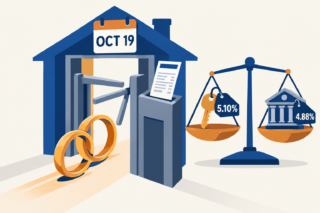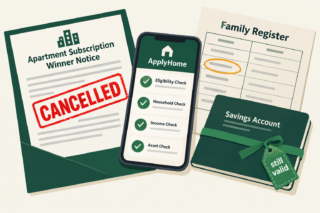
According to the Korea Real Estate Board’s subscription portal data, the average winning score for Seoul private apartments was about 59.68 points in 2024 and climbed to 65.81 points in 2025 — a record since the statistic was first published. At premium Gangnam-area complexes, even a four-person household maxing out at 69 points has been edged out in some draws. Korea’s apartment lottery scoring caps at 84, and walking into the system without knowing where your score sits means burning years on applications you were never going to win. This guide walks through how to calculate housing subscription points across all three components and what to do if your score isn’t high enough — there are detour routes (lottery quota and special supply tracks) that don’t depend on score.
The numbers below are accurate as of April 2026. All score brackets follow the official calculator on the Korea Real Estate Board’s subscription portal (applyhome.co.kr) and the Housing Supply Rules. Once you’ve scored yourself, the right complexes and tracks become obvious in minutes instead of months. Saving for a Korean home down payment is a multi-year project, so pair scoring with a steady 3-step budgeting system to keep cash flowing into your subscription savings every month.
Korea’s housing subscription points — the 84-point structure
When private-sector first-priority applicants exceed the supply at a Korean apartment complex, winners are picked by housing subscription points. The total caps at 84 across three components. Memorizing the housing subscription point structure helps you spot which component is dragging your score so you know where to put energy.
| Component | Maximum | Minimum | Key driver |
|---|---|---|---|
| Years without owning a home | 32 | 0 (current owner or unmarried under 30) | Counted from age 30 or marriage date, whichever comes first |
| Number of dependents | 35 | 5 (applicant only) | Six or more dependents (excluding self) caps at 35 |
| Subscription savings tenure | 17 | 1 (under 6 months) | 15+ years caps at 17; spouse’s tenure can add up to 3 points |
| Total | 84 | 6 | — |
Dependents (35 points) carry the most weight, followed by years without owning (32) and savings tenure (17). Hitting the 84-point housing subscription ceiling is essentially impossible. A four-person household, for example, has just three dependents (excluding the applicant) — that’s 20 dependent points, so even with 15 years of non-ownership and 15 years of savings tenure the housing subscription math caps at 32 + 20 + 17 = 69 points. Reaching the 80s requires five or more dependents (a six-or-more-person household). So one- and two-person households almost always do better aiming at the lottery quota and special-supply tracks instead of fighting the points race head-on.
Step 1: Years without owning — up to 32 housing subscription points
Korean rules count the years you and your spouse have not owned a home, measured up to the apartment’s recruitment-notice date in one-year buckets and contributing up to 32 housing subscription points. Under the Housing Supply Rules, the start date is your 30th birthday — or your marriage registration date, if you married before 30. Important caveat: if you or your spouse have ever owned a home, the count restarts from the day you became a non-owner again after disposing of that home (or from the most recent non-owner date, if you’ve owned more than once). So someone who married at 27 starts accruing earlier than a single person who waits until 30, but a previously-owned-and-sold home resets the housing subscription clock to the disposal date.
Each bucket adds two points: under one year scores 2, one to two years scores 4, and so on, capping at 32 for 15+ years. A single 45-year-old who has never owned a home from age 30 onward fills the 32-point bar fully. The catch: if you or your spouse owned a home for even a brief stretch, the counter resets to zero from the day you became non-owner again.
Watch a few traps. Holding a pre-construction sales right (분양권) or membership right (입주권) acquired after December 11, 2018 counts as ownership. The “still counts as non-owner” exceptions actually run on two separate tracks. Track one — small or low-value homes: a single home under 60㎡ assessed at KRW 160M or less in the metro area or KRW 100M or less outside (raised from KRW 130M / KRW 80M in the November 2023 update). Track two — non-apartment dwellings (added December 18, 2024): a single villa, multiplex, row house, or urban-living home under 85㎡ assessed at KRW 500M or less in the metro area or KRW 300M or less outside also keeps you classified as non-owner for housing subscription purposes. The expanded scope applies to recruitment notices issued from that date forward. Re-check your specific case on the subscription portal just before each application; the rules around these exceptions change frequently.
Step 2: Number of dependents — up to 35 housing subscription points
This score counts everyone listed alongside you on the same family registry as of the recruitment-notice date, excluding yourself. Zero dependents starts at 5 points, and each additional dependent adds 5 — six or more caps at 35.
| Dependents (excluding self) | Points |
|---|---|
| 0 (just you) | 5 |
| 1 | 10 |
| 2 | 15 |
| 3 | 20 |
| 4 | 25 |
| 5 | 30 |
| 6 or more | 35 |
Eligibility rules are picky. Your spouse counts no matter where they’re registered. Direct ascendants (parents and grandparents) only count if they’ve been listed on your registry for three or more years. Direct descendants (children) must be unmarried; for unmarried children aged 30+, an additional one-year same-registry rule currently applies — note that the Ministry of Land, Infrastructure and Transport opened a legislative notice on April 30, 2026 to raise this requirement from one year to three years, so check whether the change is in effect on your recruitment-notice date. Grandchildren only count if both parents are deceased, and siblings generally don’t qualify at all.
The most common mistake: living with parents who own a home. If a parent is under 60, you yourself become an “owner” by association, zeroing out your years-without-owning score. There’s an important exception: a home owned by a direct ascendant aged 60 or older does not break your “non-owning” status (the elderly-parent care special supply track is excluded from this exception). However, even with the 60+ exception, an ascendant who owns a home cannot be counted in your dependent score, so the dependents component still drops. Pull your parents’ property registry before applying. Also remember the registry snapshot is the recruitment-notice date — any household separation, marriage, or birth needs to be finalized before that date to count for that round.
Step 3: Subscription savings tenure — up to 17 housing subscription points
Your subscription savings account scores 1 point under six months, 2 points under one year, then adds one point for every additional year — capping at 17 points for 15+ years of continuous tenure. Open it at 18 and hold to 33, and you’ve maxed this component. Closing the account zeroes the counter, so even if you don’t actively contribute, never close it.
Since 2024, Korea has allowed spouse’s subscription savings tenure to be added at 50%, capped at 3 points. The combined ceiling for both of you remains 17. So if your own account scores 14 and your spouse’s six-year account scores 7, half of 7 (3.5) gets added — but only 3 of those points count, bringing your combined total to 17. This rule applies to private general-supply lottery scoring; public housing point tracks and special-supply tracks have their own scoring systems.
Practical tip — separate two things that get conflated. The 17-point savings-tenure score in the housing subscription gajeom is based purely on account tenure. First-priority eligibility, on the other hand, follows different rules depending on supply type. National housing uses tenure plus deposit count (12+ months and 12+ deposits in the metro area, 6 months / 6 deposits in non-metro, 24 months / 24 deposits in overheated speculation zones). Private housing uses tenure plus a region- and unit-size-based lump-sum deposit. So a KRW 20,000 monthly auto-deposit helps build the deposit count for national housing, but for private housing first-priority you only need to meet the lump-sum deposit threshold by the recruitment-notice date — frequency doesn’t matter the same way. The Housing Subscription Comprehensive Savings (주택청약종합저축) launched in May 2009 and replaced the older Cheongyak-jeochuk / Cheongyak-yegeum / Cheongyak-bugeum products; from September 1, 2015 only the comprehensive savings account is available for new accounts. Separately, the Youth Home-Dream Savings (청년 주택드림 청약통장) launched in 2024 is a different product offering preferential rates and tax deductions to non-owning singles aged 19-34.
Where does your score put you — 2024-2025 winning thresholds
Scoring yourself is half the work; the other half is knowing whether your score is competitive in the markets you’d actually buy in. Average winning scores vary widely by region and complex. Based on per-complex disclosures from the Korea Real Estate Board, here’s a rough guide.
| Region | 2024-2025 average winning score (approx.) | Notes |
|---|---|---|
| Seoul Gangnam-Seocho-Songpa | around 70+ | Even four-person max-score (69) has lost out at top complexes |
| Seoul outside Gangnam | around 60-67 | Wide spread by complex and unit size; popular complexes pass 70 |
| Gyeonggi popular zones (Gwacheon, Hanam, Pangyo) | around 60-65 | Varies with 3rd-phase new towns and public-land projects |
| Provincial metros (Busan, Daegu, etc.) | around 40-55 | Depends heavily on complex location and price |
| Smaller cities | around 20-40 or under-subscribed | Many complexes win on points alone or even with no scoring |
These are rough averages from per-complex disclosures and can swing by ±10 points depending on the unit size, timing, and complex itself. For exact numbers, look up your target complex on the subscription portal under “Past winners → winning scores by complex.” A useful heuristic: if your score is 5+ points above the regional average, the lottery is worth a try; if it’s 10+ points below, switch focus to the lottery quota and special-supply tracks instead.
When your housing subscription points fall short — lottery quota and special supply
Below 50 points, the housing subscription points-based first-priority lottery is functionally closed. But points aren’t the whole game. Two parallel tracks exist that don’t depend on your housing subscription score — used together, they keep the door open even with a low total.
Lottery quota — ratios shift with unit size and zone
Private-sector general supply splits between the points lottery and a pure draw quota. The split depends on unit size and whether the area is regulated. In non-regulated areas, units up to 85㎡ are allocated to the points lottery within a ceiling of 40% set by the local mayor or county head (the rest goes to the draw); units above 85㎡ go 100% to draw. Regulated zones (overheated speculation or adjustment areas) push more weight onto points, and the exact percentages get adjusted by government policy — always check the recruitment notice for the current allocation. Under a rule in effect since December 11, 2018, 75% or more of the draw-quota slots in metro areas and major cities are reserved for non-owners as priority supply; the remaining 25% pools rejected non-owner applicants and 1-home holders subject to a sale condition.
One- and two-person households, young singles, and recently-married couples — anyone short on the dependents component — usually do better in the draw quota than in the points lottery. Above-85㎡ complexes in non-regulated zones, in particular, are 100% pure draw, so your score doesn’t matter at all there. While you’re waiting for a winning ticket, our jeonse versus monthly rent guide can help you decide whether to lock up a deposit or stay liquid for the next subscription round.
Special supply — find your track first
Special-supply slots come out of a separate quota that runs alongside general housing subscription supply. If you fit one of the categories below, your score barely matters. The 2026 housing subscription tracks worth knowing:
- Newlywed special supply: private complexes require marriage within 7 years for non-owning households and run a five-tier allocation — newborn priority (25%), newborn general (10%), regular priority (25%), regular general (10%), and a pure-draw quota (30%) — not a single-step lottery. The March 31, 2025 rule revision raised the newborn-household share from 20% to 35%. Public and “New:Home” projects add separate criteria such as marriage within 7 years OR a child aged 6 or under, with their own income/asset thresholds and a mix of point-based and draw allocations, so always check the recruitment notice for the exact split.
- Newborn special supply: introduced in 2024 for households with a child aged 2 or under as of the recruitment-notice date. The dedicated quota runs in the public “New:Home” projects with a mix of priority, residual, and draw allocations. In private supply there’s no standalone newborn track, but 20% of the newlywed and first-time special-supply quotas are reserved for newborn households.
- First-time homebuyer special supply: every member of the household must have no record of prior home ownership. Private complexes are draw-based; public and New:Home versions split into priority, general, and draw allocations based on income and asset thresholds, with newborn households getting reserved priority slots. The track is decoupled from gajeom scoring, making it the broadest entry point for low-score applicants.
- Multi-child special supply: as of the March 25, 2024 reform, two or more minor children (including unborn children and adopted children) qualify — the prior three-child rule was relaxed. Allocations follow a points system with up to 40 points for four-or-more children, 35 for three, and 25 for two; years without owning and household size also score.
- Elderly-parent care special supply: supporting a direct ascendant aged 65+ for at least three years while non-owning. Private complexes use the same point formula as general supply; national/public housing uses a sequential queue. The 60+ ascendant non-owning exception above does NOT apply to this track.
- Youth special supply: public housing only, for unmarried non-owners aged 19-39, scored on a 9-12 point scale.
The lower your score, the harder you should look at special supply first. First-time, newborn, and youth tracks are draw or low-stakes scoring, so a thin point total doesn’t lock you out. If you’re not sure which track you might fit, the subscription portal’s self-diagnosis menu (applyhome.co.kr special supply guide) walks through eligibility line by line.
Worked example — Mr. Kim, four-person household, age 38
Concrete numbers help. Mr. Kim is a 38-year-old salaryman who married at 28 and has not owned a home since. He supports a wife and two unmarried children. He opened his subscription account at 19 and has held it for 19 years; his wife’s account is six years old.
- Years without owning: counted from age 28 (marriage) → 10 years → 22 points
- Dependents: spouse + two children = 3 → 20 points
- Subscription tenure: 15+ years on his own account → 17 points (max). Spouse’s 50% can’t add anything because his own already hit the cap
- Total: 22 + 20 + 17 = 59 points
59 points is workable in non-Gangnam Seoul mid-tier complexes but not in Gangnam premium or hot new builds. His options: (1) wait five more years to push the years-without-owning component closer to 32; (2) target the 85㎡+ non-regulated complexes where the draw quota dominates; (3) if any child is still under 8, use the final round of newlywed special supply (within 7 years of marriage). Building scenarios around his actual score keeps him from spraying applications and losing every time.
Wrapping up — what to do after scoring your housing subscription points
Housing subscription points, once calculated, don’t need recomputing every cycle. Score yourself accurately today and refresh once a year on a recruitment-notice date. If your housing subscription score sits at 60+, narrow down to a region and unit size and aim for the points lottery. In the 50s, run all three tracks (points, draw, special supply) in parallel. Below 50 housing subscription points, lean on the draw quota and special-supply tracks instead of trying to grind out more points.
Housing subscription points are an asset that time builds for you. Just keeping the subscription account open and staying non-owning grows your score automatically each year. Run your numbers through the official applyhome.co.kr point calculator, then read the recruitment notice for any complex you’re targeting to confirm the current draw/points split and eligibility rules. And once you do win, the next financial step is the property tax bill — see our acquisition tax guide to estimate the cash you’ll need at closing.
Disclaimer: This article is for informational purposes only and is not a recommendation of any specific apartment complex or financial product. Lottery quota ratios and special-supply eligibility change with government policy — verify the current rules at applyhome.co.kr and on the recruitment notice before applying.