
A tenant paying 740,000 won a month in rent switches the same flat to jeonse and the monthly cost drops to 530,000 won. The landlord, instead of pocketing the 200 million won deposit, hands it to the Korea Housing and Urban Guarantee Corporation (HUG, 주택도시보증공사) and collects 725,000 won every month. That is the example the government and HUG use for Korea’s new jeonse trust (전월세 안심신탁). (As of September 2026 · last updated 2026-09-27)
The recruitment notice comes out at the end of September and applications open in October, and tenants and landlords have very different sums to run before then.
In short, the jeonse trust is a serious option for tenants once a participating home comes up, while landlords have no reason to sign before the final yield and the tax rate are printed in the recruitment notice. For a tenant the maths comes down to one number, the loan rate, and HUG takes responsibility for returning the deposit.
For a landlord the 4.35% a year is a pre-tax figure, and the plan to cut rental income tax to a single-digit rate is still under discussion with the finance ministry. Under the current 14% separate tax rate the after-tax yield is about 4.0% (unregistered rental, no basic deduction).
Rent you collect directly is taxed as the same housing rental income, so the comparison is pre-tax 4.35% against the yield your home earns as rent today, and with reports putting the Seoul average rent yield around 5.5%, a home that rents easily earns more as plain monthly rent.
The jeonse trust sends the deposit to HUG, not to the landlord
The jeonse trust is a three-party contract between the landlord, the tenant, and a rental stabilisation body set up inside HUG. The tenant deposits the jeonse money with that body instead of the landlord, and the body invests it and pays the landlord a monthly return in place of rent. The Ministry of Land, Infrastructure and Transport (MOLIT, 국토교통부) announced it on August 20, and the HUG Jeonse Trust Center opened in Yeouido, Seoul on September 22.
- What changes for the tenant: you live on jeonse instead of monthly rent, but the deposit never reaches the landlord and HUG returns it when the lease ends.
- What changes for the landlord: you receive a monthly return instead of holding the deposit. Arrears and vacancy risk fall, and using the deposit for anything else is off the table.
- Where the money goes: deposits are pooled, lent to housing construction sites that HUG guarantees, and the interest funds the landlord’s income.
How to choose between jeonse and monthly rent in the first place is covered in the jeonse rent guide. The jeonse trust adds a third option to that menu: jeonse where a public body holds the deposit. The official description is in the MOLIT announcement on the government policy portal.
What is settled in the jeonse trust and what the notice will decide
The terms have been topped up several times in a month. Sorting what was fixed by the August 20 MOLIT announcement, the September 16 HUG policy forum and the September 22 center launch from what is still open gives the table below.
| Item | Terms | Status |
|---|---|---|
| Eligible homes | Market value up to 2 billion won, any housing type, no illegal buildings, deposits far above market value screened out | MOLIT announcement |
| Who can join | No income or asset limits, participation is voluntary | MOLIT announcement |
| Landlord yield | 4.35% a year on the deposit, paid monthly | HUG president’s remarks (September 16), final figure in the notice |
| Vacancy cover | Up to 2 months of monthly income paid even while the home sits empty | HUG announcement |
| Tenant guarantee | HUG is liable for the refund, so no deposit-return or loan guarantee is needed (about 340,000 won a year saved) | MOLIT announcement |
| Tenant loan | Beotimok (버팀목) housing-fund loan or a commercial bank jeonse loan, a dedicated low-rate product is under talks with banks | Partly under discussion |
| Landlord tax | Plan to cut the 14% separate tax on rental income to a single digit and widen deductions | Under discussion with the finance ministry (재정경제부), to be fixed before the notice |
| Mortgaged homes, half-jeonse | Homes with a mortgage and monthly or half-jeonse leases can join, the full deposit must be placed with HUG | HUG explanation (press) |
| Timeline | Notice at end of September, applications in October, price checks and three-party agreements in November, balance deposits and move-ins from January 2027 (the August plan said December) | MOLIT announcement and HUG explanation (press), final dates in the notice |
The tenant’s right to request a lease renewal stays intact, and a renewal extends the deposit period with it. If the body loses money on its investments, the tenant’s deposit is still returned in full. Applications go through the HUG website, its regional branches and the Yeouido center, which handles guidance, screening, deposit intake and refunds.
Move-ins were pencilled in for December in the August announcement, but a September 26 report of HUG’s explanation puts balance deposits and move-ins from January 2027, so plan any move around the dates in the notice.
For landlords the tax row is the one that matters. HUG is pushing a single-digit separate tax rate, but the finance ministry said in an August 20 clarification that the details would be settled later. How the rate and the deduction appear in the notice decides the landlord’s return.
Tenant maths: how 740,000 won of rent becomes 530,000 won of loan interest
The MOLIT and HUG example is a tenant in a Seoul villa (market price 300 million won) paying a 10 million won deposit and 740,000 won a month. Converting the same home to a 200 million won jeonse means 40 million won of your own money plus a 160 million won jeonse loan, 80% of the jeonse price. At an assumed loan rate of 3.97% the interest is 530,000 won a month. Those assumptions appear as given in the press report of HUG’s estimate.
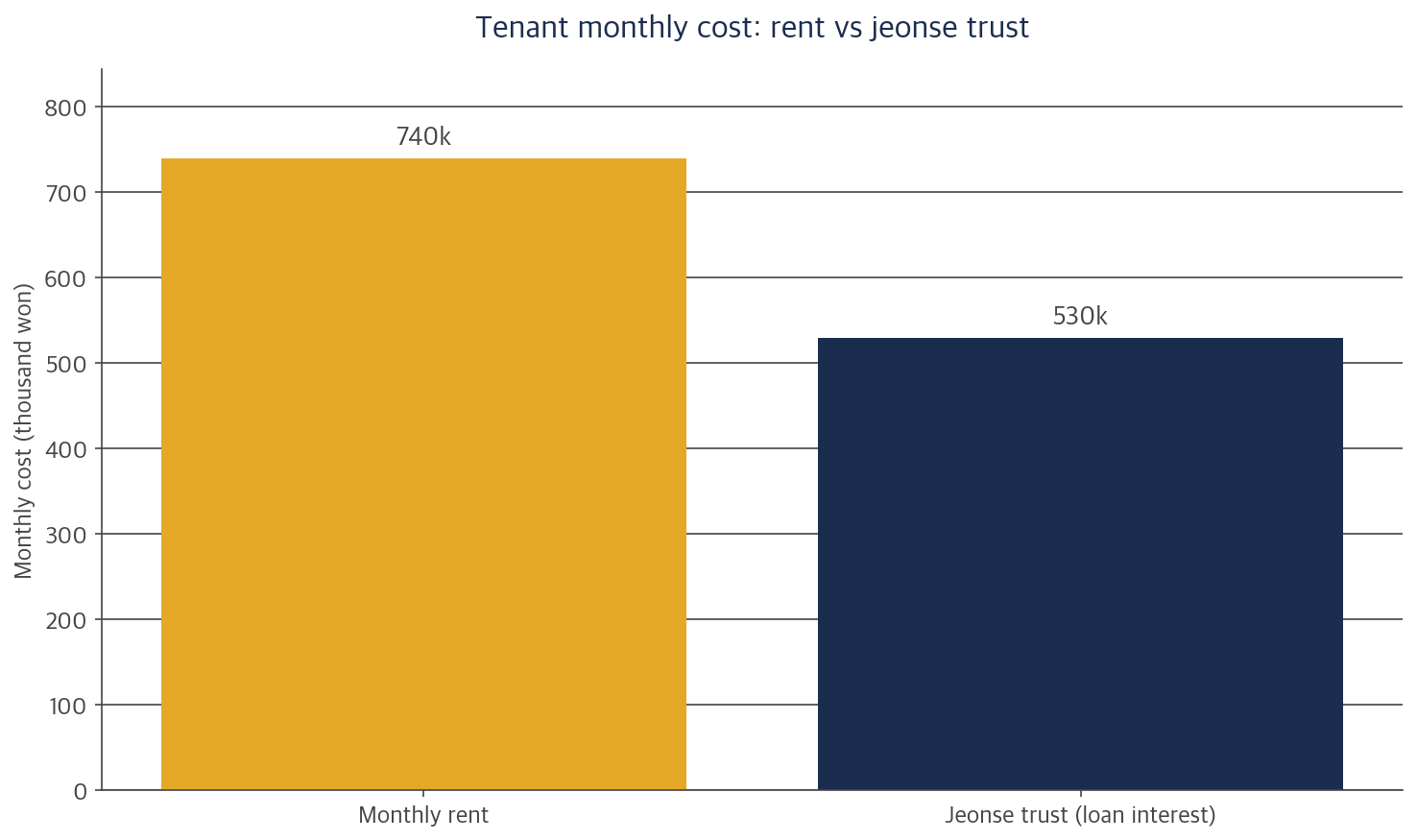
Against the rent, that leaves 210,000 won a month. The cost is 30 million won more of your own cash tied up. The interest that money would have earned in a deposit account is the opportunity cost. If you assume a 3% deposit rate, it comes to roughly 60,000 won a month after tax. Subtract it and the jeonse trust is ahead by around 150,000 won a month at a 3.97% loan rate, and that margin shrinks as the rate rises.
The 340,000 won a year in guarantee fees is a saving compared with an ordinary jeonse, not with monthly rent. A tenant on monthly rent was not paying those fees, so they are left out of the rent comparison above.
The number that flips this is the loan rate. Interest on 160 million won equals the 740,000 won rent at 5.55% a year, but that figure ignores the opportunity cost of your own cash. Add the roughly 60,000 won a month of lost deposit interest and the real break-even is about 5.1% (assuming a 3% deposit rate), or about 5.3% if you also count the guarantee fees saved against an ordinary jeonse. At a loan rate in the low 5% range, there is little difference from paying rent.
The example rent assumes a 4.7% jeonse-to-rent conversion rate, so a home whose actual rent runs higher makes the jeonse trust more attractive, while a higher loan rate does the opposite. If lending rates move after the Bank of Korea (한국은행) rate decision on October 22, this calculation moves with them.
Three things to check before applying.
- The landlord’s willingness: participation is voluntary, so nothing happens unless the landlord applies too. Ask your current landlord first, or check that a listing is a jeonse trust home.
- Loan eligibility and limit: a Beotimok loan if you qualify, otherwise a commercial bank jeonse loan. Foreign residents should confirm with the bank that the product is open to them. The dedicated low-rate loan is still being negotiated, so check its terms after the notice.
- Your own cash: the example needs 40 million won up front. Without it the lower monthly cost does not help, because the contract cannot be signed.
Landlord maths: the jeonse trust’s 4.35% is pre-tax and the rate is still 14%
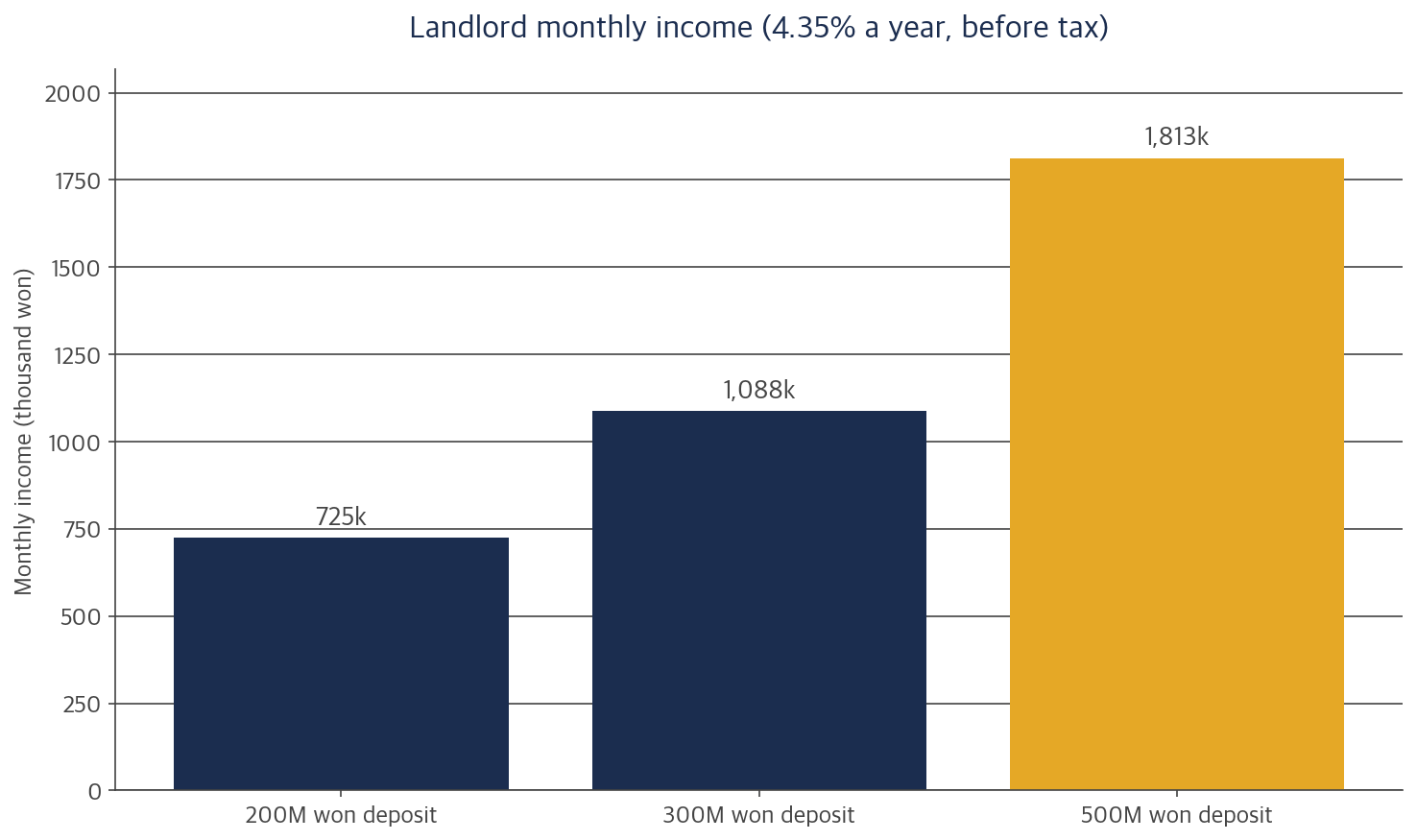
The landlord receives 4.35% a year on the deposited amount. That is 725,000 won a month on 200 million won and 1,087,500 won on 300 million won. HUG president Choi In-ho said at the September 16 policy forum that project financing rates average around 5%, which is why HUG can firmly guarantee 4.35%. The final figure goes into the recruitment notice.
This income is taxable. If your housing rental income is 20 million won a year or less, the National Tax Service (국세청) separate-taxation rules let you choose a flat 14% rate, with 50% of income allowed as deemed expenses for an unregistered rental home. A further 2 million won basic deduction applies only if your other aggregate income is 20 million won or less.
The 20 million won line counts all your housing rental income together. With no other rental income, a deposit above roughly 460 million won pushes the annual return past 20 million won, separate taxation is no longer available and the income is aggregated with your other income. If you already collect rent elsewhere, the option disappears at a smaller deposit.
| Deposit | Annual income (pre-tax) | Tax base | Income tax plus local tax | After-tax income | After-tax yield |
|---|---|---|---|---|---|
| 200 million won (no basic deduction) | 8.7 million won | 4.35 million won | about 670,000 won | about 8.03 million won | about 4.0% |
| 200 million won (2 million won deduction) | 8.7 million won | 2.35 million won | about 360,000 won | about 8.34 million won | about 4.2% |
| 300 million won (no basic deduction) | 13.05 million won | 6.525 million won | about 1 million won | about 12.05 million won | about 4.0% |
The table uses the current 14% rate and an unregistered rental home (50% deemed expenses), with local income tax added at 10% of the income tax. A single-digit rate would cut the tax line, but by how much depends on the rate and deduction printed in the notice, so the sums need to be redone then.
There are two things to compare it with. The same 4.35% from a bank term deposit would lose 15.4% to withholding tax on interest, 14% plus local tax, leaving 3.68% after tax, so rental income with its deemed-expense allowance comes out ahead. How deposit interest and its tax work is covered in savings deposit vs installment savings.
Renting the home out directly is the other benchmark. Rent is taxed as the same housing rental income, so under the current rules you compare pre-tax with pre-tax: 4.35% against the yield your home earns as rent today. Reports put the average monthly-rent yield in Seoul at around 5.5%, and the Korea Housing Landlords Association (대한주택임대인협회) also said collecting rent beats a 4% yield in most cases. Once a single-digit rate is confirmed, the jeonse trust gains that much after tax.
The exception is a single-home owner. Under the National Tax Service rules on taxable rental income, rent from one home with an assessed value of 1.2 billion won or less is tax-free, so the benchmark is different. How jeonse trust income will be taxed for a single-home owner is not settled before the notice, so read its tax clause first.
Some terms do not show up in won. You cannot touch the deposit, so buying another home with a tenant’s deposit is impossible. The deposit period is tied to the lease, and the terms for ending it early are something to check in the agreement attached to the notice. In return, arrears and vacancy worries shrink, and registered rental businesses are exempt from the deposit-return guarantee they normally must buy.
The announcement also includes linking a housing pension of around 1 to 3% a year for landlords who move to the regions. Holding taxes stay with the owner, so a date like the September property tax deadline does not change.
What to do now, depending on which side of the lease you are on
I see the jeonse trust as a default option for tenants to examine and a wait-for-the-notice question for landlords. For a tenant, HUG guarantees the principal and the outcome hinges on one loan rate. For a landlord, the two numbers that matter, the yield and the tax rate, are not in print yet.
- Tenant currently paying monthly rent: ask the landlord whether they will join. If the loan limit and your cash line up, apply in October. In the 740,000 won example the roughly 150,000 won monthly saving assumes a 3.97% loan rate, and the break-even including the cost of your own cash is about 5.1%.
- Tenant about to sign a new jeonse: before buying a deposit-return guarantee, check whether the landlord is in the jeonse trust. If so, the 340,000 won fee disappears and the deposit is protected up front rather than after a default. A mortgaged home makes this matter more.
- Landlord collecting monthly rent: turn your current rent into an annual yield and set it against the pre-tax 4.35% (rent is taxed the same way). If you are clearing 5% or more, there is no reason to switch. If arrears and vacancies have been frequent, price in the two-month vacancy cover and look again.
- Landlord holding a jeonse deposit: if the deposit is paying down a loan or sitting in an investment, joining means returning that cash, so check liquidity first. If it has simply been in a bank deposit, the jeonse trust wins after tax and the only thing left to read is the tax rate in the notice.
Three variables to watch, in order. The final yield and the tax rate and deduction in the end-of-September notice, the rate on the dedicated jeonse loan once banks release it, and the direction of lending rates after the October 22 Bank of Korea decision. HUG has also asked the Financial Services Commission (금융위원회) and the finance ministry for a higher loan-to-value limit and relief from the capital gains surcharge for participating landlords. That is still under review, so watch whether the notice adds it as an incentive.
There is a month between the October application and the November agreement, so there is time to redo the sums once the notice is out.
The common mistake on the landlord side is to set 4.35% next to a deposit rate. The right benchmark is the rent the home earns today, compared pre-tax because both are taxed the same way. Deposit interest is taxed differently, which changes the after-tax order. The tenant-side mistake is assuming that because HUG manages the money nothing comes out of your pocket. You tie up 30 million won more and the loan interest leaves every month.
When the notice lands, three lines are all you need
However long the announcement runs, the decision needs few numbers: the yield, the tax rate with its deduction, and the loan rate. Once those appear in the notice and the bank product, drop them into the tables above and recalculate. Until then, tenants can line up the landlord’s consent and their own cash, and landlords can work out the yield their home earns now.
- The jeonse trust is a three-party contract in which the tenant deposits the jeonse money with HUG and the landlord receives a monthly return. It starts with a notice at the end of September and applications in October.
- For tenants, 740,000 won of rent becomes 530,000 won of loan interest in the government example, and the break-even loan rate, counting the cost of the tenant’s own cash, is about 5.1%.
- The landlord’s 4.35% is pre-tax. Under the current 14% separate rate it is about 4.0% after tax (unregistered rental, no basic deduction), and the rate cut is due to be fixed before the notice. Against rent you collect directly, compare pre-tax with pre-tax.
- Any home valued at 2 billion won or less can join regardless of type or income, and the renewal right and full deposit protection remain.
Related reading
- Jeonse Rent Guide: How to Choose Between Korea’s Two Lease Systems
- Cheongyak Conversion Extended to September 2027: Convert Now or Wait for October?
- Acquisition Tax: Essential Guide to 5 Key Rates by Home Count and Price
Disclaimer: This article is for information only and does not recommend signing any particular lease or financial product. The jeonse trust yield, tax and loan terms summarise MOLIT and HUG announcements and press reports as of September 27, 2026. The tax cut is not yet confirmed and the final terms will be set in HUG’s recruitment notice. Check the notice on the HUG website and the National Tax Service guidance before signing. All decisions remain your own responsibility.