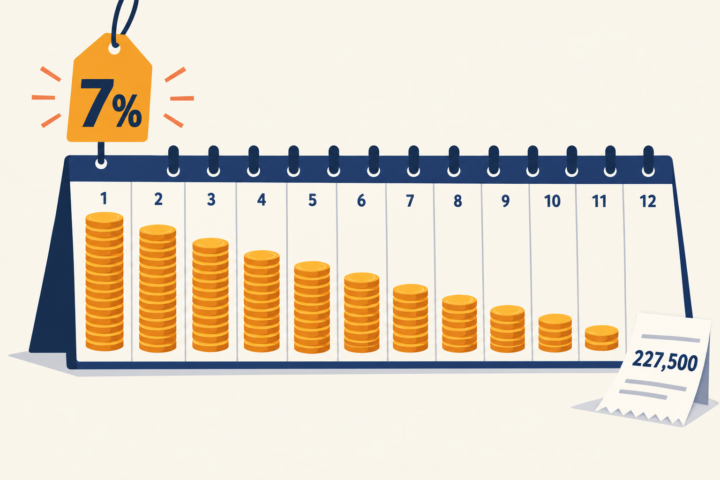
Put KRW 500,000 a month into a 7% installment savings account in Korea for a year: how much interest comes back? Many people picture 7% of the money paid in, KRW 420,000. With every bonus condition met, the actual pre-tax figure is KRW 227,500. This week one of these accounts (적금, jeokgeum) is even advertising 26%, so the rate alone no longer tells you which one pays more. (※ As of October 2026 · Last updated 2026-10-05)
Bottom line: compare installment savings by the won you receive at maturity, not by the advertised rate, and for a 12-month account that amount is simply monthly deposit × rate × 6.5. Each monthly deposit sits in the account for six and a half months on average, so against the full principal you earn a little over half the advertised rate. Miss the bonus conditions and the same account pays only KRW 61,750 at its base rate, less than a no-conditions time deposit, and less even than stacking the same money each month in a parking account paying 2%.
In the first week of October, savings rates run from 7% to 26%
The Bank of Korea (한국은행) base rate has stood at 3.00% since the hike on August 27 (Bank of Korea base rate history, in Korean). Three numbers stand out in the October 4 disclosures and that week’s reporting.
- 12-month bank installment savings: the top bonus-inclusive rate is 7.00%, based on the Financial Supervisory Service (FSS, 금융감독원) comparison disclosure. Base rates and bonus conditions differ by product (Korea Financial Times, October 4, in Korean).
- One-month “ultra-short” savings: a product that takes KRW 10,000 a day for 30 days advertises up to 26.0% (BizWatch, October 3, in Korean).
- 12-month bank time deposits (정기예금): the top bonus-inclusive rate is 4.05%, and one product pays 3.92% with no conditions (Korea Financial Times deposit report, in Korean).
The installment savings formula: monthly deposit × rate × 6.5
With simple interest, each monthly deposit earns only for the months left until maturity. In a 12-month account the first deposit earns 12 months of interest, the second 11, and the last just 1. Add those months up and you get 78; divide by 12 and you get 6.5.
So pre-tax interest on a 12-month account is monthly deposit × annual rate × 6.5. The Financial Services Commission (FSC, 금융위원회) used the same arithmetic in the example it gave when it set out advertising standards for deposits and savings in September 2023. KRW 100,000 a month for 12 months at 5.7% yields KRW 31,344 after tax: KRW 100,000 times 5.7% times 6.5, less 15.4% tax (FSC press release, in Korean).
Interest is subject to 15.4% withholding, made up of 14% income tax and 1.4% local income tax, so after-tax interest is the pre-tax figure times 0.846 (National Tax Service withholding rates, FSS Finlife savings comparison, both in Korean). That is the rate for tax residents of Korea; non-residents are withheld under a treaty or a separate statutory rate. For other terms, only the multiplier on the rate changes.
| Term | Multiplier on the rate | Pre-tax installment savings interest: KRW 100,000 a month at 5% | Time deposit rate that pays the same on the full principal |
|---|---|---|---|
| 6 months | 1.75 | KRW 8,750 | 2.92% |
| 12 months | 6.5 | KRW 32,500 | 2.71% |
| 24 months | 25 | KRW 125,000 | 2.60% |
| 36 months | 55.5 | KRW 277,500 | 2.57% |
The last column is the rate a time deposit would need in order to pay the same interest if you had placed the entire principal on day one for the same term. Whatever the term, it is a little over half the advertised rate. Put differently, an installment savings rate has to be nearly double a deposit rate to produce the same interest on the same principal.
That does not make installment savings a bad deal. Every deposit earns the contracted rate for the time it is actually in the account; the full principal simply was not there for the whole year. Flexible-deposit accounts and daily-deposit products are calculated deposit by deposit, using the number of days from each payment to maturity. The structural differences between the two products are covered in savings deposits versus installment savings in Korea.
Convert 7%, 9% and 26% into won and the ranking changes
Korean banking apps describe these accounts with a handful of recurring terms. Knowing them makes the product page much easier to read.
- 기본금리 (base rate): the rate anyone who opens the account receives, with no conditions.
- 우대금리 (bonus rate): extra percentage points added only when you meet a stated condition, such as a salary transfer or card spending.
- 최고금리 (top rate): the base rate plus every bonus. This is the number in the advertisement.
- 정액적립식 and 자유적립식: a fixed amount every month, or flexible deposits of any amount within a limit.
Here are three installment savings structures reported this week, without product names. A is the fixed-amount 12-month bank product with the highest disclosed top rate (Newspim launch report, in Korean), B is a flexible-deposit product launched for an October event (Jeonnam Ilbo, October 3, in Korean), and C is the one-month ultra-short product mentioned above (Korea Economic Daily launch report, in Korean).
| Structure | Term and deposit limit | Base rate | What earns the top rate |
|---|---|---|---|
| Account A (top 7.0%) | 12 months, KRW 100,000 to 500,000 a month | 1.9% | New customers: sign-up 3.0%p, card payment 2.0%p, marketing consent 0.1%p Existing customers: salary or pension deposit 1.5%p, utility auto-payment 2.0%p, card use 1.5%p, marketing consent 0.1%p Either path tops out at 5.1%p |
| Account B (top 9.0%) | 12 months, up to KRW 300,000 a month | 3.5% | New-customer bonus up to 3.0%p, group affiliate use up to 2.0%p, transaction bonus up to 0.5%p |
| Account C (top 26.0%) | 30 days, KRW 10,000 a day | 2.0% | Marketing consent 3.0%p, plus 7.0%p for every 10 consecutive days of app log-ins between 5 and 9 a.m. (up to 3 times). Open to customers with no checking account at that savings bank in the past year |
By rate alone the order is C, B, A. Assume you deposit the maximum on the same day each month, convert the installment savings interest at maturity into won, and the order changes like this.
| Structure | Principal at the limit | Pre-tax interest with every bonus | After tax | Pre-tax interest at the base rate only |
|---|---|---|---|---|
| Account A (7.0%, KRW 500,000 a month) | KRW 6 million | KRW 227,500 | KRW 192,465 | KRW 61,750 |
| Account B (9.0%, KRW 300,000 a month) | KRW 3.6 million | KRW 175,500 | KRW 148,473 | KRW 68,250 |
| Account C (26.0%, KRW 10,000 a day) | KRW 300,000 | about KRW 3,304 | about KRW 2,795 | about KRW 250 |
Account C has the highest rate and the smallest interest, and Account B at 9% pays KRW 52,000 less than Account A at 7%. The rates are high, but the amount you can put in and the time it stays there are small. The Account C interest is the figure BizWatch reported for the full top rate; the base-rate figure is that amount scaled down in the same proportion.
Miss the bonus conditions and the order flips again. At the base rate alone, Account A pays KRW 61,750 and Account B pays KRW 68,250.
Both new and existing customers can reach Account A’s 7% top rate, through different conditions. A new customer needs to have had no account activity at that bank in the year before sign-up and to pay at least KRW 100,000 on that bank’s card during the three months starting with the sign-up month; an existing customer reaches the same 5.1 points through salary or pension deposits, utility auto-payments and card use.
There is also evidence that fewer people collect the full bonus than you might expect. When the FSS issued a consumer alert in November 2021, it reported that customers reaching maturity on 21 special deposit and savings products at the five major commercial banks had actually received 78% of the top rate on average. For products that required spending with a partner company, only 7.7% of subscribers met the condition (Seoul Shinmun report, in Korean).
If you already have a lump sum, compare it with a time deposit this way
If you already hold KRW 6 million and open Account A, only KRW 500,000 a month moves into the installment savings account while the rest waits in another account. So you have to add the interest on the waiting money to the savings interest before comparing with a time deposit. The waiting money starts at KRW 5.5 million in the first month and falls by KRW 500,000 a month to zero in the last, so it averages KRW 2.75 million over the year.
| How to hold KRW 6 million for one year | Pre-tax interest | Calculation |
|---|---|---|
| Time deposit at 3.92% (no conditions) | KRW 235,200 | KRW 6 million × 3.92% |
| Account A at 7.0% + waiting money in a 2% parking account | KRW 282,500 | KRW 227,500 + KRW 55,000 |
| Account A at 7.0% + waiting money in a 0.1% checking account | KRW 230,250 | KRW 227,500 + KRW 2,750 |
| Account A at the 1.9% base rate + waiting money in a 2% parking account | KRW 116,750 | KRW 61,750 + KRW 55,000 |
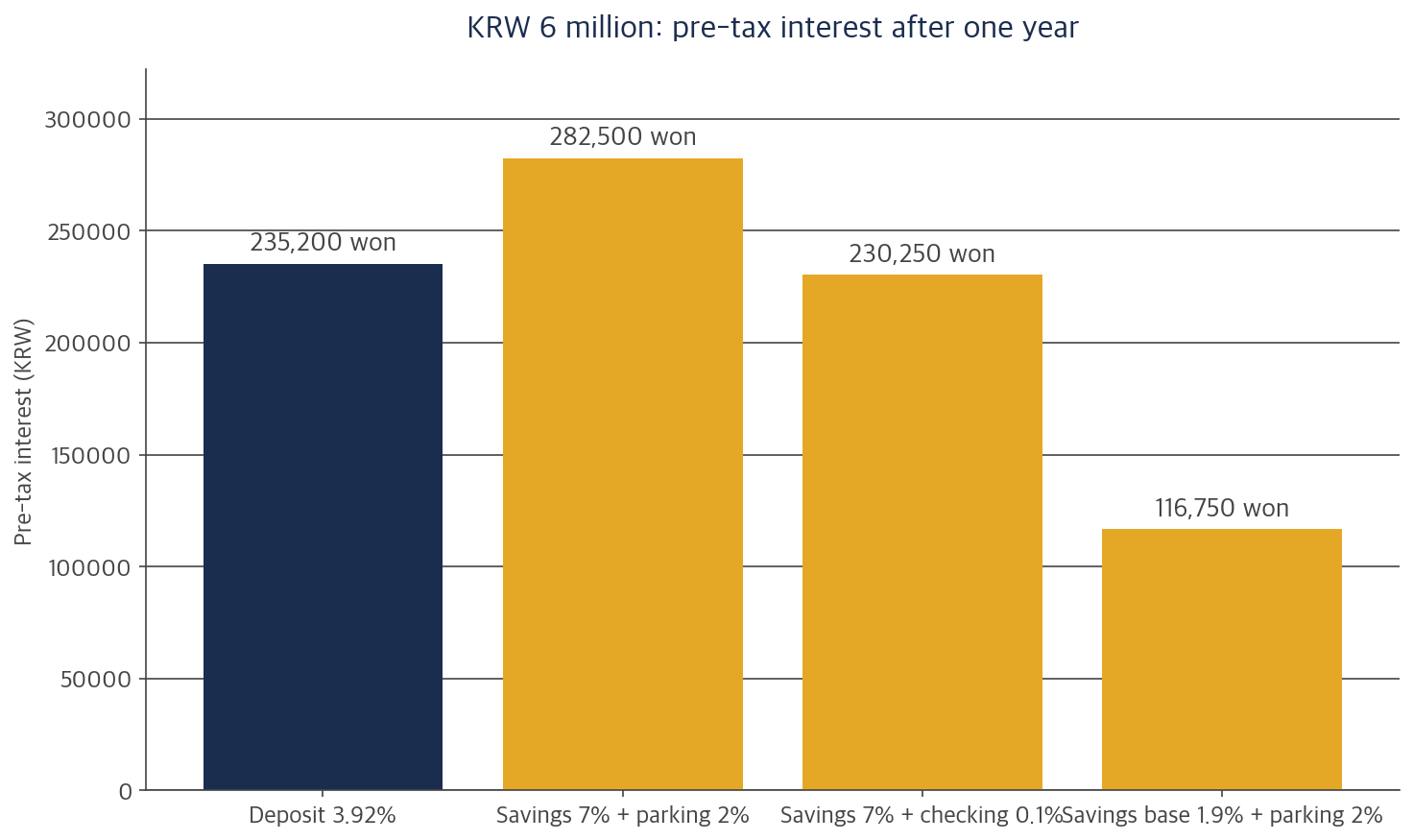
Meet every bonus condition and keep the waiting money in a parking account, and the savings route comes out KRW 47,300 ahead. Leave the waiting money in an account that pays almost nothing and you end up slightly behind the deposit; miss the bonus conditions and the combined interest is half of what the deposit pays. The 2% parking rate and the 0.1% checking rate are assumptions for the calculation; real tiered parking rates are worked through in what a parking account in Korea actually pays.
If you are saving KRW 500,000 a month out of your salary, the comparison is different. You have no lump sum to place on day one, so the alternative is not a time deposit but stacking the same money in a parking account each month. At 2%, KRW 500,000 a month earns about KRW 65,000 over the year. Account A’s installment savings interest is 3.5 times that at the full top rate, but at the base rate alone it is KRW 61,750, less than the parking account.
At the top bonus-inclusive time deposit rate of 4.05%, which includes a bonus for first-time customers of that bank, KRW 6 million earns KRW 243,000. You can check base and top rates separately on the FSS Finlife site (금융상품한눈에) for time deposits and installment savings, and on the Korea Federation of Banks (은행연합회) consumer portal. These pages are in Korean and show rates as of the day you look, so check again just before you sign up.
What to do before you open an installment savings account
With several big numbers on offer at once, rank the accounts by won of interest, not by rate. I would only sign up when the installment savings interest, calculated at a rate that includes just the bonuses I can realistically meet, beats what a time deposit or a parking account pays. As Account A in the table shows, the same product can pay more than three times as much at the top rate as at the base rate.
What to do in your situation
- Saving from your monthly salary: pick an account whose bonus conditions are met by things you already do, such as your salary transfer or a card you already use. If you open a new card and spend more than usual just to hit a condition, the extra spending can easily exceed a year of interest that amounts to a hundred-odd thousand won.
- Already holding a lump sum: check time deposit rates first. For the combination of installment savings and a parking account to beat a deposit, you need every bonus condition and a place that pays interest on the waiting money. If you are unsure about either one, a no-conditions time deposit gives the certain result.
- Looking at a product with a large new-customer bonus: check whether you have had recent activity at that bank. In a structure like Account A, where the new-customer bonus is 3.0 percentage points, an existing customer falls under a different set of conditions, so recount the bonuses you can meet and recalculate the interest. In Account A, an existing customer can still reach the same top rate through a salary transfer, utility auto-payments and card use. Foreign residents should also confirm in the app whether mobile sign-up accepts a residence card (외국인등록증).
- Aged 19 to 34: look at Youth Future Savings (청년미래적금), which adds a government contribution, before an ordinary account. Round 2 applications run from October 7 to 16 (FSC press release, in Korean). Eligibility and the day-by-day schedule are in Youth Future Savings round 2.
Dates and conditions to watch
- October 22 Monetary Policy Board meeting (Bank of Korea meeting schedule, in Korean): after the base rate decision, rates on newly opened deposits and savings can change. If you sign up around then, check the disclosed rates once more.
- Sales period and quota: accounts launched for a promotion are sold only for a set period, or close early once the quota fills. Account B was launched for a financial group event running through October (Financial News, September 30, in Korean).
- Bonus assessment window: in Account A, for a new customer, card spending over the three months starting with the sign-up month decides 2.0 percentage points. Mark that window on your calendar when you open the account.
Two things would change the call. If the waiting money earns next to nothing, then on a 12-month term a lump sum is better off in a time deposit as soon as the deposit rate exceeds 54% of the savings rate you will actually receive. Conversely, if you gain bonus conditions you can meet, such as a salary transfer, and can collect the full top rate, the installment savings account becomes more valuable.
A common mistake: assuming the higher rate pays more interest
A 9% account pays less than a 7% account, and KRW 300,000 in a 26% account earns around KRW 3,000. Installment savings interest is set by the rate together with how much you can deposit and for how long. A one-month ultra-short account is better seen as a way to build a daily saving habit than as a way to earn interest.
The FSC has made the same point: even when the top rate is high, if the base rate is markedly low you can end up with a rate below market rates when you fail the bonus conditions (FSC consumer notice, in Korean). The surest check is the expected maturity interest in won shown on the sign-up screen or in the product description.
Read the amount, not the rate, and the choice gets easier
The numbers 7%, 9% and 26% sit on different deposit limits and terms, so they cannot be compared as they are. Multiply the monthly deposit by the rate and by 6.5 to convert them into won, and one line tells you which installment savings account pays more and whether a deposit is the better choice.
- Pre-tax interest on a 12-month installment savings account is monthly deposit × rate × 6.5; multiply by 0.846 for the after-tax amount.
- KRW 500,000 a month at 7% earns KRW 227,500 before tax over a year, and KRW 61,750 at the 1.9% base rate alone.
- A 26% ultra-short account pays about KRW 2,795 after tax on KRW 300,000.
- A KRW 6 million lump sum earns KRW 235,200 in a no-conditions 3.92% time deposit; split into installment savings, it earns anywhere from KRW 116,750 to KRW 282,500 depending on the bonus conditions and the rate on the waiting money.
- After the October 22 Monetary Policy Board meeting, check disclosed deposit and savings rates again.
Related reading
- Savings Deposit vs Installment Savings Korea: A Complete Comparison Guide
- Parking Account in Korea: Why an 8% Rate Earns About 2.6% on KRW 10 Million, and When a CMA or Parking ETF Fits
- Money System Made Easy: The Complete 4-Account Method to Manage Your Salary
Disclaimer: This article is for information and education only and does not recommend or solicit any specific financial product. Rates and bonus conditions are as disclosed and reported on October 3 and 4, 2026, and institutions can change them at any time. The calculations assume a simple-interest account funded to the limit on the same day each month, so actual interest may differ. Before signing up, check the latest terms on FSS Finlife, the Korea Federation of Banks portal and the product description. All decisions are your own responsibility.