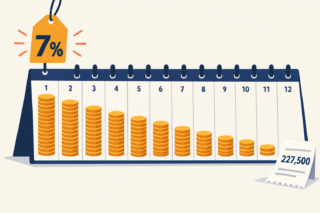
Put KRW 10 million for a year into a parking account in Korea that advertises a top rate of 8%, and even with every bonus condition met the pre-tax interest comes to KRW 255,200, a real rate of 2.55%. Only the first KRW 300,000 earns 8%; the rest of the money earns around 2% even with the bonus. Now that the base rate hikes have restarted the race among parking accounts (파킹통장), the number in the ad and the number that lands in your account can be that far apart. (※ As of September 2026 · Last updated 2026-09-29)
Bottom line: choose a parking account by the rate your whole balance actually earns, not by the top rate in the ad. On the same KRW 10 million, an account advertising only 5% but paying 3%+ on the upper tiers earns KRW 355,000 a year before tax, about KRW 100,000 more than the 8% account. Choose by upper-tier rates for an emergency fund of a few million won or more. Cash waiting to invest can sit in a CMA or parking ETF, as long as you know neither is covered by deposit insurance.
Rate hikes have restarted the parking account race
The Bank of Korea (한국은행) raised its base rate from 2.75% to 3.00% on August 27, its second hike in a row after July (Bank of Korea monetary policy decision). Rates on the saving side are moving with it.
- Fixed deposits: the top one-year rate at the five largest commercial banks was 3.4% to 3.6% as of September 23, about 0.5 percentage points higher than at the end of June (Seoul Economic Daily, September 28).
- Brokerage CMAs: major brokerages raised CMA yields by 0.20 to 0.25 points from late August, and as of September RP-type and note-type yields are around 2.50% to 2.85% (same report).
- Parking accounts: more accounts now advertise 5% to 8%, but the top rate usually applies only up to KRW 300,000 to KRW 2 million (Bizwatch parking account comparison).
A parking account’s top rate only covers the first tier
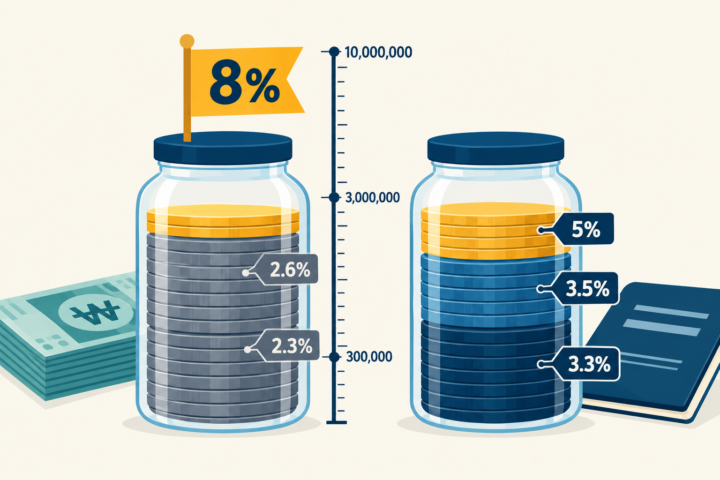
Many parking accounts split your balance into tiers and pay a different rate on each slice. The big top rate in the ad applies only to the first slice, and everything above it earns much less. Here are the structures of three savings bank parking accounts reported on September 27, with the product names removed (Dealsite, September 27).
| Structure | Top-rate tier | Second tier (base rate) | Third tier (base rate) |
|---|---|---|---|
| Account A (top 8%) | Up to KRW 300,000 at 8.0% (6.0% base + 2.0 points bonus) | Above KRW 300,000 to KRW 3 million at 0.6% (2.6% with bonus) | Above KRW 3 million to KRW 30 million at 0.3% (2.3% with bonus) |
| Account B (top 7%) | Up to KRW 500,000 at 7.0% (5.0% base + 2.0 points bonus) | Above KRW 500,000 to KRW 5 million at 0.8% (2.8% with bonus) | Above KRW 5 million to KRW 50 million at 0.1% (2.1% with bonus) |
| Account C (top 5%) | Up to KRW 1 million at 5.0% (no conditions) | Above KRW 1 million to KRW 5 million at 3.5% | Above KRW 5 million to KRW 50 million at 3.3% (no conditions) |
Once the bonus conditions are met, Accounts A and B add the bonus rate (up to 2.0 points) to every tier: up to KRW 30 million for A and up to KRW 50 million for B (Account A type product details, Account B type product guide). Even so, their upper tiers stay below Account C.
Leave money in each structure for a year with the balance unchanged, and the ranking flips as the amount grows. The table below assumes every bonus condition is met all year and ignores the small effect of monthly interest earning interest and conditions such as no bonus in the first month, so it is simplified pre-tax interest. The figure in brackets is the real rate: interest divided by the amount deposited.
| Amount deposited | Account A (top 8%) | Account B (top 7%) | Account C (top 5%) |
|---|---|---|---|
| KRW 300,000 | KRW 24,000 (8.00%) | KRW 21,000 (7.00%) | KRW 15,000 (5.00%) |
| KRW 1 million | KRW 42,200 (4.22%) | KRW 49,000 (4.90%) | KRW 50,000 (5.00%) |
| KRW 10 million | KRW 255,200 (2.55%) | KRW 266,000 (2.66%) | KRW 355,000 (3.55%) |
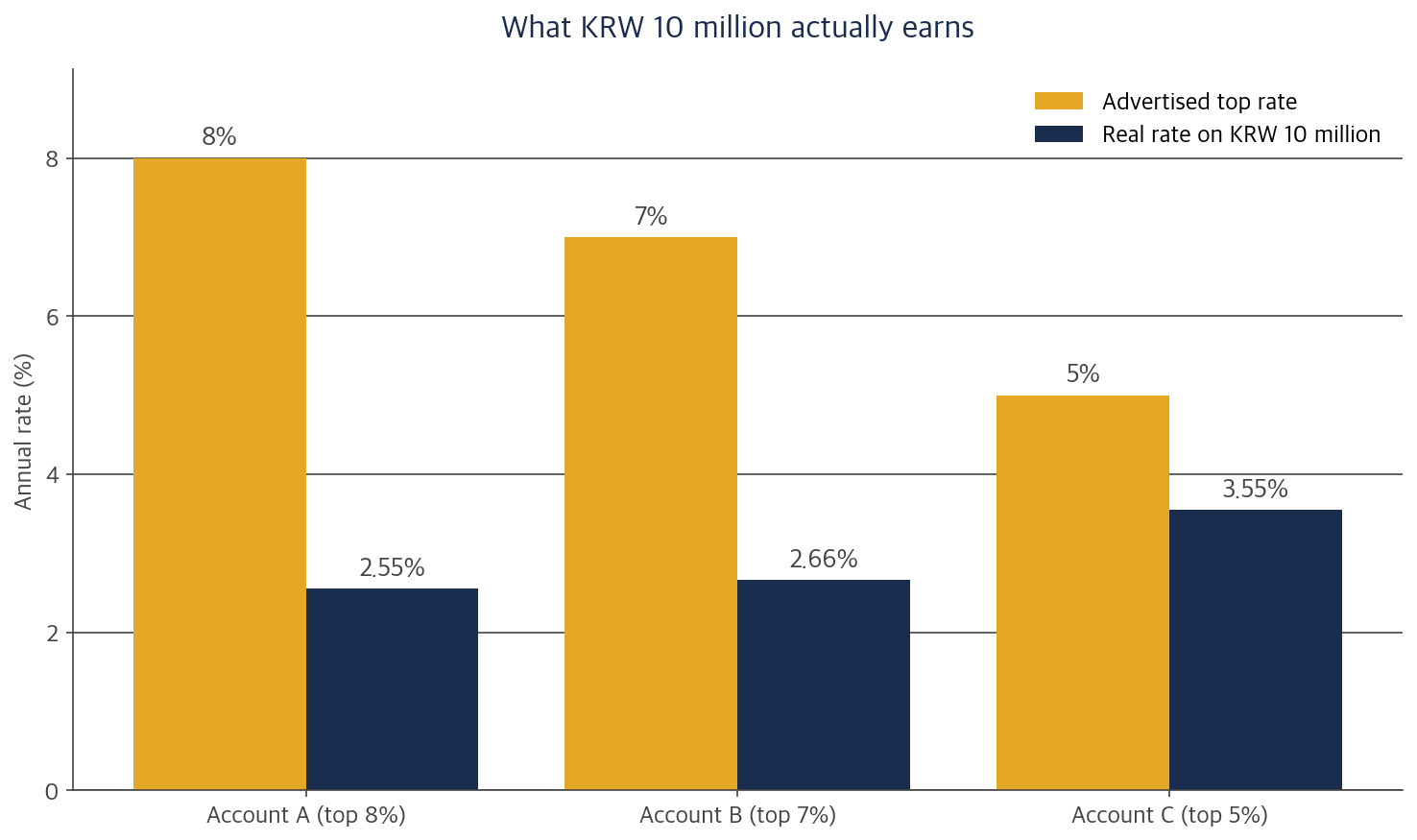
With KRW 300,000, Account A pays the most, just as the ads suggest, but its lead over Account C is only KRW 9,000 a year. At KRW 1 million, Account C is narrowly ahead, and at KRW 10 million it pays about 1.4 times what Account A does, roughly KRW 100,000 more. What decides your interest is not the top-rate tier but the rate on the tiers above it.
Interest is taxed at source at 15.4% (14% income tax plus 1.4% local income tax), so Account C’s interest on KRW 10 million is about KRW 300,000 after tax (National Tax Service (국세청) withholding tax rates, FinLife after-tax rate note). Also check when the bonus starts. Account A judges bonus conditions on the previous month’s end, so in principle the bonus rate does not apply in your first month.
Some rates also come with an end date. One internet bank gives a one-month rate coupon only to new users with no deposits in the past 12 months, and one regional bank adds an event bonus only until December 31 (Bizwatch, September 24). When the period ends, the rate falls back to the base rate, so check the applicable period on the sign-up screen first.
Parking accounts, CMAs, MMFs and parking ETFs differ on protection and payout timing
On rates alone, the four look similar. But they sit with different kinds of institutions and work differently, so the safety net for your principal and the speed at which you can get cash out are not the same.
| Item | Parking account | Brokerage CMA | MMF | Parking ETF |
|---|---|---|---|---|
| What it is | A demand deposit at a bank or savings bank | A brokerage account (RP, issued-note, MMF types and more) | A fund investing in short-term money market assets | A listed fund tracking short-term interest rates |
| How it pays | A rate set by the institution (can change) | A yield by type (MMF type is performance-based) | Performance-based | Fund returns, traded at market price |
| Deposit insurance | Principal plus interest up to KRW 100 million per institution | Not covered | Not covered | Not covered |
| When you get cash | Any time | Any time | After a redemption request, on the seller’s schedule | Two business days after selling (D+2) |
Under the Korea Deposit Insurance Corporation (예금보험공사) rules, ordinary deposits at banks and savings banks are protected, and since September 1, 2025, principal and interest are covered up to KRW 100 million per financial institution (KDIC list of protected products). Spread across different institutions, each one is covered separately up to KRW 100 million.
Brokerage CMAs, on the other hand, are classed by the KDIC as unprotected. What a brokerage protects is the cash left in your account that has not been used to buy shares or a CMA product. A CMA with the same name at a merchant bank (종합금융회사), the cash management account type, is protected, so check who actually sells the CMA before you open one.
An issued-note CMA (발행어음형) pays a little more, but it relies on the credit of the brokerage that issued the notes. Mirae Asset Securities’ own product terms state that the CMA is not covered by deposit insurance (Mirae Asset Securities issued-note CMA terms). Putting a large sum into one brokerage’s issued-note CMA means betting it on that one company’s credit.
Parking ETFs come in CD-rate, KOFR, money market and similar types and aim for returns near short-term rates. Unlike deposits and parking accounts, they are not covered by deposit insurance and the principal is not guaranteed (Maeil Business News, September 26). The fact that more than KRW 1.8 trillion flowed in over the week to September 22 does not make them safe.
Because you sell a parking ETF like a share in a brokerage account, the proceeds arrive two business days later (D+2), and you can withdraw from then on. Sell on a Friday and the cash is available the following Tuesday (KB Think guide to settlement cash). And since it is not a domestic equity ETF, even the trading gain is taxed at source as dividend income at 15.4% (Samsung Asset Management ETF tax guide).
Sort your cash by amount and by when you will need it
Before comparing rates, sort the money by how much it is and when you will spend it. If you have not settled on the size of your emergency fund yet, start with how much emergency fund you really need, and picking a bucket below gets easier.
- Living costs for the next month, KRW 1 million or less: the amount fits inside the top-rate tier, so you get close to the advertised rate. It only makes sense if spending you already do, such as debit card use or registered auto-payments, meets the bonus conditions.
- An emergency fund of a few million to tens of millions of won: a parking account with strong second- and third-tier rates wins. As the calculation above shows, at KRW 10 million the upper tiers produce most of the interest. Keep principal plus interest at one institution under KRW 100 million.
- A lump sum with a fixed date (a jeonse balance, tuition): if you will not touch it before that date, compare the rate on a fixed deposit maturing on that date. A fixed deposit locks the rate when you open it, but breaking it early means losing part of the agreed interest. The difference between the two is covered in our savings deposit vs installment savings guide.
- Cash waiting to buy shares: a CMA or parking ETF inside your brokerage account is the easiest to move into a purchase. Both sit outside deposit insurance, though, and a parking ETF takes two business days to turn into withdrawable cash, so build that into your timing.
You can compare fixed deposit rates by amount and term on the Financial Supervisory Service (금융감독원) FinLife fixed deposit comparison. For demand deposits such as parking accounts, check base and top rates separately on the Korea Federation of Banks (은행연합회) demand deposit comparison and the Korea Federation of Savings Banks (저축은행중앙회) demand deposit disclosure. Published rates are as of the day you look, so check again right before you sign up.
What to do with your Chuseok cash before you move it
With banks competing on top rates, now is the time to calculate, not to switch accounts. For an emergency fund of around KRW 10 million, I think an account with strong upper-tier rates beats the one with the highest advertised rate. As the table above shows, most of the interest comes from the tiers above the top-rate slice, not from the slice itself.
What to do in your situation
- If your emergency fund sits in a low-rate everyday account: moving it is worth the most. A structure paying 3%+ on the upper tiers earns around KRW 350,000 a year before tax on KRW 10 million, so the rate gap with your current account turns straight into interest.
- If you already use a parking account: before switching to one with a higher advertised rate, run your current balance through the new account’s tier table. If your balance is well above the top-rate cap, switching can actually cut your interest. Many top rates are also for new customers only, so do not expect the same rate on an account you already hold (Etoday, September 27).
- If you hold cash waiting to invest in a brokerage account: CMA yields rose in late August, so money you plan to invest can stay where it is. A lump sum you do not plan to use for a while, though, is better split with a protected parking account or fixed deposit, so it does not rest on one brokerage’s credit alone.
- If you are parking a small sum of KRW 300,000 to KRW 500,000: the top-rate account fits. But at KRW 300,000 the yearly gap between Account A and Account C is KRW 9,000, so spending more than usual just to meet bonus conditions leaves you worse off.
Dates and conditions to watch
- The October 22 Monetary Policy Board meeting (Bank of Korea meeting schedule): parking account and CMA rates have no fixed term, so institutions can change them at any time. After the August 27 hike, some brokerages raised CMA yields on August 28 and August 31 (Seoul Economic Daily). After the decision, check your account’s rate change notices.
- Event end dates and new-customer periods: one-month coupons and event rates that run to year-end fall back to the base rate on the day they end. Put the applicable period in your calendar when you sign up.
- How bonus conditions are judged: with accounts that judge on last month’s activity, missing a condition for a single month drops next month’s rate right away. In the Account A structure, missing every bonus cuts the pre-tax interest on KRW 10 million to KRW 55,200 a year (0.55%).
Two things should change your call. If your parking account cuts its upper-tier rate and the gap with fixed deposits widens, move money with a fixed spending date into a fixed deposit first. And if your emergency fund at one institution approaches KRW 100 million, split it with another institution even at a slightly lower rate.
A common mistake: opening several top-rate accounts for big interest
Splitting KRW 300,000 across several top-rate accounts looks like it should add up, but even 8% on KRW 300,000 is KRW 24,000 a year before tax. Each account has its own bonus conditions, such as a minimum number of debit card uses or auto-payments, and missing one drops that month’s rate. It is better to split accounts to separate what the money is for, not to chase interest. For how to split by purpose, see the 4-account money system.
Look at your balance, not the number in the ad
The rate race among parking accounts is good news for savers, but the top rate in the ad usually covers only the first KRW 300,000 to KRW 2 million. Running your balance through the tier table once will raise your interest more than opening a few extra accounts.
- A parking account’s top rate covers only the first tier; on KRW 10 million, an 8% account earns a real rate of only 2.55% even with every bonus condition met.
- Choose an emergency fund of a few million won or more by the second- and third-tier rates.
- Bank and savings bank parking accounts are protected up to KRW 100 million per institution; brokerage CMAs, MMFs and parking ETFs are not.
- A parking ETF pays out two business days after you sell, and even its trading gain is taxed at 15.4%.
- After the October 22 Monetary Policy Board meeting, check your account’s rate change notices.
Related reading
- How Much Emergency Fund Do You Really Need?
- Money System Made Easy: The Complete 4-Account Method to Manage Your Salary
- Savings Deposit vs Installment Savings Korea: A Complete Comparison Guide
Disclaimer: This article is for information and education only. It does not recommend opening, buying or selling any specific financial product. Parking account and CMA rates and tier structures are as reported between September 24 and 28, 2026, and institutions can change demand deposit rates at any time after giving notice. Before signing up, check the Korea Federation of Banks and Korea Federation of Savings Banks disclosures, the institution’s product terms and the Korea Deposit Insurance Corporation guidance yourself. All decisions are your own responsibility.