
Open your bank app on the morning of October 7 and the apply button may be locked because your birth year ends in an even digit. The fix is to wait one day. If you have paid into a Youth Leap Account (청년도약계좌) for over three years, the harder call comes first: close it and move to Youth Future Savings (청년미래적금), or ride out the remaining years? The application window lasts ten days, the opening window twelve, and the decision falls in between. (As of September 2026. Last updated 2026-09-25)
In short, anyone who qualifies should apply on October 7 or 8 without waiting, and Youth Leap Account holders should terminate nothing until their final tier is confirmed. The product terms are identical to Round 1, and if the 2027 budget passes the National Assembly, the higher preferential match is scheduled to reach people who join now retroactively, so waiting gains nothing.
In Round 1, some applicants closed a Youth Leap Account on a final “preferential” notice that was corrected to “standard” a week later. Round 2 answers that with a preliminary result sent in advance and a chance to contest it.
Why Future Savings Round 2 is happening, and what changed in screening
Round 1 drew 2,343,000 applications and 1,385,000 accounts were opened. That is roughly 40 percent of the 3.2 million people the government had budgeted for. Because money was left over, the Financial Services Commission (FSC, 금융위원회) moved the second round forward from December to October. Separately, requests from Youth Leap Account holders who had missed the switch window led it to reopen switching as well.
The product itself is unchanged. What changed is how applications are screened. The FSC press release on Round 2 lists four improvements.
- You declare SME employment yourself: applicants now select whether they work at a small or medium-sized enterprise at the application stage.
- Cross-check against KoDATA: that selection is compared with the Korea Inclusive Finance Agency (KINFA, 서민금융진흥원) screening result built on KoDATA (Korea Enterprise Data, 한국평가데이터) records.
- Preliminary result and appeal: before anything is final, applicants receive a preliminary result, and if it differs from the tier they selected they get a chance to explain and contest it.
- More servers and call-center staff: capacity is being added for the screening period, and the KINFA call center is expanding its staff.
What to do on each date: odd years on October 7, even on October 8, everyone from October 12
You apply through a participating bank’s app, and KINFA runs the screening. The first two days use an odd-even system based on the last digit of your birth year. From October 12, after the Hangul Day holiday and the weekend, anyone can apply, so missing the first two days does not cost you eligibility.
| Date | Who | What |
|---|---|---|
| October 7 (Wed) | Birth year ending in an odd digit | Apply in a participating bank app |
| October 8 (Thu) | Birth year ending in an even digit | Apply in a participating bank app |
| October 12 (Mon) to 16 (Fri) | Anyone, regardless of birth year | Apply |
| October 19 to November 13 | KINFA | Screening, preliminary result sent in advance, appeals |
| November 16 (Mon) to 27 (Fri) | Approved applicants | Open the account. Youth Leap Account switchers must also complete the special early termination inside this window |
For anyone moving over from a Youth Leap Account, the order of steps matters. The procedure below follows the Round 1 guidance, and detailed Round 2 instructions will be sent individually to eligible switchers.
- Apply: on your odd-even date, apply for Youth Future Savings in a participating bank app and declare whether you work at an SME.
- Check the preliminary result: during the screening period you will receive a preliminary tier. If it differs from what you selected, contest it.
- Final approval notice: this is where preferential or standard is settled. Do not close any account before this notice.
- Open the account: open your Youth Future Savings account between November 16 and 27.
- Special early termination of the Youth Leap Account: only after the new account is open, check on the account-opening screen that the tier matches your notice, then request a special early termination “for the purpose of joining Youth Future Savings”. Under the Round 1 guidance, failing to do this within the account-opening window meant you could not make deposits into Youth Future Savings.
For this round the eligible birth dates run from November 17, 1991 to November 27, 2007, and up to six years of military service are excluded from the age calculation. You need verifiable income for the previous year, 2025. People whose only income was tax-exempt parental-leave benefits or active-duty enlisted pay can still join. Anyone subject to comprehensive taxation on financial income in any of the previous three years is excluded.
Fourteen institutions handle the product: IBK, NH Nonghyup, Shinhan, Woori, Hana, KB Kookmin, iM Bank, Busan, Kyongnam, Kwangju, Jeonbuk, Suhyup, KakaoBank and Korea Post. The KINFA Youth Future Savings page carries the application details, and the KINFA call center is 1397.
Who gets what: 6% standard, 12% preferential, tax exemption only above 60 million won
Youth Future Savings is a three-year installment account with free deposits of up to 500,000 won a month, and the interest is exempt from interest income tax. On top of that, the government adds a monthly contribution equal to a share of what you deposit. That share splits three ways depending on your income and employer.
| Tier | Personal income | Household income | Government contribution |
|---|---|---|---|
| Preferential | SME employee with gross salary of 36 million won or less (comprehensive income 26 million won or less), or small business owner with annual sales of 100 million won or less | 150% of median household income or less | 12% of deposits (60,000 won on a 500,000 won deposit) |
| Preferential (new SME hire) | Gross salary of 60 million won or less | 200% of median household income or less | 12% of deposits |
| Standard | Gross salary of 60 million won or less (comprehensive income 48 million won or less), or small business owner with annual sales of 300 million won or less | 200% of median household income or less | 6% of deposits (30,000 won on a 500,000 won deposit) |
| Tax exemption only | Gross salary above 60 million won and up to 75 million won (comprehensive income up to 63 million won) | 200% of median household income or less | None |
Under the Round 1 definition, a new SME hire is someone who took their first job in the year before the application date and currently works at an SME. It also counts if it was not your first job ever but your total employment-insurance history before joining that company was under one year. Confirm with KINFA whether the same definition applies in Round 2.
Dual-income married couples get a looser household test. On a two-person household basis the standard tier allows up to 250 percent of median income and the preferential tier up to 200 percent. Preferential SME employees also carry a condition after joining: they must work at an SME for a total of at least 29 months between enrolment and one month before maturity, with up to two job changes allowed in that time.
The base rate is 5 percent a year at all 14 institutions, and each adds up to 2 or 3 percentage points of bonus rate, for a maximum of 7 to 8 percent. The rate is fixed for the full three years. Two bonus conditions are common to every bank: 0.5 percentage points for gross salary of 36 million won or less, and 0.2 points for completing the “financial counseling for all youth” program. The rest vary by bank.
Those two common bonuses are not added on top. They sit inside each bank’s maximum bonus rate. KB Kookmin, for example, reaches its 3.0-point maximum by combining salary transfer, withdrawal activity, a loyalty bonus, the income condition and the counseling course, as reported by Financial News (파이낸셜뉴스). If your gross salary is above 36 million won, your best rate is lower by that income bonus. These conditions come from the May 2026 Round 1 disclosure, so recheck the Korea Federation of Banks (은행연합회) comparison page before opening the account.
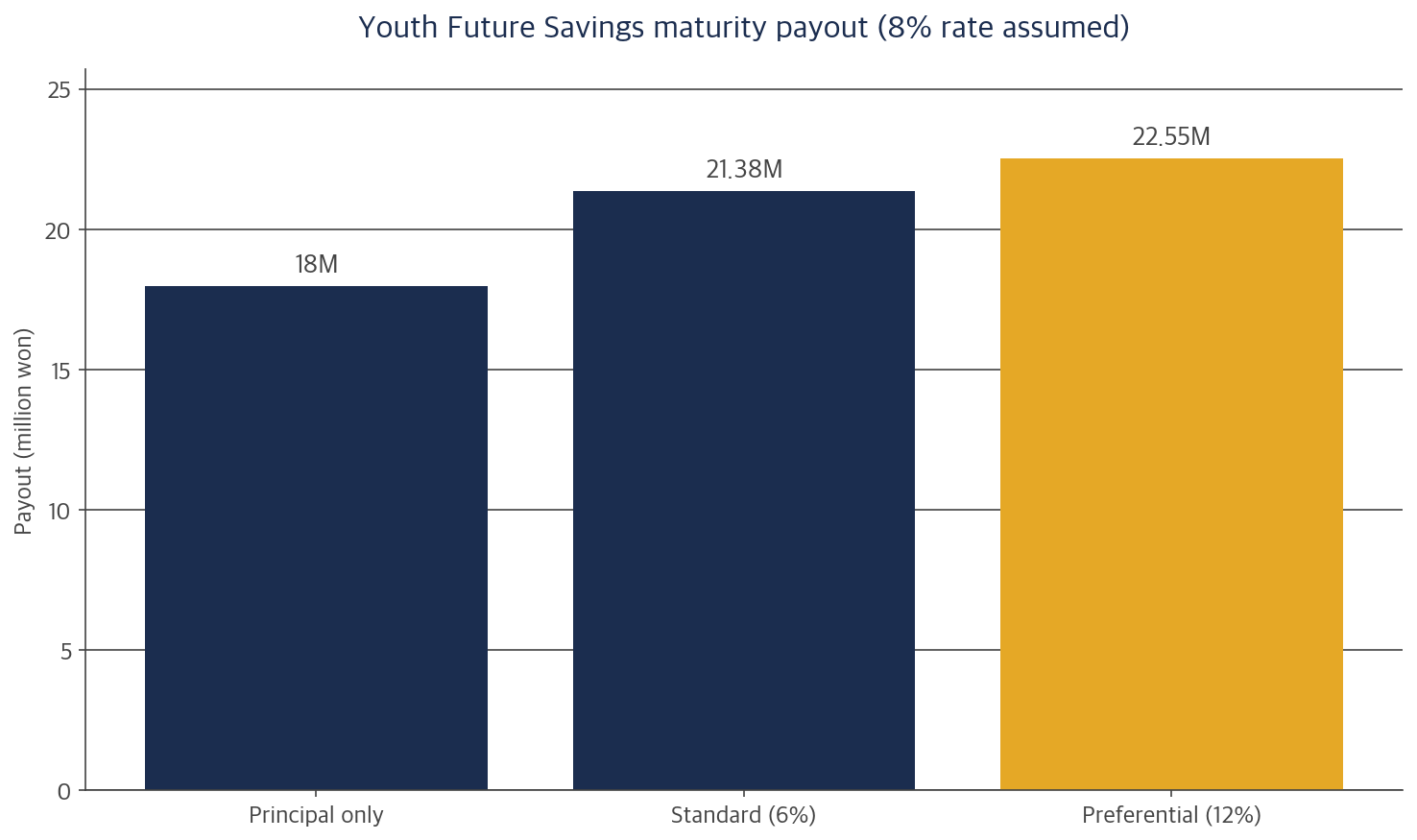
Using the FSC’s own example, 500,000 won a month for 36 months adds up to 18 million won of principal. If you earn the full 8 percent, the standard tier ends at 21.38 million won, made up of 1.08 million won in contributions and 2.30 million won in interest. The preferential tier ends at 22.55 million won, with 2.16 million won in contributions and 2.39 million won in interest.
The widely quoted “19.4 percent a year” is that preferential result restated as an ordinary savings rate, and the standard tier works out to 14.4 percent on the same assumptions.
Those conversions assume you receive the full 8 percent. Miss some bonus-rate conditions and the equivalent yield falls with the rate. Installment savings also feel lower than the headline rate because each monthly deposit sits in the account for only part of the term on average. That mechanism is explained in Savings Deposit vs Installment Savings Korea.
What happened in Round 1: people who closed a Youth Leap Account on a preferential notice, then were reclassified as standard
Round 1 results went out on July 23 and 24, and some applicants received a correction on July 31. When KINFA pulled company records from an outside data provider to confirm SME employment, inaccurate data slipped in, and some applicants who belonged in the standard tier were told they had qualified for the preferential tier.
The damage happened in the gap. A Kuki News report described an applicant who received a preferential approval message, closed their Youth Leap Account, and got a text the next day reclassifying them as standard. KINFA cancelled those terminations for anyone who had closed a Youth Leap Account on the strength of the wrong notice and let them return to the original account.
Round 2’s preliminary notice and appeal step exists to stop a repeat. Note, though, that what got reversed in Round 1 was not a preliminary result but the final screening notice. So even in Round 2, do not terminate on the final notice alone. Open the Youth Future Savings account first, confirm the tier shown on the opening screen, and only then request the special early termination.
The gap between tiers is 1.08 million won in contributions over 36 months at 500,000 won a month, and a lump-sum transfer of the termination proceeds into Youth Future Savings is not supported either.
What to do now, depending on where you stand
I see no reason for anyone who qualifies to sit out Round 2, for two reasons. First, the government’s 2027 budget proposal, already submitted to the National Assembly, opens Youth Future Savings to all young people and raises the preferential match from 12 percent to 15 percent (25 percent for those working at regional SMEs). If the Assembly confirms it, the increase is scheduled to be paid retroactively to existing account holders.
Second, a third round is slated only after that budget is confirmed and the Restriction of Special Taxation Act rules are amended, so its timing is open.
- You did not apply in Round 1, or never opened the account: find your tier in the table above and apply on October 7 or 8. With gross salary of 60 million won or less and a passing household test you are at least standard, and SME employees and small business owners flag the preferential tier themselves at application.
- You have held a Youth Leap Account for more than three years and your final tier is preferential: the case for switching is strongest here. The Youth Leap Account rate is fixed only for the first three years, and KB Kookmin, Shinhan and Woori cut the base rate on accounts past that point from 4.5 percent to 3.0 percent, taking the top rate from 6.0 to 4.5 percent. A special early termination for the purpose of joining Youth Future Savings keeps the contributions and tax exemption you have already earned, so swapping the remaining years for a 12 percent match on a three-year fixed rate has the stronger case.
- You have held it for more than three years but your final tier is standard: this one cannot be called in advance. A Youth Leap Account paid at 700,000 won a month earns a contribution of up to 33,000 won a month, which can exceed the standard-tier maximum of 30,000 won on Youth Future Savings. After Round 1, New Daily (뉴데일리) reported that standard-tier applicants come out ahead by keeping the Youth Leap Account to maturity, and Seoul Economic Daily (서울경제) cited analysis that anyone outside the preferential tier should weigh the switch carefully. Compare the projected payouts in your bank app for both paths before deciding.
- You are better off keeping the Youth Leap Account: if your final tier is standard and the projected-payout comparison favors staying, or if you deposit the full 700,000 won a month and the 500,000 won cap is a step down. Weigh this knowing that anyone who holds a Youth Leap Account to its five-year maturity is not eligible for Youth Future Savings afterwards, so this round may be the last chance to compare the two.
- Gross salary above 60 million and up to 75 million won: no contribution, but you still get a three-year fixed rate with no interest income tax. The income bonus of 0.5 percentage points goes only to gross salary of 36 million won or less, so your best rate is 0.5 points below each bank’s 7 to 8 percent maximum. If you pass the household test, it is still worth opening purely as a tax-free savings account.
- You are outside the rules for now: if your salary, household income or age falls outside the limits, this round is not for you. Once the budget is confirmed, the wider eligibility applies from the 2027 rounds, so watch the year-end budget review in the National Assembly.
| Item | Youth Future Savings | Youth Leap Account |
|---|---|---|
| Monthly deposit cap | 500,000 won | 700,000 won |
| Term | 3 years | 5 years |
| Maximum principal | 18 million won | 42 million won |
| Top rate | 7 to 8% a year (fixed for 3 years) | 6% fixed for 3 years, then 4.0 to 4.5% variable |
| Government contribution | 6% or 12% of deposits | 3 to 6% by income bracket |
| Maximum yield as an ordinary savings rate (simple) | About 14.4% or 19.4% | About 9.2% |
The variables to watch each come with a date.
- October 19 to November 13: preliminary results arrive. If yours differs from the tier you selected, this is when you contest it.
- November 16 to 27: open the account and, for switchers, complete the Youth Leap Account special early termination in the same window. Detailed switching steps will be sent individually.
- Year-end budget review in the National Assembly: confirmation of the 2027 Youth Future Savings budget settles the retroactive preferential increase and the wider eligibility. Until it passes, both are plans, not rules.
- Bonus-rate conditions just before you apply: the base rate is the same everywhere, but bonus conditions differ, so use the Korea Federation of Banks disclosure to pick the bank whose conditions you can actually meet.
The common mistake is “the terms improve next year, so wait.” The preferential increase is scheduled to reach existing holders retroactively once confirmed, and the wider eligibility applies from the 2027 rounds, which is irrelevant to anyone who already qualifies. No date has been set for a third round. Waiting gains nothing and simply pushes back the three years in which the contributions accrue. The background on why the government’s plan lets a youth Productive Finance ISA sit alongside Youth Future Savings is in Productive Finance ISA in Korea.
Hurry the application, never the termination
Youth Future Savings Round 2 is not a round with new terms. It is a round with a new order of screening. Apply early on your odd-even date, and close a Youth Leap Account only after your final tier is confirmed and the new account is open. For the wider map of youth asset-building products in Korea, continue with Youth Savings 2026 in Korea.
- Apply on October 7 (odd birth years), October 8 (even) or October 12 to 16 (anyone). Approved applicants open accounts from November 16 to 27.
- Contribution is 6 percent for standard and 12 percent for preferential. Gross salary above 60 million and up to 75 million won gets the tax exemption only.
- Switch from a Youth Leap Account in this order: final notice, open the new account, then special early termination. Never terminate before the new account is open, and if your final tier is standard, compare projected payouts first.
- If the 2027 budget passes, the higher preferential match is scheduled to reach existing holders retroactively. That is not a reason to wait.
Related reading
- Youth Savings 2026 in Korea: Naeil Chaeumgongje Closure and 4 Alternatives
- Productive Finance ISA in Korea: 3 Things Existing ISA Holders Should Check
- Savings Deposit vs Installment Savings Korea: A Complete Comparison Guide
Disclaimer: This article is for information only and does not recommend any particular bank’s product. The Round 2 schedule, eligibility rules and contribution rates follow Financial Services Commission and KINFA announcements as of September 25, 2026, and the 2027 budget items are still before the National Assembly and may change. Check the KINFA guidance and your bank’s disclosure before applying or terminating a Youth Leap Account.