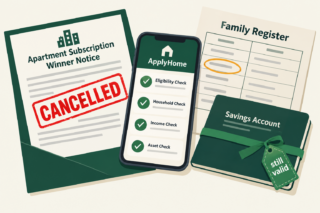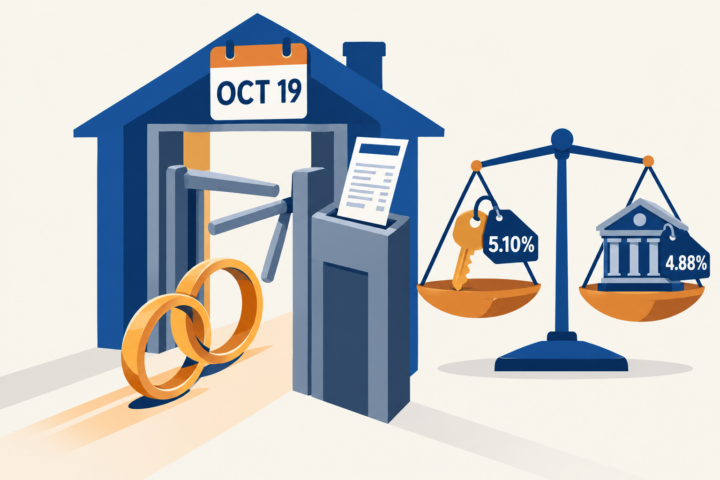
A newlywed couple in Korea earning KRW 40 million and KRW 50 million a year, with no children, cannot apply for a Bogeumjari Loan (보금자리론) today. Their combined KRW 90 million is above the KRW 85 million income cap for newlyweds. Before the wedding, on the income test alone, each of them could have applied alone.
The Korea Housing Finance Corporation (한국주택금융공사, HF) calls this the “marriage penalty” and is removing it. For new applications from October 19, a newlywed couple qualifies if just one spouse earns KRW 70 million or less a year (HF press release, September 28, in Korean). (As of October 2026 · last updated 2026-10-04)
Bottom line: what widens on October 19 is eligibility, not the loan terms. The limit is calculated on the income and debts of the one spouse who borrows, while the rate discounts and the exemption from regulated-area cuts are still judged on the couple’s combined income. So a couple above the combined cap ends up on the base rate with no discount: 5.10% for a 30-year term in October, which is higher than the 4.88% average that banks charged on fixed-type mortgages in August.
Check three things before you apply for a Bogeumjari Loan: which of you will be the borrower, whether that person’s income supports the amount you need, and whether a rate that stays fixed to maturity is worth paying for compared with a bank quote.
What changes in the Bogeumjari Loan income test on October 19
Only one thing changes: the income test for newlywed households. A newlywed household is a couple applying within 7 years of registering the marriage, and it includes couples who will marry within 3 months of the application. Everything else stays, including the KRW 600 million home price cap and the standard KRW 360 million loan limit.
- Until now: combined annual income had to be KRW 85 million or less with no children, KRW 90 million with one child, and KRW 100 million with two or more (only children under 19 count).
- For new applications from October 19: a couple above the combined cap can still apply if one spouse earns KRW 70 million or less a year.
- Background: it follows the financial package for housing market stability that the Financial Services Commission (금융위원회, FSC) announced on August 13 (FSC press release, August 13, in Korean).
Which couples can apply on one income, and which cannot
The new test opens only to newlywed households whose combined income is above the cap. The first three rows below are the examples HF gave in the Q&A attached to its release. The last three apply the same rule to other situations.
| Couple (annual income) | Combined income | Until October 18 | From October 19 |
|---|---|---|---|
| KRW 40M + KRW 50M, no children | KRW 90M | Not eligible | Eligible |
| KRW 40M + KRW 60M, one child | KRW 100M | Not eligible | Eligible |
| KRW 40M + KRW 70M, two children | KRW 110M | Not eligible | Eligible |
| KRW 35M + KRW 45M, no children | KRW 80M | Eligible (combined test) | Eligible (combined test, unchanged) |
| KRW 75M + KRW 80M | KRW 155M | Not eligible | Not eligible (both above KRW 70M) |
| Married 8 years, KRW 40M + KRW 50M, no children | KRW 90M | Not eligible | Not eligible (non-newlyweds need KRW 70M or less combined) |
Eligibility comes with conditions on how the application is screened. HF’s Q&A sets out five of them (Etoday report, September 28, in Korean).
- No choice if you are within the combined cap: a couple inside the combined cap is screened on combined income, as before. You cannot put forward only the spouse with the lower income or fewer debts.
- The spouse who proves the income is the borrower: the one earning KRW 70 million or less must be the person who applies and becomes the borrower (차주). Qualifying on one spouse’s income and borrowing in the other’s name is not allowed.
- Repayment capacity is also judged on that one person: the debt-to-income (DTI) review uses the borrower’s own income and debts. The other spouse’s income cannot be added to raise the limit.
- The other spouse’s income and debts are still checked: HF needs them to decide rate discounts and the end-user test, and to see whether that spouse has loans to repay, such as an interim payment loan or a jeonse loan.
- Homes are counted for the couple together: the rule that you own no home, or one home, apart from the one being mortgaged is applied to both spouses’ holdings combined.
If both of you earn KRW 70 million or less, either can be the borrower. Because the limit is calculated on the borrower alone, it usually works better for the spouse with the higher income and fewer other loans to apply. If your spouse is a foreign national, they must have completed alien registration for the two of you to count as a newlywed household (HF product page, in Korean).
The Bogeumjari Loan limit on one borrower’s income
The Bogeumjari Loan limit is the smallest of three numbers: the loan-to-value cap (LTV, 70% for apartments), the DTI cap (60%), and the product limit of KRW 360 million. When you apply on one income, DTI is calculated on the borrower’s income alone. The lower that income, the sooner DTI becomes the number that binds.
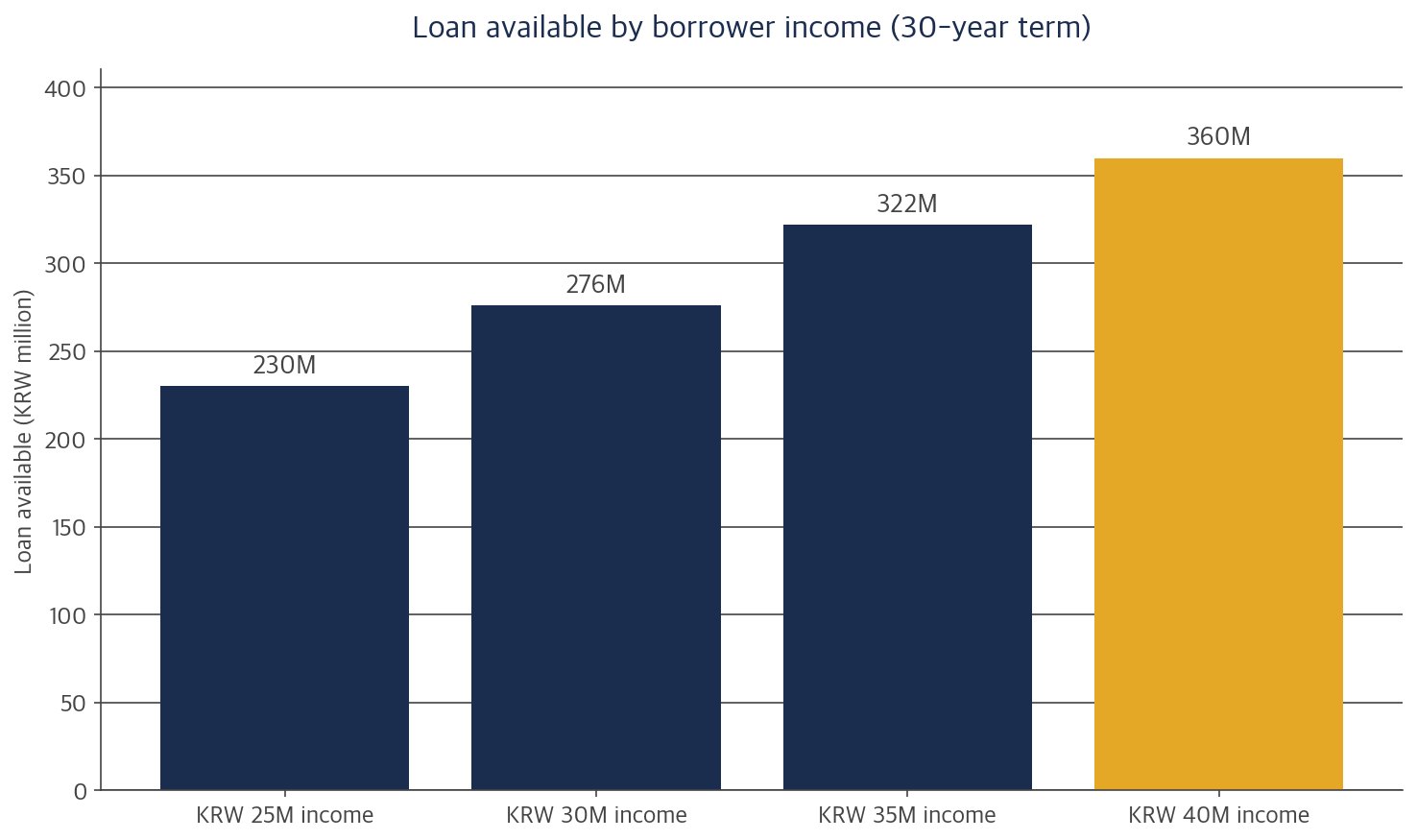
The table assumes the borrower has no other loans and repays in level payments of principal and interest. It shows the largest loan whose yearly payments stay within 60% of annual income, at the October rates for the online product with e-contract, Akkim-e (아낌e) (HF rate page, in Korean).
| Borrower’s annual income | 30-year term (5.10%) | 40-year term (5.15%) | 50-year term (5.20%) |
|---|---|---|---|
| KRW 25 million | about KRW 230 million | about KRW 254 million | about KRW 267 million |
| KRW 30 million | about KRW 276 million | about KRW 305 million | about KRW 320 million |
| KRW 35 million | about KRW 322 million | about KRW 356 million | KRW 360 million (cap) |
| KRW 40 million or more | KRW 360 million (cap) | KRW 360 million (cap) | KRW 360 million (cap) |
Two things stand out. First, to use the full limit on a 30-year term, the borrower needs an annual income of about KRW 39.1 million. Second, below that level you can still stretch the term to lower the monthly payment. In a newlywed household, a borrower under 50 can choose a 40-year term and a borrower under 40 can choose 50 years.
Your real Bogeumjari Loan limit can come out lower. These are the conditions that move it.
- The borrower has other loans: credit loans and overdraft lines (마이너스통장) are reflected in the review and reduce what you can borrow. HF itself notes on its estimate page that the real limit can be smaller once debts are counted.
- The home is in a regulated area: in adjustment target areas, speculative areas and overheated speculation districts, LTV and DTI are each cut by 10 percentage points and 0.2 percentage points is added to the rate. At a 50% DTI and 5.30%, borrowing KRW 360 million over 30 years takes a borrower income of about KRW 48 million.
- Exemptions from the cut: first-time home buyers are not cut even in regulated areas. End users (no home, buying to live in, KRW 600 million or less, combined income of KRW 70 million or less) are also exempt, but a couple that applies on one income because it is above the combined cap cannot meet that income condition.
- First-time buyer limit: the product limit for first-time home buyers is KRW 420 million. Using all of it on a 30-year term takes a borrower income of about KRW 45.6 million.
To run your own numbers, enter income, term and regulated-area status in the HF loan estimate tool (in Korean). The result is based on minimal inputs and can differ from the actual review.
Couples above the combined cap lose most Bogeumjari Loan rate discounts
Bogeumjari Loan rates were frozen again for October: from 4.90% for a 10-year term to 5.20% for 50 years on the Akkim-e product (HF October rate release, in Korean). The t-Bogeumjari Loan taken out at a bank branch and the u-Bogeumjari Loan without e-contract are each 0.1 percentage points higher. Discounts of up to 1.0 percentage point come off these rates, but most of them carry a combined-income condition.
| Discount | Size | Income condition | Couple applying on one income |
|---|---|---|---|
| Newlywed household | 0.3%p | Combined income of KRW 70 million or less | Not available |
| Household with a newborn | 0.2%p | Combined income of KRW 70 million or less | Not available |
| Low-income youth | 0.1%p | Combined income of KRW 70 million or less, under 40 | Not available |
| Green building | 0.1%p | None (certification grade required) | Available if the home qualifies |
The one-income test applies only when combined income is above KRW 85 million, so discounts that require KRW 70 million or less combined are out of reach by design. The multi-child discount (0.5%p for two children, 0.7%p for three or more) is listed in the reference table of the HF release with a combined income of KRW 100 million. A couple with two or more children whose combined income is above that should confirm at application whether it applies.
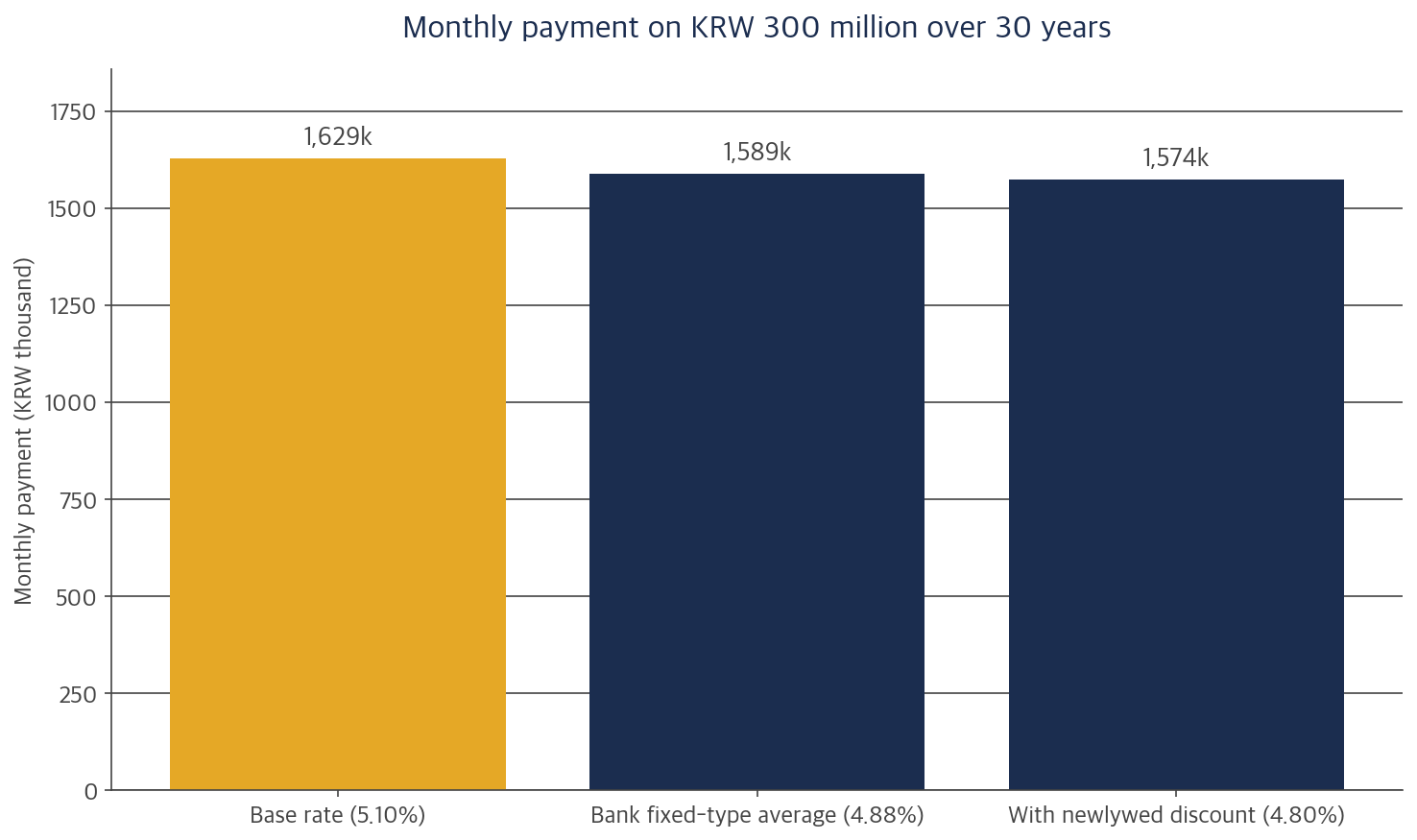
Without the 0.3%p newlywed discount, a KRW 300 million loan over 30 years costs about KRW 55,000 more a month, or about KRW 19.75 million more over the full term.
The Bank of Korea (한국은행) put the average mortgage rate at deposit banks in August at 4.66% on new loans, with fixed-type loans at 4.88% and variable-type loans at 4.53% (Hankook Ilbo report, September 30, in Korean). The undiscounted 30-year rate of 5.10% is 0.22 percentage points above the bank fixed-type average.
These are averages, so the rate a bank offers you may differ. The direction is still clear. For a couple that gets no discount, the Bogeumjari Loan is not the cheaper loan.
It is a loan with different terms: the rate does not change from the day the loan is paid out until maturity, the term can run up to 50 years, and the early repayment fee applies only in the first 3 years, capped at 0.5%. How to choose between fixed and variable is covered in our fixed vs variable loan rate guide.
What to do if you plan to apply on one income
Becoming eligible does not make the Bogeumjari Loan the answer. In my view it fits a couple applying on one income in two cases: you plan to repay over 30 years or more and need a rate that never changes, or you need a long term to bring the monthly payment down. On rate alone, the bank fixed-type average was lower in August.
- Newlyweds within the combined cap: nothing changes for you. Apply on combined income as before. If your combined income is KRW 70 million or less you also get the 0.3%p newlywed discount, so there is no reason to wait for October 19.
- Newlyweds above the cap with one spouse at KRW 70 million or less: apply on or after October 19 so the new test applies. Before that, decide who borrows, use the table above to see whether that income supports the amount you need, then get a bank fixed-rate quote and compare rate and term side by side.
- Couples who were putting off marriage registration: if you will marry within 3 months of applying, you count as a newlywed household. With one of you at KRW 70 million or less, registering no longer costs you eligibility, so the Bogeumjari Loan is no longer a reason to delay.
- Both above KRW 70 million, married more than 7 years, or buying a home above KRW 600 million: this change does not reach you. A home is excluded if any one of its market price, appraisal value or purchase price is above KRW 600 million, so plan around a bank mortgage.
If you decide to apply for a Bogeumjari Loan, the process starts on the HF website (HF application steps, in Korean).
- Check both incomes: the review is based on pre-tax income for the last 2 years. Pull income documents for both of you first and check the combined figure and each individual figure.
- Apply online: log in with a digital certificate and apply, and an HF agent calls to tell you which documents to prepare. The Akkim-e product with e-contract is 0.1 percentage points cheaper.
- Submit documents: through the website, the Smart Housing Finance app (스마트주택금융) or KakaoTalk. Expect to provide your spouse’s ID and consent form, proof of income and employment, and a copy of the sale contract.
- Visit the bank after approval: the result arrives by text message, and you then sign the loan agreement and receive the funds at a handling bank. For a purchase, you must apply within 3 months of the ownership transfer registration date.
- Move in: if the home is in the Seoul metropolitan area or a regulated area, you must move in within 6 months of the loan being paid out and submit proof.
Three dates are worth watching.
- October 22, Bank of Korea rate decision: the base rate was raised twice, to 2.75% in July and 3.00% in August. If bank loan rates move after the decision, the gap with the Bogeumjari Loan moves too, so get a fresh bank quote right before you apply (Bank of Korea meeting schedule, in Korean).
- The November Bogeumjari Loan rate: rates are posted monthly. The October rate was announced on September 28, so check the rate page at the end of October for November. If the rate changes, the limits and payments in the tables above change with it.
- January 2027, new youth housing products: the FSC said it will launch a Youth Future Bogeumjari Loan (청년미래보금자리론) next January for people aged 39 or under buying their first home, limited to non-apartment homes of KRW 400 million or less and 85㎡ or less. It is an announced plan ahead of launch, so details may change (Newsis report, August 16, in Korean).
The most common misreading is that “if only one of us earns KRW 70 million or less, the loan terms follow that person too.” Only the income test and DTI move to one person. The number of homes, the rate discounts and the regulated-area exemption still look at the couple together, and the review also checks whether the other spouse has an interim payment loan or a jeonse loan to repay.
One point for international couples: the borrower must be a Korean national listed on a resident registration record, which includes overseas Koreans (재외국민) and ethnic Koreans with foreign nationality (외국국적동포). Under the one-income test, that means the spouse earning KRW 70 million or less also has to meet this nationality rule. For the tax that comes with buying a home, see our acquisition tax guide.
Eligibility follows one spouse, the terms still follow the couple
This change means fewer dual-income newlyweds will be turned away from the Bogeumjari Loan simply because they married. The limit and the rate after you get through the door are a separate calculation, and whether that calculation beats a bank quote differs from couple to couple.
- For new applications from October 19, a newlywed household above the combined income cap can apply for a Bogeumjari Loan if one spouse earns KRW 70 million or less a year.
- The spouse who proves the income becomes the borrower, and DTI is calculated on that person’s income and debts. Using the full KRW 360 million on a 30-year term takes a borrower income of about KRW 39.1 million.
- Discounts such as the 0.3%p newlywed discount require a combined income of KRW 70 million or less, so couples applying on one income do not get them.
- The undiscounted 30-year Bogeumjari Loan rate of 5.10% is above the 4.88% bank fixed-type average for August. Start by asking whether you need a rate fixed to maturity and a long term.
- The KRW 600 million home price cap, the couple-wide home count and the check on the other spouse’s debts all stay as they are.
Related reading
- Loan Rate Comparison: Essential 5 Factors for Fixed vs Variable
- Acquisition Tax: Essential Guide to 5 Key Rates by Home Count and Price
- Jeonse Rent Guide: How to Choose Between Korea’s Two Lease Systems
Disclaimer: This article is for information and education only and is not individual loan advice or a recommendation of any financial product. The income test and rates reflect announcements by the Korea Housing Finance Corporation as of October 4, 2026, and rates can change every month. The limit and payment figures are examples under the stated assumptions; your actual limit and rate depend on how income is assessed, your existing debts, the home and your credit status. Before applying, check your own case on the HF website or with the HF call center (1688-8114). All decisions are your own responsibility.