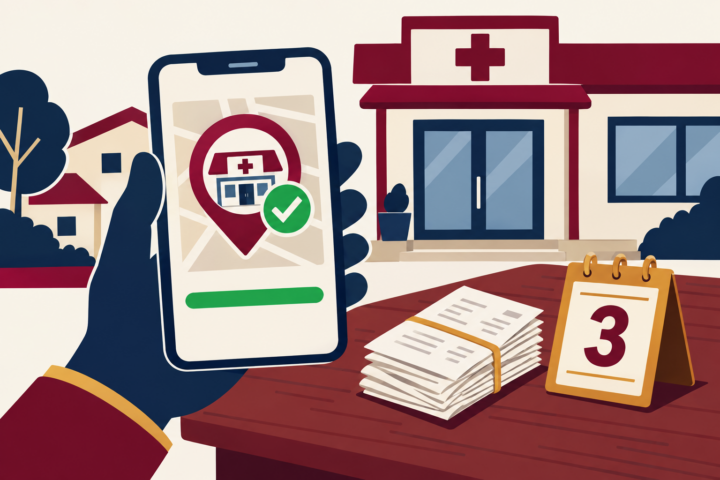
You walk out of a neighborhood clinic after paying about KRW 20,000, and the Silson insurance (실손보험) claim gets pushed to “later”. Photographing the receipt and typing the clinic name and visit date takes a few minutes, and claims left unfiled were estimated at roughly KRW 276 billion a year on average for 2021 to 2023 (a lawmaker’s analysis released in September 2023, reported by Docdocdoc). From October 7 those minutes shrink again. A claim can be completed inside the Naver Map, Naver Pay and Toss apps, and with MyData (마이데이터) consent you no longer type in the clinic, the visit date or your bank account. (As of October 2026 · last updated 2026-10-01)
Bottom line: even after October 7, a paperless Silson insurance claim only works when the clinic or pharmacy you visited is linked to Silson24 (실손24). As of September 28 the linkage rate was 47.7%, a little under half, and visits at an unlinked clinic, or visits that do not show up in the app, still need the old document-based claim. So there are two things to do. When you pick a clinic, check the Silson24 filter in Naver Map first. For the receipts piling up in a drawer, count the three-year deadline and file them on paper now.
What changes on October 7 is that you no longer leave the app
Using Silson24 through Naver and Toss has been possible since November 28, 2025. Back then, though, tapping the button on either platform sent you over to the Silson24 site to finish the claim. The Financial Services Commission (금융위원회) says that from October 7 the claim is completed inside the Naver Map, Naver Pay and Toss apps, and that anyone who consents to MyData no longer needs to enter the medical institution, the visit date, the insurer or the account number (FSC press release, September 30, 2026).
| Date | What became possible |
|---|---|
| 2024-10-25 | Electronic claims through Silson24 start at hospitals with 30 or more beds and public health centers |
| 2025-10-25 | Extended to clinics and pharmacies |
| 2025-11-28 | Silson24 usable through Naver and Toss without installing the app or signing up (redirects to the site) |
| 2026-10-07 | Claim completed inside Naver Map, Naver Pay and Toss, with MyData auto-fill |
Which clinics take a paperless Silson insurance claim, and which still do not
Silson24 is the electronic claims channel run by the Korea Insurance Development Institute (보험개발원). When you are treated at a participating clinic, the bill and receipt, the itemized statement and the prescription are sent from the clinic straight to your insurer, and all you do in the app is pick the visit date and fill in the claim form (Korea.kr policy briefing, October 25, 2024). The catch is that this convenience only works when the clinic is actually linked to Silson24.
As of September 28, 50,340 medical institutions were linked, about 47.7% of the total. Stage-one institutions such as hospitals and public health centers stand at 60.0%, but stage two, which covers neighborhood clinics and pharmacies, is only at 46.7% (FSC press release, September 30, 2026). In other words, the places you visit most often are more likely than not to be unlinked.
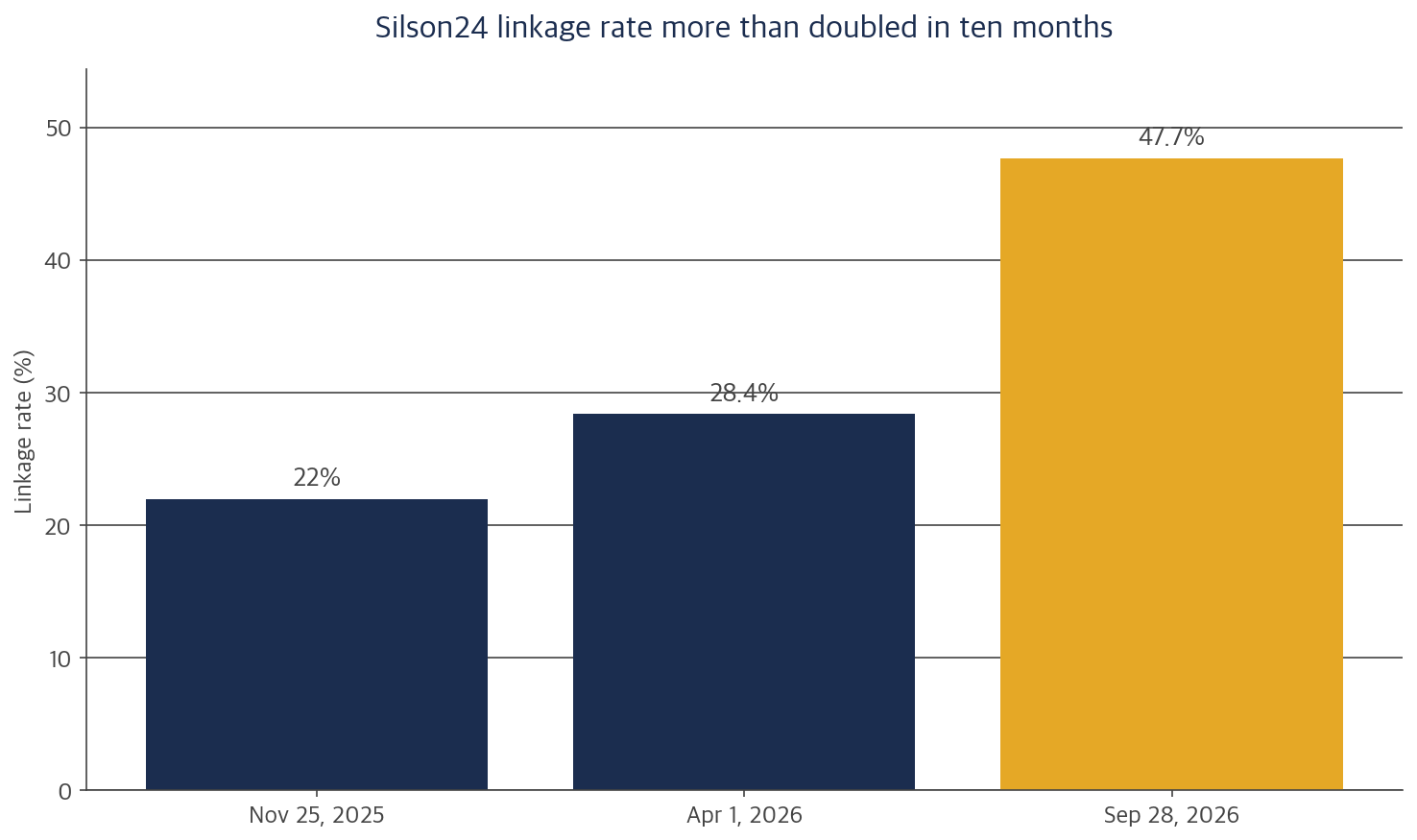
The linkage rate is climbing fast. As the chart above shows, it more than doubled in ten months, and the FSC has set a year-end target of 80 to 90% (FSC press release, November 27, 2025, Newspim, September 30, 2026). For now, though, the first step is still to check whether your clinic is linked.
- Naver Map: with this update, Silson24 clinics carry a banner on their detail page, and a Silson24 filter lets you list only participating clinics.
- Search in Naver Map or Kakao Map: typing “실손24” in the search bar shows participating clinics and pharmacies on the map (Korea.kr briefing on the Silson24 expansion).
- Silson24 app: the “nearby clinics” lookup shows where electronic claims are accepted (Kyunghyang Shinmun, October 25, 2024).
Timing matters as much as linkage. Electronic claims cover visits at participating clinics after the system launched. Visits before the launch, visits to an unlinked clinic, and visits that simply do not show up in the app go the old way: you gather the receipt and itemized statement yourself and file through the insurer’s app, website or fax (KB Kookmin Bank guide to Silson insurance claims). Documents that are not sent electronically, such as a medical certificate, are photographed and attached separately in the app.
| Your situation | How to claim | What to prepare |
|---|---|---|
| Linked clinic, visit after it joined | Electronic claim in Silson24 or inside Naver or Toss | Nothing (with MyData consent the clinic, date and account fill in automatically) |
| Participating clinic, but the visit does not show in the app (for example, before the launch) | Document claim through the insurer’s app, website or fax | Receipt, itemized statement and other documents by amount |
| Unlinked clinic or pharmacy | Document claim through the insurer’s app, website or fax | Receipt, itemized statement and other documents by amount |
| Minor child or elderly parent | Family relationship verified electronically in Silson24; proxy claims allowed | Public MyData link confirms the family relationship |
Claims for children and parents also run through Silson24. For a minor child, the family relationship is verified electronically through the Ministry of the Interior and Safety’s public MyData link, and older people who struggle with the app can have a child or another family member file on their behalf (Korea.kr policy briefing, October 25, 2024). Inside Silson24, two functions handle this (FSC press release on the stage-two expansion).
- My child’s claim: a parent with custody files a minor child’s bills directly from their own app.
- Third-party claim: a child or another person runs the claim on a parent’s behalf. If you check in advance whether your parents’ regular clinic is linked, the burden of claiming drops sharply.
Documents by amount for a paper claim, and how long payment takes
Visits to unlinked clinics are still document claims. Fortunately the General Insurance Association of Korea (손해보험협회) has standardized the paperwork, so what you need depends on the size of the bill (GIAK guide to standardized Silson claim documents). For outpatient visits the lines are KRW 30,000 and KRW 100,000; for hospital stays the line is KRW 500,000. The amount is measured by the receipt total for the same incident.
| Type | Documents required | Notes |
|---|---|---|
| Outpatient, KRW 30,000 or less | Claim form, clinic receipt | Obstetrics, proctology, urology and dermatology are excluded |
| Outpatient, over KRW 30,000 up to KRW 100,000 | Claim form, receipt, prescription showing the disease classification code | Check that the prescription carries the code; obstetrics, proctology, urology and dermatology are excluded |
| Outpatient, over KRW 100,000 | The above plus a medical certificate, outpatient confirmation, treatment confirmation, doctor’s opinion or chart | One document that states the diagnosis is often enough |
| Inpatient | Bill (receipt), itemized statement, medical certificate | Up to KRW 500,000, an admission and discharge confirmation or treatment confirmation stating the diagnosis can replace the certificate |
The clock after you file is also fixed. As a rule the insurer pays within 3 business days of receiving the documents, and if it needs to investigate or verify the claim, it sets an expected payment date, in principle within 30 business days, and tells you (KB Insurance claim guidance). If a week passes with no word at all, the filing probably did not register, so call the insurer.
The two items most often missing from a paper claim are the itemized statement and the prescription. When a visit includes non-covered items, the receipt alone does not show the amount per item, so the insurer asks for the itemized statement, and for outpatient bills above KRW 30,000 a prescription without the disease classification code can lead to a request for paid extra documents such as a medical certificate. The General Insurance Association of Korea advises getting two copies of a prescription with the disease code after treatment. Asking the front desk once for “an itemized statement and two copies of a prescription with the disease code, for a Silson insurance claim” saves a second trip.
The three-year deadline and what a small visit actually pays out
The right to claim insurance money is extinguished if it is not exercised for three years (Commercial Act (상법) Article 662). Where the clock starts depends on the type of event and the policy terms, so the safe order is to file the oldest receipts in the drawer first. No insurer will remind you that three years have passed.
The saying that small visits are not worth claiming is only half true, and the reason is the deductible structure. Fourth-generation Silson insurance, sold since July 1, 2021, has you bear 20% of items covered by National Health Insurance (급여) and 30% of non-covered items (비급여), with a minimum deductible per outpatient visit of KRW 10,000 for covered items (KRW 20,000 at tertiary and general hospitals) and KRW 30,000 for non-covered items (FSC press release on the launch of 4th-generation Silson insurance). Whichever is larger, the percentage or the minimum deductible, is what comes off.
| 4th-generation outpatient example | What you paid | Deductible | Eligible for payment |
|---|---|---|---|
| Clinic, covered treatment | KRW 15,000 | KRW 10,000 (the KRW 10,000 minimum beats 20%, or KRW 3,000) | KRW 5,000 |
| Tertiary hospital, covered treatment | KRW 30,000 | KRW 20,000 (the KRW 20,000 minimum beats 20%, or KRW 6,000) | KRW 10,000 |
| Clinic, non-covered physical therapy | KRW 50,000 | KRW 30,000 (the KRW 30,000 minimum beats 30%, or KRW 15,000) | KRW 20,000 |
| Clinic, covered treatment | KRW 8,000 | KRW 8,000 (the KRW 10,000 minimum exceeds the bill) | KRW 0 |
As the table shows, a cold treated for around KRW 10,000 pays nothing or a few thousand won on a 4th-generation policy, but the sum changes once non-covered items are mixed in or you visited several times for the same illness. If you hold a 1st, 2nd or 3rd-generation policy, the co-payment rate and deductible differ by policy, so check your generation and deductible terms in the policy document or the insurer’s app first. Judge whether a claim is worth it by the bundle of visits for one illness, not by a single receipt.
Fifth-generation Silson insurance, launched on May 6, changed the non-covered side considerably (FSC press release on the launch of 5th-generation Silson insurance).
- Covered inpatient care: the current 20% co-payment is kept.
- Non-severe non-covered care: the co-payment rises from 30% to 50%, and the coverage limit falls from KRW 50 million to KRW 10 million.
- Excluded from coverage: musculoskeletal physical therapy such as manual therapy, shockwave therapy and non-covered injections are excluded from 5th-generation coverage altogether.
Switching is optional for existing policyholders, not mandatory, so keep the question of claim convenience separate from the question of switching. If you hold a 1st or 2nd-generation policy taken out before March 2013, also compare the optional discount rider and the switching discount scheduled to start in November.
What to do now, depending on where you stand
I see no reason to wait for October 7. The convenience of finishing a claim inside the app only exists at linked clinics, and the linkage rate is still under half. File on paper now whatever can be filed now, and from October 7 add linkage to your list of criteria when choosing a clinic. That is how you get the most back from Silson insurance. By situation, it breaks down like this.
- If you have a clinic visit coming up this month: turn on the Silson24 filter in Naver Map and pick a linked clinic. If two similar clinics sit in the same neighborhood, the linked one costs you nothing to claim from. Give your MyData consent in advance, and from October 7 the clinic, date and account fields disappear.
- If receipts are piling up in a drawer: do not wait for the app integration, file them on paper now. Visits before the launch or at unlinked clinics are not eligible for electronic claims anyway, and the three-year clock does not stop because the app got easier. Group receipts by illness and prepare them by the document table above, and it is done in one go.
- If you handle medical bills for a child or parent: Silson24 verifies the family relationship electronically, so claim your child’s bills from your own app and file your parents’ as a proxy. Checking whether your parents’ regular clinic is linked comes first.
- If you are a salaried employee heading into year-end tax settlement (연말정산): money you got back from Silson insurance is excluded from the medical expense tax credit. The National Tax Service (국세청) says the amount received is subtracted from the medical expenses of the year that gave rise to the payout, so a payout received this year for last year’s visits comes off last year’s medical expenses. You check the payout history on Hometax (홈택스) and reflect it (NTS call center guidance on the medical expense credit). The full list of items is in 15 essential year-end tax deductions.
Three variables are worth watching.
- The year-end linkage rate: the FSC’s target is 80 to 90%, and the closer it gets, the less you need to choose clinics by linkage.
- An amendment to the Insurance Business Act: it would allow fines on unlinked medical institutions and electronic medical record vendors. The FSC says it will pursue this only if voluntary cooperation proves insufficient to raise the linkage rate, so it is at the review stage. It has not been submitted to or passed by the National Assembly, and until the law changes, unlinked clinics stay unlinked.
- Payouts you receive this year for visits in earlier years: that money must be subtracted from the medical expenses of the year you paid the bill, so if you already took the medical expense credit for that year, you need to file an amended return. The NTS says no penalty applies if you amend by the comprehensive income tax filing deadline of the year you received the payout (NTS call center guidance on the medical expense credit).
The common misjudgment is to think that because Naver and Toss now handle it, paperwork disappears at every clinic. What moved into the app is the claim counter, not the clinic’s documents. The clinic still sends the paperwork, and if it is not linked, no visit shows up on your claim screen. The opposite error is to let receipts pile up because “small amounts never pay out”. Whether a claim pays is decided by whether the bill clears the minimum deductible, not by the size of one receipt, and now that claiming costs close to nothing, anything that clears it is worth filing.
It also helps to decide in advance where the Silson insurance payout goes. Medical bills are unplanned spending, so if you set the payout account as your emergency fund, you pay the next bill from that account and the payout refills it. Which card to pay the clinic with is covered separately in credit card versus debit card in Korea.
The closer the claim counter gets, the more the clinic matters
The October 7 change keeps the claim inside your app; it does not remove the clinic’s paperwork. The habit of checking whether your clinic is linked will return more Silson insurance money than any app.
- From October 7 a Silson insurance claim is completed inside Naver Map, Naver Pay and Toss, and with MyData consent the clinic, date and account fields disappear.
- Paperless claims apply only to visits at Silson24-linked clinics after the system launched; the linkage rate was 47.7% as of September 28.
- For unlinked clinics, prepare documents by the KRW 30,000 and KRW 100,000 outpatient lines and the KRW 500,000 inpatient line; payment within 3 business days of filing is the rule.
- The right to claim expires after three years, and 4th-generation policies pay only the part above the minimum deductible (KRW 10,000 covered, KRW 30,000 non-covered).
- Silson insurance payouts are subtracted from the medical expense tax credit at year-end settlement.
Related reading
- 15 Essential Tax Deductions You Can’t Afford to Miss: Year-End Checklist
- Credit Card vs Debit Card 2026: A Smart & Easy Comparison Guide
- How Much Emergency Fund Do You Really Need?
Disclaimer: This article is for information and education only and does not recommend buying, switching or selling any insurance or financial product. Silson24 linkage figures and the Naver and Toss schedule are as of the Financial Services Commission’s September 30, 2026 press release; claim documents, deductibles and payment deadlines vary by insurer, policy terms and policy generation. Before filing, check your insurer’s policy terms and the guidance from the Financial Services Commission, the General Insurance Association of Korea and the National Tax Service. All decisions are your own responsibility.