
Put in KRW 100 million and KRW 1.25 million lands in your account every month. That is the usual pitch for a monthly dividend ETF (월배당 ETF) in Korea advertising a 15% annual distribution rate. Covered-call products of this kind now make up 35.8% of the net assets of distribution-paying ETFs listed here (Dealsite report), and since September 30 the Financial Supervisory Service (금융감독원, FSS) has required newly launched covered-call funds to state their key risks in the registration statement. The cash in your account and the money you actually made are not the same number. (※ As of October 2026 · Last updated 2026-10-06)
Bottom line: the distribution rate of a monthly dividend ETF tells you how much cash arrives each month, not what you earned, so judge it by total return, meaning after-tax distributions plus the change in price. On KRW 100 million at a 15% rate, a fully taxed distribution leaves KRW 1,057,500 a month, and a price drop of more than about 12.7% over a year puts you at a loss even after collecting every payment. Once interest and dividends, distributions included, pass KRW 10 million a year, health insurance premiums apply for a regional subscriber, and once financial income passes KRW 20 million, comprehensive taxation applies, so the account you hold the fund in changes the outcome again.
Why rerun the numbers on a monthly dividend ETF now
Korea now lists 62 covered-call ETFs with KRW 28.8203 trillion in net assets, the largest group among ETFs that pay distributions (Dealsite’s count, based on the past year of distribution records). On top of that, the way risk is disclosed changed on September 30.
- Registration statements for new products: Under the Fund Key Risk Standard (펀드 핵심위험 표준안) the FSS released on August 25, a manager launching a fund in one of 10 types, covered-call included, must state one principal-loss risk and up to three product-specific risks in the registration statement.
- Products already listed stay as they are: The standard applies to products launched after the effective date (Newspim report, in Korean). The prospectuses of monthly dividend ETFs already trading are not rewritten all at once, so for existing products the math and the checking are up to the investor.
Monthly dividend ETF on KRW 100 million: after-tax payout by distribution rate
In an ordinary brokerage account, a distribution (분배금) counts as dividend income. The withholding rate on dividend income is 14% according to the National Tax Service (국세청, NTS), and with local income tax added the financial institution takes 15.4% before paying you (Samsung Asset Management ETF tax guide, in Korean). The table assumes KRW 100 million in a monthly dividend ETF and a distribution that is taxed in full.
| Annual distribution rate | Annual distribution (pre-tax) | Monthly distribution (pre-tax) | Monthly payout (after tax) | Line the annual distribution reaches |
|---|---|---|---|---|
| 4% | KRW 4 million | KRW 333,333 | KRW 282,000 | Below KRW 10 million |
| 6% | KRW 6 million | KRW 500,000 | KRW 423,000 | Below KRW 10 million |
| 10% | KRW 10 million | KRW 833,333 | KRW 705,000 | Reaches KRW 10 million |
| 15% | KRW 15 million | KRW 1,250,000 | KRW 1,057,500 | Above KRW 10 million |
| 20% | KRW 20 million | KRW 1,666,667 | KRW 1,410,000 | Reaches KRW 20 million |
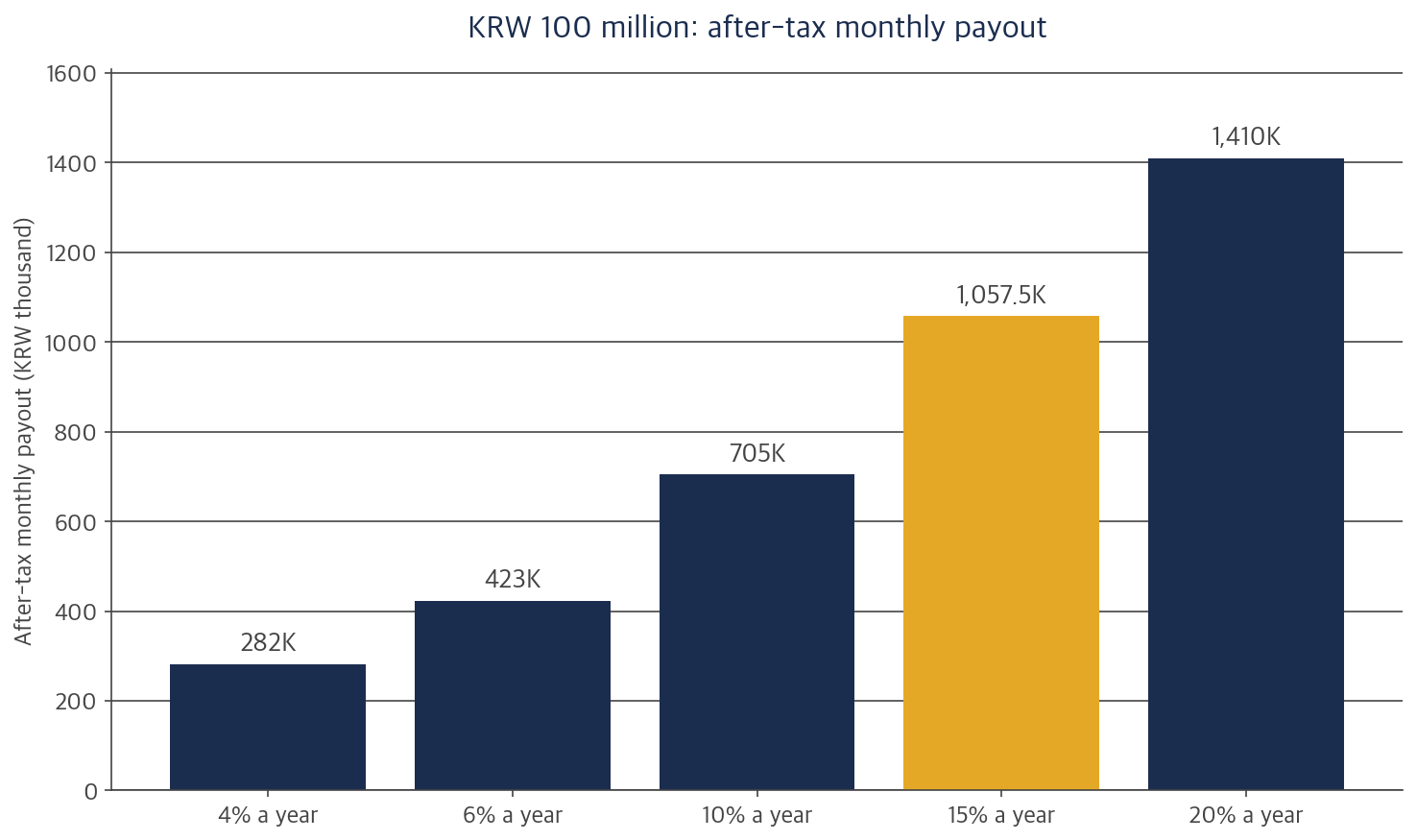
These after-tax figures are the heaviest-tax case. The KRW 10 million and KRW 20 million lines in the last column are where health insurance premiums and comprehensive taxation begin, and the account comparison below covers them. Tax differs with what the product invests in, and there is more than one way to compute a distribution rate (분배율).
- Domestic-equity covered-call funds can have a smaller taxable amount: For a product run with Korean stocks and Korean exchange-traded options, option premium income is tax-exempt, so the 15.4% applies only to the smaller of the distribution and the increase in the taxable base price (과표기준가) (Samsung Asset Management notice, in Korean). The taxable share can still rise from January to March and at quarter-ends, when stock dividends come in, and in some months the whole distribution can be taxed.
- Funds holding overseas assets are taxed when you sell, too: For any Korea-listed ETF that is not a domestic-equity fund, the gain on sale is also treated as dividend income and 15.4% is withheld. The tax gap between a Korean listing and buying directly in the US is laid out in US ETF from Korea: Korean listing or direct.
- Managers do not compute the distribution rate the same way: Some divide the per-share distribution by the closing price on the day before the ex-distribution date, others by net asset value (NAV) on a given day (IB Tomato report, in Korean). To compare products, divide the last 12 months of per-share distributions by the current price so the basis matches. To see your own yield, divide by your purchase price.
Why the distribution rate is not a return: ex-distribution drops and price moves
A distribution is not money that appears from outside. It leaves the net assets of the ETF. The reduction in net assets by the amount paid out is called the ex-distribution drop (분배락) (Mirae Asset Investment and Pension Center, in Korean). That is why the performance of a monthly dividend ETF has to be read as total return: distributions received plus the change in price.
It also matters that the rate is not measured against the money you put in. In a 2024 consumer alert, the FSS said the distribution rate is the distribution relative to NAV on the record date, so it has nothing to do with an investor’s principal, and that the rate written into a product name is only the manager’s target (Edaily report, in Korean). At the same monthly rate of 1.25%, a share priced at KRW 10,000 pays KRW 125, and at KRW 8,000 it pays KRW 100.
The next table puts KRW 100 million into a monthly dividend ETF with a 15% annual distribution rate and looks one year ahead. To keep it simple, it assumes KRW 15 million was paid on the original principal, leaving KRW 12.69 million after tax.
| Price change over the year | Value after one year | After-tax distributions | After-tax total return |
|---|---|---|---|
| +5% | KRW 105 million | KRW 12.69 million | +KRW 17.69 million (+17.69%) |
| 0% | KRW 100 million | KRW 12.69 million | +KRW 12.69 million (+12.69%) |
| -10% | KRW 90 million | KRW 12.69 million | +KRW 2.69 million (+2.69%) |
| -12.69% | KRW 87.31 million | KRW 12.69 million | KRW 0 |
| -20% | KRW 80 million | KRW 12.69 million | -KRW 7.31 million (-7.31%) |
A price drop of about 12.7% cancels a full year of after-tax distributions. In practice the payout shrinks along with the price, so the real result is worse than the table. In an ordinary account the tax is taken each time a distribution is paid, which means it stays paid even if the position later ends at a loss.
A covered-call monthly dividend ETF adds a structural asymmetry. When the underlying asset rises, the upside is capped. When it falls, the option premium cushions only part of the loss and the downside is not limited. In the words of the FSS, the distribution is the price paid for giving up the rise in the underlying asset (Etoday report, in Korean). For covered-call ETFs launched after September 30, these points appear among the key risks in the registration statement (Newspim report, in Korean).
- The target distribution rate is not a fixed return: The manager must state that the actual rate can fall short of the target depending on how the fund performs.
- Capped on the way up, exposed on the way down: Gains are limited when the underlying price rises and losses occur when it falls, and this goes in as a key risk.
- Past loss history: If the same manager’s products of the same type have lost more than 20%, that case must be disclosed. For open-ended products such as ETFs, the yardstick is maximum drawdown (MDD), the fall from the highest point to the lowest point after it.
Monthly dividend ETFs that were already listed carry no such section. What you can do today is pull the price history and the distribution record from the manager’s product page and fill in the table above yourself.
The same distribution leaves different amounts depending on the account
Distributions received in an ordinary account are added to interest and counted as financial income. Each time the annual total crosses a certain amount, one more cost is added.
| Annual line | What happens above it | Who it applies to |
|---|---|---|
| Interest and dividends of KRW 10 million | Health insurance premiums are charged on all interest and dividend income for that year | Regional subscribers (지역가입자), such as retirees |
| Financial income of KRW 20 million | The excess is combined with other income under comprehensive taxation (종합과세) | All investors |
| Non-salary income of KRW 20 million | An additional premium at the 7.19% health insurance rate on the excess | Employee subscribers (직장가입자) |
| Combined income of KRW 20 million | The income requirement for dependent status is no longer met | Dependents (피부양자) |
The sources, in order, are the Mirae Asset Investment and Pension Center, the NTS guide to financial income, and the National Health Insurance Service (국민건강보험공단, NHIS) pages on the premium on non-salary income and the dependent criteria (all in Korean). The health insurance rate for 2026 is 7.19%. For employee subscribers too, interest and dividends are left out of non-salary income when they total KRW 10 million or less.
Set this beside the payout table. On KRW 100 million, a 10% rate produces KRW 10 million a year, so even a little deposit interest pushes you over the first line. At 20%, distributions alone reach KRW 20 million. An employee subscriber with KRW 24 million of non-salary income pays about KRW 23,967 more a month in health insurance on the KRW 4 million excess (the long-term care insurance premium is charged on top). A different account changes this picture.
- Ordinary account: 15.4% is withheld on every distribution, and every line in the table applies.
- ISA: Gains and losses inside the account are netted, the first KRW 2 million is tax-free under the general type (KRW 4 million under the low-income type, 서민형), and the rest is taxed separately at 9.9% (BNK Securities guide, in Korean). Separately taxed financial income that meets the legal requirements is excluded from comprehensive taxation. The constraints are a 3-year mandatory holding period and a contribution limit of KRW 20 million a year. Anyone who was subject to comprehensive financial income taxation in any of the previous three tax years cannot open or extend an ISA (Mirae Asset Securities ISA guide, in Korean).
- Pension savings (연금저축) and IRP: No tax is taken when a distribution comes in. When you draw a pension, pension income tax of 3.3% to 5.5% applies depending on your age. Pension income drawn from these accounts is not charged health insurance premiums, and when pension income exceeds KRW 15 million a year it is combined with other income, though a flat 16.5% rate can be applied instead (Mirae Asset Investment and Pension Center, in Korean). Taking money out early changes the tax, so check what early withdrawal from a tax-advantaged account costs first.
Do not count on the separate taxation of dividends from high-dividend companies, which began this year, for a monthly dividend ETF. The rule runs temporarily for dividends paid from 2026 through 2028 and is limited to dividends from listed companies that meet the requirements. Dividends from ETFs and REITs are excluded (Nongmin Shinmun report, in Korean). The requirements are covered in Dividend Investing in Korea 2026.
How to decide on a monthly dividend ETF in your situation
I think the right way to see a monthly dividend ETF is as a product that converts returns into monthly cash, not one that pays extra returns. Distributions come out of net assets, and a high covered-call distribution rate is the price of giving up the upside. So the order of questions is whether you need cash now, then how much is left after tax, and only then the distribution rate.
The common misjudgment is “if I only spend the distributions, my principal stays intact.” Net assets fall by each payout, and the rate is then applied to that smaller base, so when the price drops, principal and distributions shrink together.
If you are still building assets: ask whether you need the cash at all
If you are saving out of a salary and have no use for the payouts, a high distribution rate in an ordinary account means paying tax early. Only what is left after the 15.4% gets reinvested. If the plan is to reinvest distributions anyway, holding the monthly dividend ETF in an ISA or a pension account and pushing the tax back fits the arithmetic better. The conditions for each ISA type are in ISA account types in Korea.
If you need monthly cash: work backward from the amount
Start from the living cost you need, not from the distribution rate. To receive KRW 1 million a month after tax, you need about KRW 1,182,000 a month before tax on a fully taxed basis, or roughly KRW 14.18 million a year in distributions. That is above the KRW 10 million line for interest and dividends, so a regional subscriber has to subtract health insurance premiums as well.
I would begin with the lowest distribution rate that still covers the amount you need. The higher the rate, the larger the share taken out of net assets and the more upside is given up.
If you already hold a high-payout product: compute total return first
Add the after-tax distributions received over your holding period to the current unrealized gain or loss. The distribution deposit history in your brokerage app and your purchase price are all you need. Compare that total return with the return over the same period of a product that tracks the same underlying asset without options. Whether you can accept the gap as the price of monthly cash is the test for keeping or adjusting the position.
If your financial income is near KRW 10 to 20 million: add it up before December
First total the interest and distributions received since January. If you are on course to cross a line, direct new money into an ISA or a pension account, and use the table above to see which line the monthly dividend ETF payouts in your ordinary account will reach. For a regional subscriber the KRW 10 million line comes first, so health insurance has to be calculated before tax. A dependent should check whether total income, with other income included, exceeds KRW 20 million.
Before you route money into an ISA, check that you qualify. A single year with financial income above KRW 20 million blocks you from opening or extending an ISA for the following three tax years. If this year’s total is close to KRW 20 million, that is one more reason to check before you cross the line. If you were already subject to comprehensive taxation in the last three years, look at a pension account before an ISA.
Dates and variables to watch
- December 31: The KRW 20 million test for financial income uses the total an individual receives over the calendar year. Add up every distribution actually deposited from January through December of this year.
- Every November: Premiums for regional subscribers are calculated on new income and property data from November of each year through October of the next. Higher distributions show up in premiums with a lag.
- January to March and quarter-ends: Domestic-equity covered-call products can see the taxable share of their distributions rise in these periods, so the after-tax payout can be smaller than usual.
- The year-end tax review in the National Assembly: The government’s tax reform plan released in September includes a Productive Finance ISA (생산적금융 ISA) that invests in Korea-listed stocks, equity funds and ETFs and exempts all interest and dividend income (Samsung Securities guide, in Korean). Under the proposal, Korea-listed ETFs that hold overseas assets cannot go into this account, so a monthly dividend ETF built on overseas assets is not eligible. It is a government proposal that becomes final only if the National Assembly passes it, so leave it out of your plan until then. The stages are tracked in Productive Finance ISA in Korea.
Choose by after-tax total return, not by distribution rate
Money arriving every month is easy to see. Shrinking net assets and tax already withheld are not. Put after-tax total return and your account type ahead of the distribution rate when choosing a monthly dividend ETF, and the same KRW 100 million leaves a different amount in your hands.
- At a 15% distribution rate, KRW 100 million pays KRW 1,057,500 a month after tax when the distribution is taxed in full.
- A price drop of about 12.7% over a year cancels the full KRW 12.69 million of after-tax distributions.
- In an ordinary account, distributions added to interest reach the health insurance line for regional subscribers at KRW 10 million a year and the comprehensive taxation line at KRW 20 million.
- Covered-call ETFs launched from September 30 state their key risks in the registration statement, but an existing monthly dividend ETF has to be checked by hand.
Related reading
- Essential Dividend Investing in Korea 2026: New Tax Rules
- US ETF From Korea: Buy the Korean Listing or Go Direct? The KRW 8.33 Million Line and Your Tax Bracket
- Tax-Advantaged Account Withdrawals in Korea: What Closing an ISA, Pension Savings or IRP Early Costs
Disclaimer: This article is for information and education only. It does not solicit the purchase or sale of any ETF or financial product and does not recommend any specific product. The after-tax and total-return tables are examples that assume a fully taxed distribution and a fixed price change, and actual distributions and taxable amounts vary by product and period. Tax rates and health insurance criteria are as of October 6, 2026, so check the manager’s prospectus and the guidance of the National Tax Service and the National Health Insurance Service before investing. ETFs can lose principal, and every decision is your own responsibility.