How much money did it take to win one extra share in a Korean IPO that pulled in KRW 6.7 trillion of deposits? A KOSDAQ offering that took orders on October 1 and 2 closed at 1,741 to 1 (Newspim report, in Korean), and the arithmetic says one share through proportional allotment needed a deposit of about KRW 21.42 million. Meanwhile, people who put in only the minimum were still set to receive one or two shares through equal allotment. With some 20 companies opening an IPO subscription (공모주 청약) this month and one broker now paying interest on the money you park, the right amount to put in starts from that calculation. (※ As of October 2026 · Last updated 2026-10-03)
Bottom line: in a Korean IPO subscription, the default is to apply for the minimum quantity and take the equal allotment, and to add money for proportional allotment only when the price of one share, “offer price × proportional ratio ÷ 2”, is an amount you can comfortably tie up. The new deposit interest comes to roughly KRW 1,000 before tax on KRW 20 million held for three days, less than the KRW 2,000 online subscription fee. Treat the interest as a small bonus. It is no reason to put more money into an IPO.
October’s IPO subscription calendar: the one new variable is deposit interest
About 20 companies take retail orders in October, and several IPO subscription windows overlap in the week around October 20 (Point Daily report, in Korean). The allotment rules are unchanged. What is new is interest on the subscription deposit (청약증거금).
- One broker moved first: Daishin Securities (대신증권) pays 1% a year on the first KRW 1 million of a deposit and 0.6% on the rest, starting with offerings whose registration statement was filed on or after September 21 (Bizwatch report, in Korean).
- The industry-wide rule is still under discussion: the Financial Services Commission (금융위원회, FSC) said in its second-half work plan in July that it would change the rules, and the details are being worked out through the Korea Financial Investment Association (금융투자협회) (Money Today report, in Korean). No standard applying to every broker has been set.
Equal and proportional allotment: how an IPO subscription decides your share count
The shares set aside for retail investors are split two ways. At least half goes through equal allotment (균등배정), which gives the same chance to everyone who paid at least the minimum deposit. The rest goes through proportional allotment (비례배정), in line with the quantity each person applied for (FSC press release, in Korean). One application enters you in both pools, and the size of your deposit only changes your proportional share.
| Item | Equal allotment | Proportional allotment |
|---|---|---|
| Pool | At least half of the retail tranche | What remains after the equal pool |
| Divided by | Number of applicants (applications) | Quantity applied for |
| Deposit needed | Minimum quantity × offer price × 50% | Per share: offer price × proportional ratio × 50% |
| Number that drives the result | Application count | Proportional competition ratio |
Your equal allotment is the equal pool divided by the number of applications. In the offering above, the equal pool (half of the 625,000-share retail tranche) was divided among 254,009 applications, and the equal allotment worked out to 1.23 shares per application (CBC News report, in Korean). That means every applicant gets one share, and the leftover shares go to some applicants by lottery, one more each. When applications outnumber the equal pool, even the first share is handed out by lottery (in Korean), and those who miss out receive nothing.
Four rules are worth knowing before your first IPO subscription.
- The deposit rate is 50%: you pay half of the order value (quantity × offer price) when you apply. Ten shares at an offer price of KRW 20,000 take a deposit of KRW 100,000.
- One person, one broker: if you apply for the same IPO at several brokers, only the first application received counts. When an offering has several underwriters, pick one.
- Open the account early: depending on the broker and on how you open the account, it must exist by the day before the subscription opens. Shinhan Securities (신한투자증권) needs an account opened at a branch by the day before the subscription starts, while an account opened online (through the app, for example) can be opened up to the closing day (in Korean).
- Your ceiling depends on your customer tier: the maximum quantity you may apply for differs by tier. Samsung Securities (삼성증권) sets it at 50%, 100% or 200% of the standard limit.
The deposit for one proportional share: offer price × proportional ratio ÷ 2
The number of shares you get through proportional allotment is the quantity you applied for divided by the proportional competition ratio. To receive one share you must apply for as many shares as that ratio, and you only deposit half of the order value. So the deposit needed for one proportional share is “offer price × proportional ratio ÷ 2”.
The proportional ratio is not the number in the headlines. Headlines quote the overall ratio: total shares applied for divided by the whole retail tranche. When the tranche is split half and half, the proportional pool is half the size, so the proportional ratio is twice the overall ratio. In the offering above, the overall ratio was 1,741.48 to 1 and the proportional ratio was 3,482.96 to 1.
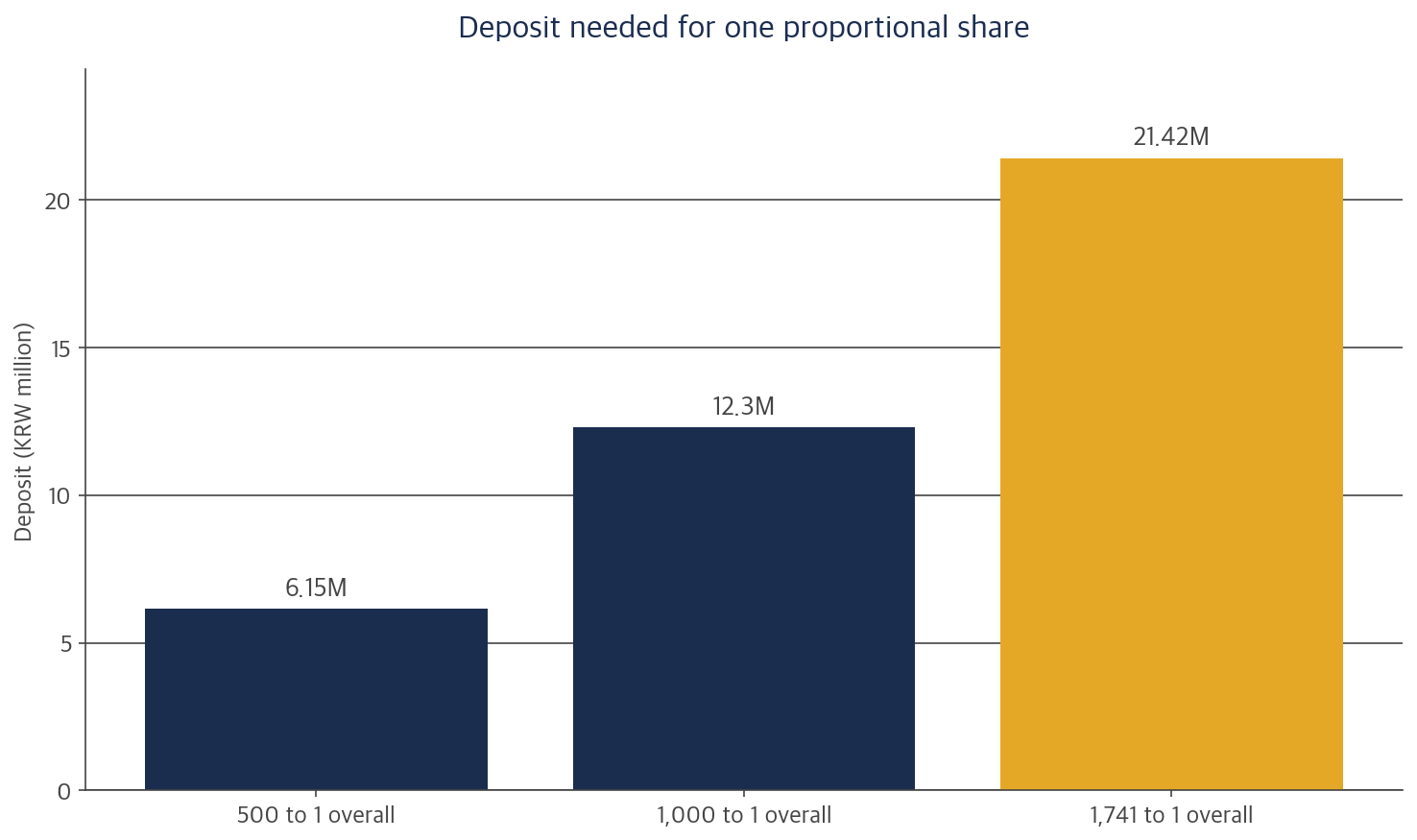
With real numbers it looks like this. At an offer price of KRW 12,300 and a proportional ratio of 3,482.96 to 1, one share requires an application for 3,483 shares. The deposit is half of that order, about KRW 21.42 million. Even KRW 40 million would not reach two shares on paper. In the same IPO subscription, people who applied for the minimum were set to receive one or two shares through equal allotment (1.23 shares per application), so per won deposited the equal pool was far more efficient.
The formula is most useful on the closing day of an IPO subscription. Put the competition ratio the lead manager publishes during the subscription window into it, and you can see at once whether the amount you have in mind buys one proportional share. Keep in mind that the result is a figure on paper. How fractions below one share are handled follows the allotment rules in each offering’s prospectus (투자설명서).
The interest is smaller than the fee: how long the money is tied up and what it costs
In an IPO subscription, your deposit is locked from the day you apply until the refund date. Refunds usually arrive within two business days after the subscription closes. Holidays stretch that. The offering above closed on Friday, October 2, and with the weekend and the substitute holiday on October 5 in between, refund and payment fall on October 7. Even money put in on the closing day waits five calendar days.
Here is the interest for that wait at the rates Daishin Securities announced: 1% a year up to KRW 1 million and 0.6% a year above it, calculated daily on a 365-day basis, before tax.
| Deposit | Interest for three days | Interest for five days |
|---|---|---|
| KRW 100,000 | KRW 8 | KRW 14 |
| KRW 20 million | KRW 1,019 | KRW 1,699 |
| KRW 100 million | KRW 4,964 | KRW 8,274 |
Set that against the money going out over the same days and the size of the interest becomes clear. The interest rates below are assumptions for the calculation.
- IPO subscription fee: Daishin Securities, the broker paying the interest, also charges KRW 2,000 per online application and does not charge customers who receive no shares. At Shinhan Securities, the standard tier likewise pays KRW 2,000, waived if you receive no shares, and higher tiers pay KRW 1,000 or nothing.
- Interest you give up: moving KRW 20 million out of an account paying 2% a year for five days forgoes about KRW 5,479 before tax.
- Interest on borrowed money: borrowing KRW 20 million at 5% a year for five days costs about KRW 13,699.
- Tax when you sell: for sales from January 1, 2026, you pay 0.20% of the sale amount. On KOSPI that is a 0.05% securities transaction tax plus a 0.15% special rural tax, and on KOSDAQ a 0.20% securities transaction tax. Gains a minority shareholder makes selling listed shares on the exchange carry no capital gains tax (large shareholders excepted).
Nothing guarantees the shares will rise either. On the first trading day the price can move between 60% and 400% of the offer price. For an offer price of KRW 12,300, that is a range of KRW 7,380 to KRW 49,200. The stock can trade 40% below what you paid, so the more shares you receive, the larger the possible loss.
If you plan an IPO subscription this month, here is how to move
I would keep equal allotment as the default this month too, and add money for proportional allotment only after working out the price of one share. Even with deposit interest, KRW 1,019 on KRW 20 million does not cover a single fee, and so far the interest applies only to some offerings at one broker. The common misjudgment is “interest is paid now, so a bigger deposit can only help.” The interest is smaller than what the same money earns sitting in a bank account, and if the stock falls below the offer price, the loss grows with every share you hold.
First-time subscribers: the account and the minimum quantity
Find out which broker is the lead manager (주관사) for the offering and open the account first. Some brokers and channels require it by the day before the subscription opens, so the first day can be too late. The minimum quantity is enough for a first IPO subscription. The deposit runs from tens of thousands to a few hundred thousand won, and in the equal pool you stand in the same line as someone who put in a fortune. Check the fee in advance, and whether it is waived when you receive nothing.
Spare cash aimed at proportional allotment: the one-share price and the refund date
Use the closing-day ratio to price one share and see how many shares your amount buys. If one share costs more than KRW 20 million, weigh that against what the money gives up while it is locked. If it comes out of a parking account, the interest for those days is your cost. In the crowded week around October 20, check refund dates too. If the refund from one subscription lands after the next one closes, the same money cannot go into both.
Borrowing through a loan or overdraft: at a high ratio, the interest exceeds the share
I would not borrow to chase proportional allotment. As calculated above, borrowing KRW 20 million for five days costs about KRW 13,699 in interest, and at a ratio like 1,741 to 1 that deposit buys less than one share with an offer price of KRW 12,300. The interest is larger than the share itself. At a lower ratio you receive more shares, but the interest is paid all the same. Add the fact that the first-day price can drop to 60% of the offer price, and an IPO subscription on borrowed money does not add up.
Subscribing as a family: one equal chance per person
Equal allotment divides by headcount, so when family members each apply through an account in their own name, the household gets one equal chance per person. An account in a minor child’s name can apply as well. Money you put into a child’s account for the deposit can count as a gift, though. The steps for opening one are in the child account guide, and the deduction limits are in the gift tax guide for a child’s account.
Numbers to check before applying, and what to watch next
How much to deposit is one question. Whether the IPO is worth receiving at all is another, and the prospectus and the institutional book-building results answer that one. For reading an offer price against the company’s value, the guide to PER, PBR and ROE covers the basics.
- Lock-up commitment ratio (의무보유 확약): the share of institutional orders that promised not to sell for a set period. Introduced in July 2025, the rule now requires at least 40% of the institutional tranche to be allotted first to institutions that commit, for offerings filed on or after January 1, 2026 (both in Korean).
- Registration statement filing date (증권신고서 제출일): deposit interest applies to companies that filed on or after September 21. The filing date is listed on the Korea Exchange KIND page for companies in the offering process (in Korean).
- The regulator’s rule change: the FSC is reviewing how to apply a customer deposit usage fee (예탁금 이용료) to subscription deposits, including an amendment to the Capital Markets Act. Once a rate and scope are set, the interest math will change. The money is still locked for only a few days, so even at several times the rate, the decision turns on the one-share price and the price risk.
- Other brokers joining: watch each broker’s notices to see whether more of them start paying interest. With a single lead manager you cannot choose the broker. With several you can take interest into account, but the amount is on the scale of the fee and not enough to change the decision.
Set your amount by the one-share price, not by the competition ratio
A headline about a sky-high ratio sounds like a signal to put in more, but the arithmetic points the other way. The higher the ratio, the more one proportional share costs, and the better the minimum application does through the equal pool. For any IPO subscription in Korea, let the one-share price you calculate yourself decide the amount, not the ratio in the news.
- The deposit for one proportional share is offer price × proportional ratio ÷ 2, and the proportional ratio is twice the overall ratio.
- In an IPO subscription at 1,741 to 1 with an offer price of KRW 12,300, one proportional share cost about KRW 21.42 million, while minimum applicants were set to receive one or two shares through equal allotment.
- Deposit interest on KRW 20 million held for three days is KRW 1,019 before tax, less than the KRW 2,000 online fee.
- The first-day price can range from 60% to 400% of the offer price, so losses are possible, and at a ratio like 1,741 to 1 the interest on borrowed money exceeds the value of the shares received.
Related reading
- Parking Account in Korea: Why an 8% Rate Earns About 2.6% on KRW 10 Million, and When a CMA or Parking ETF Fits
- Child Account in Korea 2026: Essential ISA & Gift Tax Guide
- PER, PBR, ROE Explained: 6 Essential Valuation Metrics for Smarter Stock Analysis (2026)
Disclaimer: This article is for information and education only. It does not recommend subscribing to, buying or selling any specific IPO or broker product, and it does not recommend any specific product. Competition ratios, offer prices and deposit interest rates reflect news reports and broker guidance up to October 3, 2026, and the interest and cost figures are illustrations. Allotment rules, fees and refund dates differ by offering and by broker, so check the prospectus on the Financial Supervisory Service’s electronic disclosure system (DART) and the lead manager’s notices yourself before applying. IPO shares can fall below the offer price after listing and you can lose principal. All decisions are your own responsibility.