
Is there an old housing subscription passbook somewhere in your home, one that a parent opened in the early 2000s, or one your Korean spouse paid into for a few years and then forgot? The cheongyak conversion window that lets those legacy accounts become today’s comprehensive housing subscription savings (주택청약종합저축) closes on September 30, 2026. And with two weeks to go, a news report says the deadline may be pushed back another year. (※ As of September 2026 · Last updated 2026-09-17)
In short, if you plan to use that account to apply for housing at any point, finish the cheongyak conversion before September 30 regardless of the extension report. The extension is, for now, a request that the Korea Housing and Urban Guarantee Corporation (HUG, 주택도시보증공사) has sent to the Ministry of Land, Infrastructure and Transport (국토교통부) for approval.
Even if it is granted, the terms of conversion will not get better. The one exception runs the other way: a cheongyak savings account you intend to transfer to a child or spouse, whenever it was opened, or a cheongyak deposit or installment account opened before March 26, 2000 with the same plan, should not be converted, because the comprehensive savings account can only change hands through inheritance after the holder’s death.
Where the cheongyak conversion deadline and the extension report actually stand
Korea’s housing subscription system (청약) allocates new apartments to holders of a qualifying savings account. Three legacy accounts, cheongyak savings (청약저축) for national housing (국민주택, publicly supplied units) and cheongyak deposits (청약예금) and installment savings (청약부금) for private housing (민영주택), stopped taking new sign-ups in September 2015. Since October 2024 the government has let holders convert them to the comprehensive housing subscription account, and after a one-year extension last year the window closes on September 30, 2026. Where things stand fits in three lines.
- A further extension is only reported: HUG has asked the ministry to approve another one-year extension, but as of September 16 there is no ministry approval, no new deadline and no bank notice.
- The official deadline is September 30, 2026: the government’s policy weekly Gonggam (공감) and bank notices such as KB Kookmin Bank’s and Toss Bank’s show this date.
- The decision may come at the last minute: last year the bank notice appeared only five days before the deadline, and nothing guarantees an extension this year.
So rather than wait on the extension, first work out which of the situations below describes your account.
What a cheongyak conversion changes, and what it keeps
The core change is scope. After converting, a deposit or installment holder can also apply for national housing, and a cheongyak savings holder can also apply for private housing. A higher interest rate comes with it, and for deposit and installment holders the income deduction opens up for the first time. In exchange, a converted account cannot be switched back to the old product, and the rules on changing the account holder become those of the comprehensive account.
| Item | Cheongyak deposit / installment (before) | Comprehensive savings (after cheongyak conversion) |
|---|---|---|
| Housing you can apply for | Private housing only | Both private and national housing |
| Interest rate | Around 1.8 to 2.4 percent a year | 3.1 percent after two years (2.3 percent under one year, 2.8 percent for one to two years) |
| Income deduction | None | 40 percent of up to 3 million won a year, a maximum of 1.2 million won, for a no-home household head (or spouse) with total salary of 70 million won or less (no-home confirmation filed with the bank by the end of the following February) |
| National housing record | None | Up to 250,000 won a month counted (only payments made after conversion) |
| Changing the holder | Accounts opened before March 26, 2000 can pass to a spouse upon marriage, or to a spouse or lineal relative who becomes the registered household head (cheongyak savings: whenever opened) |
Inheritance after the holder’s death only (a legal name change is not a transfer) |
| Reversing the conversion | Not applicable | Not possible |
What carries over: the record for the housing type you already had
The membership period and deposit balance that a deposit or installment account used for private housing are recognized in full after conversion. The same holds for the payment count and amount that a cheongyak savings account built up for national housing. For the housing type you could already apply for, a cheongyak conversion costs you nothing.
The Didimdol loan rate discount actually opens up only after you convert. Korea Housing Finance Corporation (한국주택금융공사) rate guidance excludes cheongyak deposit and installment accounts from the discount, and says that when you convert into a comprehensive account it counts your existing membership period and payment rounds: 0.3%p at 5 years and 60 rounds, 0.4%p at 10 years and 120 rounds, 0.5%p at 15 years and 180 rounds.
What starts from zero: the record for the newly opened housing type
The record for the type you gain access to counts only payments made after the conversion date. A deposit holder who wants to apply for national housing must build the payment count and amount from scratch.
First-priority status for national housing requires 24 months of membership and 24 or more payments in speculation-overheated or subscription-overheated zones, 12 months and 12 payments in the Seoul metropolitan area, and 6 months and 6 payments elsewhere. If you are eyeing a public sale in a regulated zone, a cheongyak conversion in September 2026 makes you first priority in September 2028. That arithmetic is half the reason not to wait for the extension.
Conversely, for a cheongyak savings holder who wants private housing, the membership period is counted from the conversion date, while the converted balance counts toward the deposit threshold by region and unit size (from 3 million won for units of 85 square meters or less in Seoul and Busan up to 15 million won for all sizes), so only any shortfall needs topping up. The points score itself does not depend on the account type. It is set by years without a home, dependents and membership period, and you can work through it in our 84-point housing subscription guide.
How to file the cheongyak conversion
You apply through the mobile app or a branch of the bank that holds the account. Deposit and installment accounts can also be moved to another subscription-handling bank as part of the conversion. Four things to check before the deadline:
- Check whether the app can do it: accounts that cannot be converted in the app need a branch visit with ID.
- Finish before Chuseok: after the Chuseok holiday (September 24 to 26), only three business days, September 28 to 30, remain before the deadline.
- If you plan to apply, finish by the day before the notice: whichever legacy account you hold, the conversion must be complete by the day before the recruitment notice is published to apply with the new account, and a legacy account closed for conversion can no longer be used to apply. Some guides, such as KB’s, give the day before the first application date for deposit and installment accounts, but the earlier notice date is the safer deadline.
- Accounts that cannot be converted: one that has already won a unit, one with an application still awaiting results, or one under seizure or a similar restriction cannot be converted.
Interest and the income deduction, in won
A cheongyak conversion changes your money in two ways. The interest gap is small and comes with conditions, but the income deduction is something deposit and installment accounts never had, so that difference is clear.
Interest: 10 million won held for a year
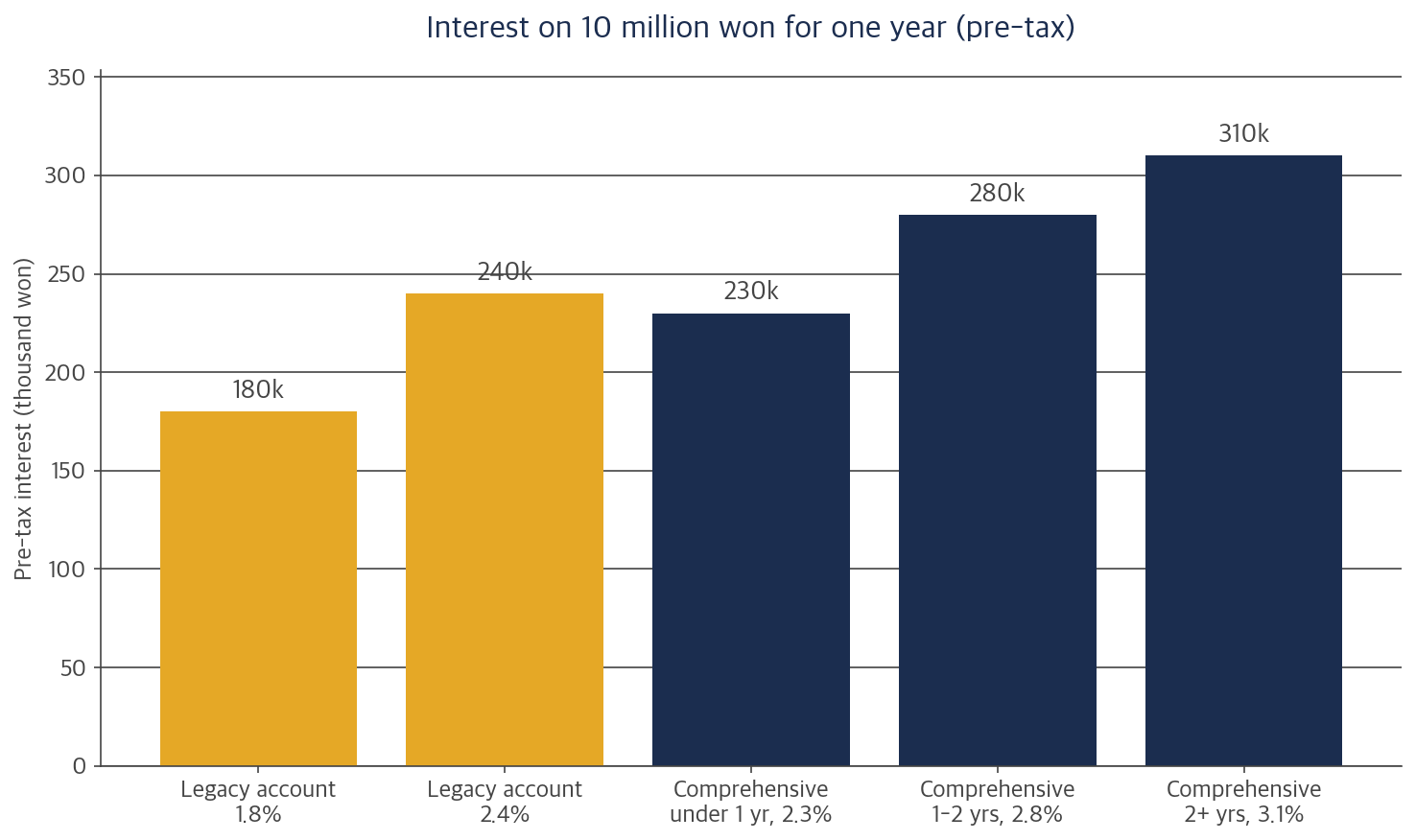
According to the Housing and Urban Fund product page, the comprehensive account pays no interest for the first month, 2.3 percent a year up to one year, 2.8 percent from one to two years, and 3.1 percent from two years. Compared with legacy deposit and installment accounts (around 1.8 to 2.4 percent), the two-year tier pays 70,000 to 130,000 won more a year.
If the tiers restart from the conversion date, though, the first year pays 2.3 percent with the first month interest-free, so the gap is close to nothing. The comprehensive rate applies from conversion onward, and the converted balance and later payments earn the same rate. Banks may explain differently which date the tiers count from, so ask yours before converting.
Income deduction: tax saved by bracket
Deposit and installment accounts are not among the housing savings the National Tax Service (국세청) recognizes, so this benefit opens only after a cheongyak conversion. Under Article 87 of the Restriction of Special Taxation Act (조세특례제한법), 40 percent of payments up to 3 million won a year is deducted, so up to 1.2 million won comes off your income. The tax you actually save depends on your bracket.
| Taxable income | Rate | Income tax saved | With local income tax |
|---|---|---|---|
| 14 million won or less | 6% | 72,000 won | 79,200 won |
| Above 14 million, up to 50 million won | 15% | 180,000 won | 198,000 won |
| Above 50 million, up to 88 million won | 24% | 288,000 won | 316,800 won |
To claim it, all of these must hold.
- Who: an employee with total salary of 70 million won or less who is the registered head (세대주) of a household that owns no home, or that head’s spouse (spouses qualify for payments from 2025)
- Paperwork: file a no-home confirmation (무주택확인서) with your bank by the end of February of the year after the one you claim for
- What counts: money paid in from that year onward. The balance carried over at conversion does not count
- Cap: 3 million won a year (raised from 2.4 million won in 2024), the same as the 250,000 won monthly recognition cap
- Clawback: cancel within five years of opening, or win a unit larger than the national housing size limit, and 6 percent of the payments made from the tax year you started claiming is clawed back
- Sunset: payments through December 31, 2028. Making the deduction permanent is in the government bill confirmed at the Cabinet meeting on September 1 and awaits the regular Assembly session
For where this sits in your year-end settlement, see the housing-related deductions section of our 15 year-end tax deductions checklist.
What to do now if you are holding a legacy account
I see no reason to wait for the extension decision. If it is approved, the terms do not improve. If it is not, the opportunity is gone. The decision variable is not the extension but your own application plan and your transfer plan. With those two settled, you can decide today.
Because a cheongyak conversion cannot be undone, start by finding which of the four situations below describes your account.
You plan to apply within two or three years: convert now
This applies most sharply to deposit or installment holders who want a public sale or national housing in a regulated zone. The conversion date is day one of your record, and the 24 month, 24 payment requirement slides back by exactly as long as you wait. Even if you only ever apply for private housing, your existing record is untouched, the deduction opens up and the rate may rise depending on the tier.
You have no application plans and just keep a balance there: convert only if you will keep it
This is the account that has become a de facto savings deposit. If you meet the deduction conditions above, converting opens the deduction on later payments, and the rate may rise depending on the tier. But if you expect to cancel and use the money elsewhere within months, there is no reason to convert.
Cancel within the same tax year and that year’s payments are not deducted at all, and cancelling within five years of opening the account triggers a clawback of 6 percent of the payments made after you started claiming the deduction. Ask your bank which opening date applies to a converted account. If you have not decided what this money is for, settle its role first using the four-account money system.
You plan to transfer a cheongyak savings account, or a deposit or installment account from before March 26, 2000: hold off
This is the one situation with the opposite answer. A cheongyak savings account, whenever it was opened, and a deposit or installment account opened before March 26, 2000, can be transferred to a spouse upon marriage, or to a spouse or lineal relative who becomes the registered household head, and the membership period, payment count and amount carry over. By contrast, a deposit or installment account opened on or after March 27, 2000 can only change hands on the holder’s death or a legal name change.
A parent’s decades-old deposit or installment account handed to an adult child fills the membership period portion of the private housing points score (17 points at 15 years or more) in one move, and a cheongyak savings account passes on its national housing payment count and amount. The moment that account goes through a cheongyak conversion, that route closes and only inheritance after death remains.
Subscription accounts are one per person, so the recipient must close any subscription account they already hold. A transfer requires a change of registered household head, so confirm the procedure first. If the plan is firm, do not convert.
You already hold a comprehensive account: this deadline does not apply
The cheongyak conversion deadline concerns legacy holders only. What matters for you is that the 250,000 won monthly recognition cap and the 3 million won deduction cap line up. Adjust your monthly payment depending on whether you need to build a public sale record quickly and whether you meet the deduction requirements. Foreign residents can open the comprehensive account, so the same review applies if you started one after arriving in Korea.
What to watch from here
- From now until the deadline, ministry approval of the rule amendment and the bank notices: last year the extension became known through a bank notice on September 25, five days before the deadline. The business days left this year are September 17 and 18, September 21 to 23, and September 28 to 30. A notice on the deadline day itself cannot be ruled out, so until you see one, treat September 30 as the deadline.
- The regular Assembly session: whether the permanent deduction passes. If the 2026 tax reform bill passes as written, the end-of-2028 sunset disappears. If not, the sunset stays.
- Regulated-zone designations. If the area you want to apply in becomes a speculation-overheated or subscription-overheated zone, first priority for national housing requires 24 months and 24 payments, and your record start date matters even more.
The most common misreading is that converting wipes out your existing membership period and deposit. It does not. The record for the housing type you already had stays intact, and only the newly opened type counts from the conversion date. The opposite misreading also circulates: that a cheongyak conversion makes you first priority for every housing type immediately. For the new type, the requirements start from zero.
Your application plan, not the extension news, is the yardstick
As of today the cheongyak conversion deadline is September 30, 2026, and the extension is a news report. Whichever way that resolves, the decision does not change.
- If the account is for applying, convert before September 30. The record for the new housing type starts on the conversion date, so every week of delay pushes first priority back.
- The membership period, deposit and payment count for the housing type you already had carry over in full.
- For a deposit or installment account, conversion unlocks 3.1 percent interest after two years and, for a no-home household head with total salary of 70 million won or less, an income deduction of up to 1.2 million won a year (no-home confirmation filed by the end of the following February).
- If it is a cheongyak savings account, or a deposit or installment account opened before March 26, 2000, and you plan to transfer it to family, do not convert. The comprehensive account passes only by inheritance.
- A cheongyak conversion cannot be reversed, so convert only if you intend to keep the account.
Related reading
- Housing Subscription Points: A Complete & Easy 84-Point Guide
- 15 Essential Tax Deductions You Can’t Afford to Miss: Year-End Checklist
- Jeonse Rent Guide: How to Choose Between Korea’s Two Lease Systems
Disclaimer: This article is for informational purposes only and does not constitute investment advice or tax consultation. The cheongyak conversion deadline and conditions are stated as of September 16, 2026. The deadline may change subject to approval by the Ministry of Land, Infrastructure and Transport, and the income deduction rules may change depending on the National Assembly’s review. Before filing a conversion, confirm the latest notices on the Housing and Urban Fund website, the National Tax Service website and with your bank.