In 2023 alone, 3.49 million freelancers and gig workers in Korea got back KRW 850.2 billion. That was withholding tax taken out of their pay at 3.3% and reclaimed the following May (Korea Tax Times report, October 1, in Korean).
The government now wants to stop collecting too much first and refunding it later. Its tax reform bill would cut the withholding tax on personal-service income (인적용역 사업소득) from 3.3% to 2.2%, and on October 1 the head of the National Tax Service (국세청, NTS) and lawmakers met delivery riders, caddies and broadcast writers to explain why. (As of October 2026 · last updated 2026-10-02)
Bottom line: a lower withholding tax rate does not change your total tax for the year; it only changes when you pay it. You would receive 1.1% more of your revenue each month, and in May your refund shrinks by that amount, or your extra payment grows by it. The cut is still a government bill under review at the National Assembly, and even if it passes it applies only to income paid on or after January 1, 2027.
What you can do today is something else: claim, free of charge, the unclaimed refunds from the past five years that the NTS has been notifying people about since September 1.
The 2.2% withholding tax is a government bill, not yet law
The cut from 3% to 2% for personal-service business income is part of the government’s 2026 tax reform plan. Add local income tax (지방소득세), which is 10% of the income tax, and 3.3% becomes 2.2% (NTS press reference, October 1, 2026). The dates show how far it has come.
- August 3, announced: the plan lowers the rate from 3% to 2% and applies it to income paid on or after January 1, 2027 (Ilgan NTN summary of the reform plan by tax).
- September 1, Cabinet approval; September 3, sent to the National Assembly: it became the official government bill (Kim & Chang note on the reform plan).
- Now: it has to go through the tax subcommittee of the Assembly’s Finance and Economy Planning Committee (재정경제기획위원회) (Newspim report, September 3), and tax law changes are usually finalized by a plenary vote in December.
Until the Assembly passes it, this is not a confirmed rule. And not every 3.3% deduction comes down. The bill keeps the current 3% for personal services that are settled by the payer at year-end, such as insurance solicitors.
A smaller withholding tax means 1.1% more of your revenue each month
Today, whoever pays you for the work takes 3% of the business income as income tax (NTS guide to withholding on business income) and another 0.3%, a tenth of that, as local income tax. This covers people who work without an employment contract and are paid per job: home-study and after-school tutors, delivery riders, home-visit service technicians, event staff. Under the bill the two numbers become 2% and 0.2%. A KRW 1,000,000 job that used to land in your account as KRW 967,000 would land as KRW 978,000.
| Annual revenue | Withholding tax now (3.3%) | Withholding tax under the bill (2.2%) | Extra cash per year | Per month |
|---|---|---|---|---|
| KRW 12 million | KRW 396,000 | KRW 264,000 | KRW 132,000 | KRW 11,000 |
| KRW 24 million | KRW 792,000 | KRW 528,000 | KRW 264,000 | KRW 22,000 |
| KRW 36 million | KRW 1,188,000 | KRW 792,000 | KRW 396,000 | KRW 33,000 |
| KRW 45 million | KRW 1,485,000 | KRW 990,000 | KRW 495,000 | About KRW 41,000 |
| KRW 60 million | KRW 1,980,000 | KRW 1,320,000 | KRW 660,000 | KRW 55,000 |
The NTS example runs the same arithmetic. For a single-person household with annual revenue of KRW 45 million (about KRW 3.8 million a month), income tax withheld over the year falls from KRW 1.35 million to KRW 900,000, and local income tax from KRW 135,000 to KRW 90,000.
The point that is easy to miss: this is not a tax cut. Withholding is a way of prepaying the year’s tax in pieces. Your final tax is recalculated in the global income tax return (종합소득세 신고) the following May, from your revenue, expenses and deductions. If you prepaid more than the final tax you get a refund; if you prepaid less you pay the difference (NTS guide to income tax refunds). Prepay less, and the May bill moves by exactly that much.
Who gets a smaller refund in May, and who pays more
The dividing line is your final tax as a share of revenue. Counting income tax only, if it is below 2% you still get a refund after the withholding tax rate drops. Between 2% and 3%, someone who used to get a refund can flip to owing money. Above 3% you already pay extra in May, and that payment grows by 1% of revenue (1.1% with local income tax).
The table below follows the method the NTS uses in its own worked example: a 64.1% simplified expense ratio (단순경비율), the KRW 1.5 million personal deduction for yourself, and the KRW 70,000 standard tax credit (worked example in the NTS guide for online content creators).
The rates are 6% on a tax base up to KRW 14 million and 15% from there to KRW 50 million (NTS income tax rate table). The expense ratio differs by type of work, so 64.1% is an illustration, and the amounts show income tax only. Local income tax moves separately in the same direction, at 10% of each figure.
| Case (no other income or deductions assumed) | Final income tax | May result with 3% withholding tax (now) | May result with 2% withholding tax (bill) |
|---|---|---|---|
| Revenue KRW 12 million, 64.1% simplified expense ratio | KRW 98,000 | KRW 360,000 withheld, KRW 262,000 refunded | KRW 240,000 withheld, KRW 142,000 refunded |
| Revenue KRW 24 million, 64.1% simplified expense ratio | KRW 357,000 | KRW 720,000 withheld, KRW 363,000 refunded | KRW 480,000 withheld, KRW 123,000 refunded |
| Revenue KRW 36 million, 64.1% simplified expense ratio (previous year’s revenue assumed under KRW 36 million) | KRW 615,000 | KRW 1,080,000 withheld, KRW 465,000 refunded | KRW 720,000 withheld, KRW 105,000 refunded |
| Revenue KRW 45 million (NTS example) | Not disclosed by the NTS (expense ratio and deductions not given) | KRW 1,350,000 withheld, KRW 440,000 refunded | KRW 900,000 withheld; per the NTS, no separate refund filing needed |
| Revenue KRW 60 million, income after bookkept expenses assumed at KRW 30 million | KRW 2,945,000 | KRW 1,800,000 withheld, KRW 1,145,000 more to pay | KRW 1,200,000 withheld, KRW 1,745,000 more to pay |
| Employee with side revenue of KRW 12 million, 64.1% simplified expense ratio, assumed to sit in the 15% bracket once combined with salary | KRW 646,000 on the side income | KRW 360,000 withheld, KRW 286,000 more to pay | KRW 240,000 withheld, KRW 406,000 more to pay |
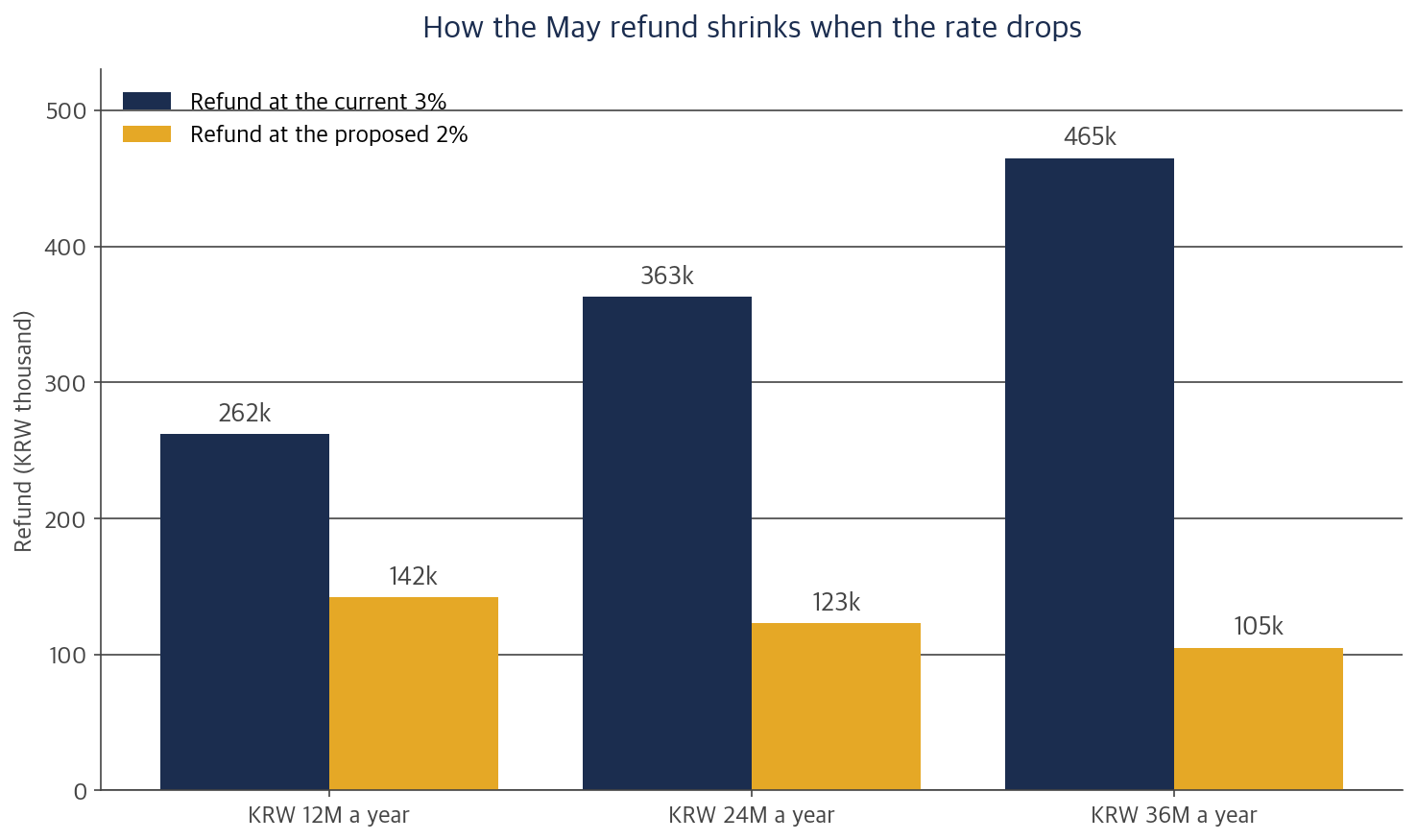
Three things to read from the table.
- If you file with the simplified expense ratio, you stay on the refund side: personal-service providers qualify when the previous year’s revenue was under KRW 36 million (NTS criteria for expense ratios). In the examples above the final tax is 0.8% to 1.7% of revenue, so 2% withholding still leaves something to return. The refund, though, falls from the KRW 260,000 to 460,000 range to the KRW 100,000 to 140,000 range.
- Under the conditions of the NTS example, revenue around KRW 45 million is the boundary: the NTS describes this as a case where a separate refund filing is no longer needed once the withholding tax rate drops. It attaches a caveat, though: the actual tax and whether a refund arises depend on each person’s income and deductions. At the same revenue, your expense ratio and deductions can leave a small refund or a small amount to pay.
- If you file from books or the standard expense ratio (기준경비율) with few expenses, or you are an employee with a side job, you will likely pay more: when fewer expenses are recognized, or the income is stacked on a salary and taxed at 15%, the final tax runs well above 3% of revenue. You already pay extra in May, and once the withholding tax rate drops you need to set aside another 1% of revenue (1.1% with local income tax).
This is also why choosing the new rate was not simple. A bill to lower the withholding tax rate, introduced in October 2024, failed to pass over the concern that some people would end up paying more instead of getting a refund, and the government redesigned this year’s bill at 2.2% (Korea Tax Times report, October 1). Even so, as the bottom two rows show, some people will still owe more in May.
Refunds you can claim now, whatever happens to the rate
The withholding tax cut starts with 2027 payments at the earliest, but getting back the 3.3% already taken is possible today. Since September 1 the NTS has been notifying 820,000 people who never filed an income tax return, and so never collected their refund, of KRW 163.5 billion in total. That is about KRW 200,000 per person on average.
The notices cover personal-service earners and wage, pension and other-income earners who did not file for tax years 2021 to 2025, and for personal-service earners they are limited to those eligible for the simplified expense ratio.
- Find the mobile notice: the notice sent on September 1 shows your expected refund, an individual authentication number and how to file.
- Go to Sontax or the phone line: the buttons in the notice, “Sontax filing shortcut” (손택스 신고 바로가기) and “File by ARS phone” (ARS 전화로 신고하기), take you straight to filing. The ARS number is 1544-9944.
- Check the pre-filled return: the NTS provides a fully pre-filled return (모두채움 신고서), calculated from revenue through to the refund amount. From this year the ARS flow also fills in your contact number and refund account automatically.
- Add any missing deductions: if a deduction such as a dependent is not reflected, edit the return yourself before filing. The refund is capped at the tax you prepaid.
The advantage of this route is that there is no filing-agent fee. If you cannot find the notice, you can log in to Hometax (홈택스) or the Sontax (손택스) mobile app and make the same claim. What to check on the filing screen is laid out step by step in the freelancer tax filing guide.
The October 1 meeting covered more than the withholding tax rate. Several other changes touch personal-service earners, and each is at a different stage, so it helps to separate what is already running from what is still being pursued.
| Item | What it does | Stage |
|---|---|---|
| Fee-free refund notices | 820,000 people, KRW 163.5 billion. Claim through Hometax, Sontax or ARS | Running since September 1 |
| Withholding tax rate cut | From 3.3% to 2.2% (local income tax included) | Government bill, under review at the National Assembly |
| Business registration deadline for the earned income and child tax credits (근로·자녀장려금) | From December 31 of the previous year to the date the credit is decided, about 8 months later | Enforcement decree amendment proposed, in talks with the Ministry of Finance and Economy (재정경제부) |
| Paperwork for adjusting National Pension contributions | Income confirmed from NTS data, without a contract termination certificate (해촉증명서) | Legal basis in place; system in development, targeted to apply from November 2026 (NTS plan) |
The tax credit item concerns nine lines of work paid directly by consumers, such as designated driving, golf caddying, caregiving and sports instruction. Under the current rule you must hold a business registration by December 31 of the previous year to receive the earned income and child tax credits. That deadline stands until the decree is actually amended, so if you work in one of those fields and plan to apply for the credit, registering before December 31 this year is the safer course.
Start by checking whether your final tax is above 2% of revenue
I would read this change not as “taxes are going down” but as “the lump sum you used to receive in May will arrive spread over twelve months”. Nothing that sets the final tax, meaning revenue, expenses and deductions, changes at all. So preparation starts with your own return, not with the rate headline.
Take the final tax (결정세액) on the return you filed this May, divide it by your revenue, and compare it with 2% and 3%. That tells you which side you are on. By situation, it breaks down like this.
- If you skipped a May filing in any year: there is no reason to wait for the withholding tax cut. An unclaimed refund does not arrive on its own, and the amount the NTS is notifying averages about KRW 200,000 per person. Check the notice or Hometax for the past five years first.
- If you use the simplified expense ratio and get a refund every year: once the withholding tax rate drops you receive a little more each month and your May refund falls by 1% of revenue (1.1% with local income tax), which is KRW 120,000 to 360,000 of income tax in the table above. If the refund has been covering insurance premiums or other yearly bills, you need to put the extra monthly cash aside to end up with the same money.
- If you already pay extra in May: this usually includes people who file from books or the standard expense ratio, and employees who combine side income with their salary. The extra take-home is not spending money; it is money you will owe in May. Move 1.1% of each payment into a tax account as it arrives and the larger bill costs you nothing new. How to split accounts is covered in the four-account money system guide.
- If the company settles your business income at year-end: this applies to insurance solicitors, door-to-door sales agents and beverage delivery sales agents (NTS guide to year-end settlement of business income). The bill keeps the current 3% for these services, so your take-home does not change.
Three variables to watch from here.
- The Assembly review: the tax subcommittee can change the rate or the start date, and the final vote usually comes at the December plenary session. Until it passes, it is better not to reset contract prices or a household budget around a 2.2% withholding tax.
- The reference date: the bill applies to income paid on or after January 1, 2027. Payments you receive this year are still withheld at 3.3%, and the May 2027 return, which settles 2026 income, does not change either. The first time you would meet a smaller refund or a larger payment is May 2028.
- Whether the tax credit decree is amended: the NTS plans to consult the Ministry of Finance and Economy from October to December this year and to guide applicants in the first half of 2027. Until the amendment is confirmed, the December 31 deadline holds.
The common misjudgment is “at 2.2% I will not need to file in May”. The bill changes the withholding rate and nothing else. The rule that anyone with business income must, in principle, file a final income tax return stays as it is (NTS guide to business income subject to withholding).
“No separate refund filing needed” in the NTS example means that, in that case, there is no longer a refund to file for; it does not mean the duty to file goes away. Anyone still owed a refund has to file to get it, and anyone who owes more and skips filing faces a non-filing penalty of 20% of the unpaid tax plus a late-payment penalty (NTS income tax penalty table).
Other items in the same tax reform plan are going through the same Assembly review. The changes to tax-advantaged accounts are covered separately in the Productive Finance ISA government bill overview.
Withholding less is not the same as paying less
The withholding tax cut turns money you used to get back all at once in May into money you receive month by month. If you know your final tax as a share of revenue, neither a smaller refund nor a larger payment will come as a surprise.
- A government bill to cut the withholding tax on personal-service business income from 3.3% to 2.2% (local income tax included) is under Assembly review; if passed, it applies to income paid on or after January 1, 2027.
- Total tax for the year stays the same even with less withheld. You receive 1.1% more of revenue each month, and the May refund shrinks or the extra payment grows by that amount.
- If your final income tax is below 2% of revenue you keep a refund; above 3%, the extra payment grows by 1% of revenue (1.1% with local income tax).
- Since September 1 the NTS has been notifying 820,000 people of KRW 163.5 billion in refunds, claimable without a fee through Hometax, Sontax or ARS (1544-9944).
- Personal services settled at year-end, such as insurance solicitors, stay at 3%, and for the nine consumer-paid lines of work the business registration deadline for the tax credits remains December 31 until the decree changes.
Related reading
- Freelancer Tax Filing Guide: A Step-by-Step Walkthrough
- Money System Made Easy: The Complete 4-Account Method to Manage Your Salary
- Productive Finance ISA in Korea: 3 Things Existing ISA Holders Should Check
Disclaimer: This article is for information and education only and is not individual tax advice. The withholding tax cut is a government bill under National Assembly review as of October 2, 2026, and the rate and start date may change with the Assembly vote and the enforcement decree. The calculations follow the stated assumptions; your actual tax depends on your expense ratio, other income and deductions. Before filing, check your own case on NTS Hometax or with the NTS call center (126). All decisions are your own responsibility.