Search for the S&P 500 in a Korean brokerage app and the same index shows up twice: a version listed on the Korea Exchange and bought in won, and the original US ETF bought in dollars on a US exchange. By September 28 this year, individual investors had put more than KRW 8 trillion into the Korean-listed versions, KRW 4.86 trillion into the top seller alone (Asia Economy, in Korean). Yet the route you pick changes which tax you pay, at what rate, and how. (As of September 2026 · Last updated 2026-09-30)
Bottom line: if you have room left in an ISA or a pension savings account, holding the Korean-listed version of a US ETF there beats both routes on tax. In a regular account, buying direct costs less when your realized gains for the year stay below about KRW 8.33 million; above that, the Korean listing costs less. Past KRW 20 million, your income tax bracket decides: with no other financial income and a 24% bracket, the Korean-listed route costs less tax up to about KRW 37.5 million of gains, but for salaried employees national health insurance premiums on the excess over KRW 20 million pull that line in to about KRW 26 million.
Where a US ETF is listed changes which tax applies
Gains on a Korean-listed ETF that holds foreign stocks are taxed as dividend income (배당소득세), while gains on an ETF listed directly on the NYSE or Nasdaq are taxed as capital gains (양도소득세) (Kiwoom Asset Management ETF tax guide, in Korean). A different tax means a different rate, deduction, loss treatment and interaction with your other income. Everything below assumes you are a Korean tax resident.
| Item | Korean-listed US ETF | US-listed ETF (bought direct) |
|---|---|---|
| Tax on trading gains | Dividend income tax 15.4% | Capital gains tax 22% |
| Basic deduction | None | KRW 2.5 million per person per year |
| How it is paid | Withheld when you sell | Self-filed and paid the following May |
| Offsetting losses | No (each profitable sale is taxed) | Netted with other overseas stocks and taxable Korean stocks in the same year |
| Trading gains count toward the KRW 20 million financial income line | Yes | No |
| Accounts that can hold it | Regular, ISA, pension savings, IRP | Regular overseas stock account |
The filing steps and dividend rules for the direct route are covered step by step in our foreign stock tax guide.
The first line where US ETF tax flips: KRW 8.33 million a year
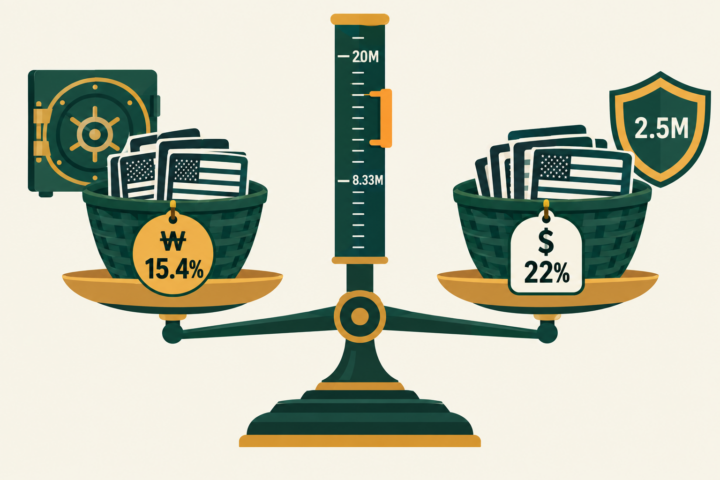
In a regular account, the point where the two routes cost the same comes from one equation. The Korean-listed US ETF pays 15.4% on the whole gain; the direct route pays 22% on the gain minus KRW 2.5 million. Solving 0.154 × gain = 0.22 × (gain − 2.5 million) gives a gain of about KRW 8.33 million, where both routes owe about KRW 1.28 million.
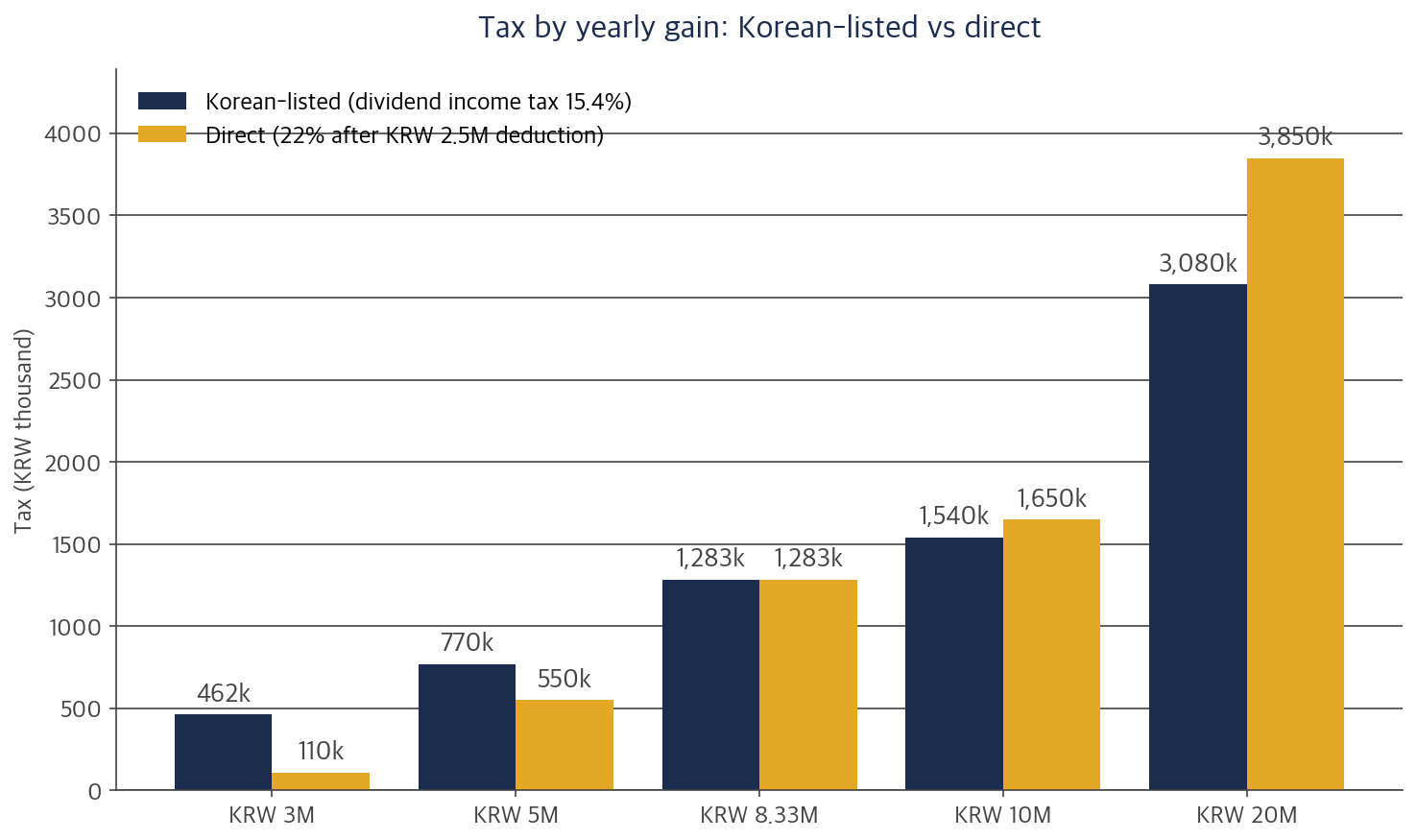
Below KRW 8.33 million, the KRW 2.5 million deduction does most of the work and buying direct wins. On a KRW 3 million gain, the Korean-listed route owes KRW 462,000 and the direct route KRW 110,000. At KRW 10 million the order flips: KRW 1.54 million for the Korean-listed route against KRW 1.65 million for direct.
That line holds only under four assumptions. If any of them fails for you, your own break-even point moves above or below KRW 8.33 million.
- No other overseas stock trades that year: the KRW 2.5 million deduction applies once per person per year, after gains and losses on overseas stocks and taxable Korean stocks are combined (Yuanta Securities overseas stock tax guide, in Korean). If another stock already used it up, the direct route costs more.
- Little other financial income: gains on the Korean-listed route are added to your interest and dividends, so if the total nears KRW 20 million, use the bracket table in the next section instead.
- Taxable gain equals the actual gain: a Korean-listed ETF is taxed at 15.4% on the smaller of the rise in its taxable base price (과표기준가격) and your actual trading gain (Samsung Asset Management ETF tax guide, in Korean). If the two differ, check the real figure on your broker’s sale record.
- Fees and currency costs left out: the direct route lets you deduct trading commissions as expenses, but you also pay to convert won to dollars and back.
Above KRW 20 million, your tax bracket changes the answer
Because gains on a Korean-listed US ETF count as dividend income, they are grouped with your bank interest as financial income. Gains from selling securities such as stocks are not financial income, so gains from buying direct stay out of that total (National Tax Service (국세청) financial income FAQ, in Korean).
Once financial income passes KRW 20 million in a year, the National Tax Service takes the larger of two amounts. One taxes the first KRW 20 million at 14% and adds the excess to your other income, such as salary, at the basic progressive rates. The other applies the 14% withholding rate to all financial income and taxes your other income separately at the basic rates. In practice, the excess is taxed at your marginal rate, and you pay more by however much that rate exceeds 14%.
| Yearly gain (KRW) | Direct | Korean-listed, 15% marginal rate | Korean-listed, 24% | Korean-listed, 35% |
|---|---|---|---|---|
| 20 million | 3.85 million | 3.08 million | 3.08 million | 3.08 million |
| 25 million | 4.95 million | 3.905 million | 4.4 million | 5.005 million |
| 30 million | 6.05 million | 4.73 million | 5.72 million | 6.93 million |
| 40 million | 8.25 million | 6.38 million | 8.36 million | 10.78 million |
| Gain where Korean-listed becomes costlier (tax only) | Baseline | Never | About 37.5 million | About 24.67 million |
| Same line with employee health insurance premiums | Baseline | About 49 million | About 26 million | About 23 million |
The amounts are income tax plus the 10% local income tax; health insurance premiums are not included. The table assumes zero other financial income and keeps the whole excess over KRW 20 million inside one bracket. On the National Tax Service rate table, taxable income (과세표준) of KRW 14 million to 50 million is taxed at 15%, KRW 50 million to 88 million at 24%, and KRW 88 million to 150 million at 35% (National Tax Service income tax rates, in Korean).
As the table shows, “direct wins above KRW 20 million” mostly holds from the 35% bracket up. On tax alone, the 15% bracket taxes the excess at 16.5%, below the direct route’s 22%, so the Korean-listed route stays cheaper throughout. In the 24% bracket it stays cheaper up to about KRW 37.5 million of gains.
If you are a salaried employee, add health insurance. An employee insured through work (직장가입자) whose non-salary income passes KRW 20 million a year pays an extra premium on the excess (보수 외 소득월액보험료), fully out of pocket. The income counted is interest, dividends, business, employment, pension and other income, so gains on a Korean-listed US ETF count and capital gains from buying direct do not (National Health Insurance Service (국민건강보험공단) guide, in Korean).
The 2026 rates are 7.19% for health insurance (Ministry of Health and Welfare (보건복지부) announcement, in Korean) plus 0.9448% for long-term care (long-term care rate announcement, in Korean), about 8.1% combined. For an employee whose only non-salary income is this gain, the line moves in sharply, as the last table row shows: in the 24% bracket it drops from about KRW 37.5 million to about KRW 26 million.
Bank interest is the part people forget. The Bank of Korea raised its Base Rate from 2.75% to 3.00% on August 27 (Bank of Korea monetary policy decision), and every extra won of interest shrinks the room your ETF gains have before the KRW 20 million line.
Say you earn KRW 8 million in deposit interest and realize a KRW 15 million gain on a Korean-listed US ETF. Your financial income becomes KRW 23 million, and the KRW 3 million above the line moves into comprehensive taxation. In the 24% bracket, the rate on that KRW 3 million rises from 15.4% to 26.4%, about KRW 330,000 more. An employee also pays about KRW 240,000 in health insurance premiums on the same KRW 3 million, for a total increase of about KRW 570,000.
ISA and pension accounts only hold the Korean-listed version
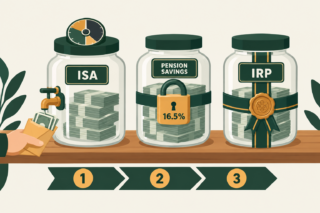
Pension savings accounts (연금저축), IRPs and ISAs can only invest in ETFs listed on the Korean market; an S&P 500 ETF listed on a US exchange cannot go in (Mirae Asset Securities magazine, in Korean). Once tax-advantaged accounts enter the picture, “Korean-listed or direct” turns into “which account.” The same news report cites the ability to buy Korean-listed S&P 500 ETFs in pension accounts as one reason for this year’s inflows.
| Account | Tax on gains and distributions from a Korean-listed US ETF | Limits to know |
|---|---|---|
| ISA (general, low-income type 서민형) | After 3 years, net profit tax-free up to KRW 2 million or 4 million, then 9.9% flat | 3-year minimum, KRW 20 million a year (KRW 100 million total); no new account if you were subject to comprehensive financial income taxation even once in the previous 3 years |
| Pension savings | Not taxed inside the account; taxed at a low rate when drawn as a pension | No leveraged or inverse ETFs |
| IRP | Same as pension savings | No leveraged or inverse ETFs; risky assets capped at 70% of the balance |
| Regular account | 15.4% withheld on each profitable sale | Counts toward the KRW 20 million financial income line |
Gains realized inside an ISA stay out of the KRW 20 million financial income total (Sisa Journal-e, in Korean). There is an entry condition, though: if you were subject to comprehensive financial income taxation even once in the previous three years, you cannot open a new ISA (BNK Investment & Securities brokerage ISA page, in Korean).
Pension savings accounts and IRPs do not tax distributions when they arrive and tax them when you draw a pension (Samsung Asset Management ETF tax guide, in Korean). Even so, the 15% US withholding on distributions from US stocks is taken first, inside the account too (Kiwoom guide, above).
The gap is not small. In a low-income-type ISA held for three years, the first KRW 4 million of net profit is tax-free and the rest is taxed at 9.9%, well under 15.4% in a regular account or 22% on the direct route. See ISA account types for the limits by type, and what closing an ISA or pension account early costs before you commit money you might need back.
Beyond tax: exchange rates, filing and distributions
- How the exchange rate enters your gain: on the direct route, the purchase and sale amounts are each converted to won at that day’s base exchange rate (Korea Investment & Securities overseas tax guide, in Korean). You can break even in dollars and still owe tax if the won weakened in between.
- Filing work: direct-route sales settled between January 1 and December 31 are self-reported and paid the following May. If you use several brokers you must add them up, and some brokers offer a filing service (Yuanta guide, above). The Korean-listed route ends with withholding as long as financial income stays at or below KRW 20 million.
- Distributions: dividends from US stocks held by an ETF are first withheld at 15% in the US (Kiwoom guide, above). Either way, distributions are financial income and count toward the KRW 20 million line.
Total expense ratios, commissions and currency conversion discounts vary by product, broker and promotion, so no single line compares them fairly. Narrow the field to two or three funds that track the same index, then set the manager’s disclosed expense ratio next to your broker’s fee table.
If you are about to buy a US ETF, decide in this order
I think filling tax-advantaged accounts first matters more than the KRW 8.33 million calculation. Between the two regular-account routes the rate gap is around 6.6 percentage points, while an ISA charges 0% up to its tax-free limit, 9.9% after that, and never adds the gain to your financial income. The route question only applies to money left over once those accounts are full.
If you have ISA or pension savings room left
Buy the Korean-listed US ETF inside that account. As the account table shows, the gain is tax-free, taxed at 9.9% or deferred, and the KRW 20 million worry disappears. If you may need the money within three years, check the ISA minimum period first; if you might withdraw before retirement, check the cost of closing a pension account.
If you use a regular account and gains run to a few million won a year
Buying direct costs less tax. The KRW 2.5 million deduction resets every year, so spreading gains over several years uses more of it. In exchange you carry the currency costs and the May filing, and remember that gains on other overseas stocks in the same year use up the deduction first.
If you already earn a lot of interest or your gains run to tens of millions
First estimate whether this year’s financial income will pass KRW 20 million. If it will, find your taxable income bracket and read across the bracket table above. Above KRW 88 million of taxable income, in the 35% bracket or higher, the direct route’s 22% gives a clear ceiling and often wins. At 24% or below, the Korean-listed route holds out longer on tax alone, but salaried employees should read the last table row, which adds health insurance.
If you do not have an ISA yet, open one before your financial income in a regular account passes KRW 20 million. Once you become subject to comprehensive financial income taxation, you cannot open a new ISA for the next three years.
If you already own ETFs bought directly in the US
Selling them to switch to the Korean-listed version triggers capital gains tax that year. There is one relief: overseas stocks you held as of December 23, 2025 can be sold through a Reshoring Investment Account (RIA, 국내시장 복귀계좌) and the proceeds kept in Korean-listed stocks or Korean equity funds (ETFs included) for a year. Sales settled between August 1 and December 31 this year get 50% of the gain deducted, with deposits of sale proceeds capped at KRW 50 million across all brokers (Mirae Asset Securities RIA terms, in Korean).
The trap is that a Korean-listed US ETF is not an eligible RIA investment. Net buying of Korean-listed overseas ETFs in any account outside the RIA, ISAs and pension accounts included, cuts the deduction in proportion (Yuanta Securities RIA guide, in Korean). Buying a large amount of Korean-listed US ETFs in the same year you unwind direct holdings through an RIA erodes the relief, so plan the two so they do not overlap.
What to watch next
- The last sale date for settlement this year, in late December: direct-route gains belong to the year they settle, and overseas stock trades take T+1 to T+3 days to settle depending on the country (Yuanta RIA guide, above). To use this year’s KRW 2.5 million deduction, sell before the last date your broker announces.
- December 31, 2026: the RIA sign-up deadline and the last settlement date that earns the 50% deduction. After that, unwinding direct holdings gets no RIA relief.
- The National Assembly’s review of the tax reform bill: the government’s tax reform plan, finalized on September 1 and submitted to the National Assembly on September 3, creates a new Productive Finance ISA (생산적금융 ISA) limited to Korean assets, designed so it cannot hold Korean-listed ETFs that track US indexes. Existing ISA benefits stay as they are under the government plan (Samsung Securities ISA tax reform guide, in Korean). Nothing is final until the Assembly passes it, so check the outcome before choosing an ISA type.
The most common mistake is “above KRW 20 million, direct always wins.” The extra tax from comprehensive taxation is only the gap between your marginal rate and 14% on the excess, so on tax alone the Korean-listed route is still cheaper up to about KRW 37.5 million in the 24% bracket. For a salaried employee, though, the roughly 8.1% health insurance premium pulls that line in to about KRW 26 million. Rework the line with your own bracket and insurance status instead of borrowing someone else’s number.
Account order comes before the rate table
The same S&P 500 exposure is taxed differently depending on four things: where the fund is listed, which account holds it, how much gain you realize in a year, and your income bracket. Fill tax-advantaged accounts first, then choose the route for whatever is left in a regular account based on the size of your gains.
- ISAs, pension savings accounts and IRPs only hold Korean-listed US ETFs, and that route carries the least tax.
- In a regular account, about KRW 8.33 million of yearly gains is the line between buying direct and buying the Korean listing.
- Once financial income passes KRW 20 million, your marginal rate and health insurance decide: in the 24% bracket the line is about KRW 37.5 million on tax alone and about KRW 26 million once an employee’s premiums are added.
- Net buying of Korean-listed overseas ETFs in the year you unwind direct holdings through an RIA reduces the RIA deduction.
Related reading
- Foreign Stock Tax 2026: Complete Capital Gains & Dividend Guide
- ISA Account Types: 3 Essential Differences You Need to Know
- Pension Savings vs IRP: 5 Essential Differences You Must Know
Disclaimer: This article does not recommend any ETF or stock; it is a general tax comparison for information only. Rates and calculations are as of September 30, 2026, and comprehensive taxation and health insurance premiums depend on your mix of income, deductions and insurance status. Before filing, check the latest guidance from the National Tax Service (국세청) and your broker, and consult a tax professional for large amounts. If you also file taxes in another country, its rules on foreign funds may change the math. Investment decisions and their results are your own responsibility.