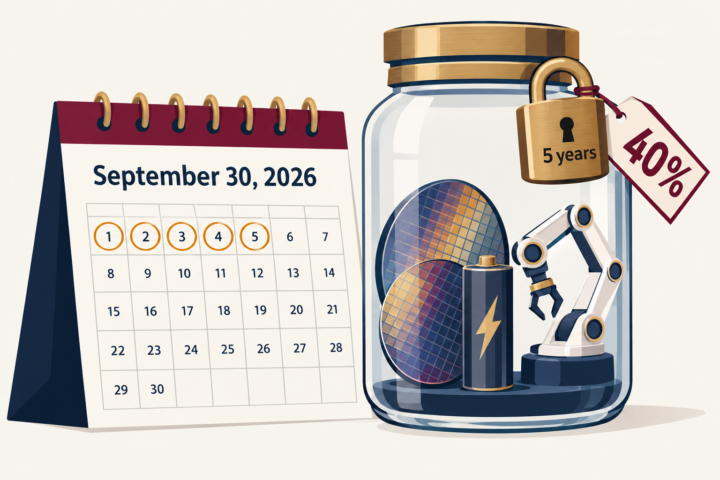
Round 1 of Korea’s Public Participation National Growth Fund (국민참여성장펀드, the Growth Fund below) sold out its entire 600 billion won in one week in May, and only 20% of it had been reserved for lower-income buyers. Round 2, announced by the Financial Services Commission (금융위원회), raises that share to half and mostly drops the step where you pulled your own income certificate. (As of September 2026 · last updated 2026-09-23)
What has not changed: no redemption for 5 years, and a tax clawback if you sell within 3 years.
Bottom line: treat round 2 of the Growth Fund as “money you cannot touch for 5 years” first, and as a “40% deduction” second. An income deduction reduces your taxable income, not your tax bill, so the actual saving is the deduction multiplied by your marginal rate. If your wage income is 50 million won or less, you can use the priority window that opens September 30 and closes October 7, but qualifying is not a reason to rush. Anyone who invests this year can still buy next year’s product.
Growth Fund round 2: two things changed from round 1
On paper, round 2 repeats round 1. The 600 billion won size, the 5-year maturity and the tax benefits are identical. What changed is the share reserved for lower-income buyers and the way income is verified.
| Item | Round 1 (May) | Round 2 (from September 30) |
|---|---|---|
| Sales period | Opened May 22, sold out May 29 | September 30 to October 15 (10 business days, first come first served) |
| Reserved for lower-income buyers | 20% (120 billion won), first 2 weeks | 50% (300 billion won), first 5 business days |
| Income check | You issued and submitted a certificate yourself | With your consent, the seller checks it for you (some securities branches still need the paper) |
| Round 1 investors | Not applicable | Cannot buy (account-only holders can) |
For readers who meet the income test, the first week is a more comfortable entry and most of the paperwork burden is gone. The full conditions are in the FSC press release on the round 2 Growth Fund sale (September 8) and the FSC notice on launch details (September 22), both in Korean.
The priority window is the first 5 business days, and the income test matches the seomin ISA
Round 2 runs in two stages. From September 30 to October 7, the first 5 business days, half of the 600 billion won, or 300 billion won, is reserved for buyers the government classifies as seomin (서민), its lower-income tier. From October 8 to October 15, the second week, anyone can buy what is left. If the reserved amount does not sell out in week one, the remainder is also released to everyone.
The income test is the same one used for the seomin-type ISA. You qualify with wage income of 50 million won or less, and if you also have other comprehensive income, that total must be 38 million won or less. All 24 sellers, 10 banks and 14 securities firms, apply the same test. Five procedures are worth knowing before you go in.
- Income verification: In round 1 you had to issue an “income certificate for ISA enrollment” on Hometax (홈택스) or Government24 (정부24) and hand it in. In round 2, if you consent, the seller checks your National Tax Service (국세청) income data through public MyData (20 sellers) or screen scraping (4 sellers). Two exceptions remain: if you subscribe at a branch of Shinhan Securities, iM Securities or Yuanta Securities (신한투자·아이엠·유안타증권), the three scraping-based brokers, or if you open the dedicated account at any securities branch before September 30, you must hand in the income certificate for ISA enrollment yourself. Banks open the account and sell the fund in one visit, so there is nothing to open in advance.
- Online quota: In week one, online sales are capped at 40% of a bank’s allocation and 60% of a securities firm’s. The cap exists so that branch counters are not crowded out, which means app-only buyers may find the online quota gone first. There is no cap in week two.
- Dedicated account: The tax benefits attach only if you buy through a dedicated account that invests in the Growth Fund alone. The account limit is 100 million won a year and 200 million won over 5 years. The minimum purchase is either 100,000 won or 1 million won depending on the seller.
- Investor profile test: The fund carries risk grade 1, the highest, with no principal guarantee, so you must be assessed as a suitable investor in the seller’s investor-profile test before you can subscribe. If you plan to use the first-day window, run the test in the app ahead of time.
- Round 1 buyers: Anyone who actually invested in round 1 cannot buy round 2. If you only opened the dedicated account in round 1 and never invested, you can. And anyone who invests this year can still buy the product launched next year.
Round 1 shows why the priority window matters. According to the tally reported on May 29, the day it sold out, 11,677 of the 30,258 subscribers were lower-income buyers, and the FSC’s final count puts their share at 38.8% by headcount and about 35% by amount. Only 20% of the allocation had been reserved for them, so demand from that group exceeded the reserved share. Round 2 of the Growth Fund lifts the share to half.
A 40% deduction is not a 40% tax cut: what you actually save
Round 2 of the Growth Fund carries two tax benefits. The first is an income deduction on the amount invested. The second is separate taxation of dividends at 9.9% (including local income tax) for 5 years from the investment date. The deduction rate depends on the tier your investment falls into, and it drops as the amount rises.
| Investment tier | Deduction rate | Cumulative deduction |
|---|---|---|
| Up to 30 million won | 40% | Up to 12 million won |
| Over 30 million up to 50 million won | 20% | Up to 16 million won |
| Over 50 million up to 70 million won | 10% | Up to 18 million won |
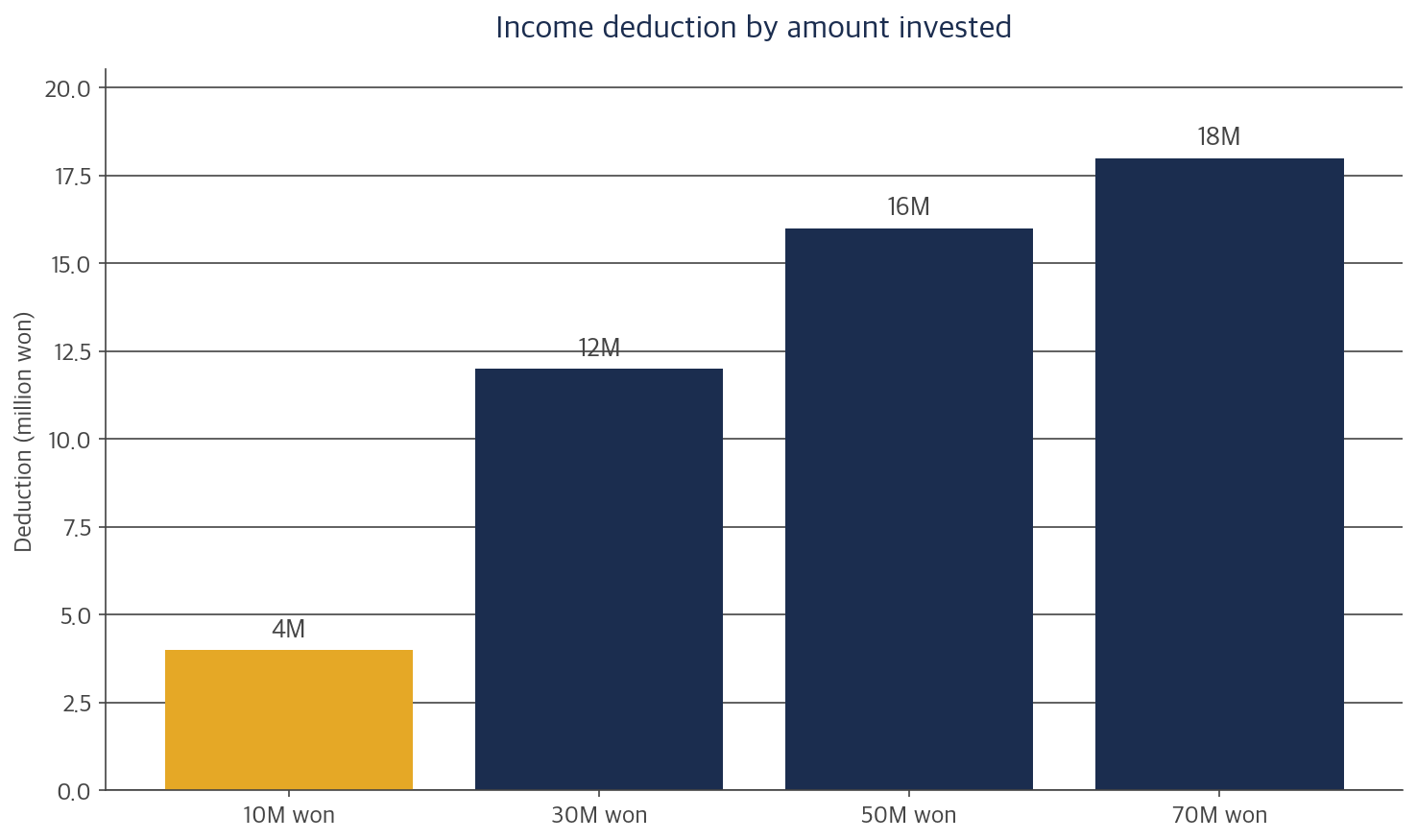
This is where most people get confused. An income deduction is not a tax credit that cuts your bill directly. It lowers the base on which tax is calculated, your taxable income. If you invest 30 million won and deduct 12 million won, the tax you actually save is 12 million won multiplied by your marginal rate. Using the National Tax Service rate table, the numbers look like this.
| Amount invested | Deduction | 15% bracket (16.5% with local tax) | 24% bracket (26.4% with local tax) |
|---|---|---|---|
| 10 million won | 4 million won | about 660,000 won | about 1.06 million won |
| 30 million won | 12 million won | about 1.98 million won | about 3.17 million won |
| 50 million won | 16 million won | about 2.64 million won | about 4.22 million won |
| 70 million won | 18 million won | about 2.97 million won | about 4.75 million won |
The table assumes you stay in the same bracket after the deduction. If the deduction pushes your taxable income into a lower bracket, the saving shrinks, and no other deductions or credits are reflected. The 15% bracket covers taxable income over 14 million won up to 50 million won, and the 24% bracket covers over 50 million won up to 88 million won.
There is one more cap. The Growth Fund deduction counts toward the 25 million won annual aggregate cap on income deductions (in Korean), shared with the credit card, housing fund and housing subscription deductions. If those have already used up most of the cap, the deduction in the table will not be recognized in full.
If your taxable income before the deduction is at least 26 million won, so that you stay in the 15% bracket after it, investing 30 million won returns about 1.98 million won at the next year-end tax settlement (연말정산), roughly 6.6% of the amount invested. Below that, part of the deduction falls into the 6% bracket and the saving shrinks. At 20 million won of taxable income, for example, it is about 1.39 million won, or 4.6%.
And the refund can never exceed the tax you actually owe for the year. Whether that figure is worth having the money locked for 5 years is the starting point for judging the Growth Fund.
Eligibility is tied to the tax benefit as well. A dedicated account can be opened by anyone aged 19 or older, or by wage earners aged 15 or older, but not by anyone who was subject to comprehensive taxation of financial income in any of 2023, 2024 or 2025. Those investors can still buy through a regular account without tax benefits, capped at 30 million won per person per year.
The deduction rests on an amendment to the Restriction of Special Taxation Act (조세특례제한법, in Korean) that passed the National Assembly plenary on April 23, 2026, and it applies through 2030. Wage earners claim it at the year-end settlement in early 2027. If you file a comprehensive income tax return instead, you claim it in the May 2027 filing.
The 5-year lock and the 3-year clawback are real
The Growth Fund is a closed-end fund with a 5-year maturity. For 5 years you cannot ask the seller to redeem your units. Once the fund is listed on the exchange you may sell your units to another investor, but the FSC itself writes in the press release that “liquidity is expected to be low, so trades may not occur, and even when they do, a price below the net asset value is expected”. It is safer to assume there is no practical way out before maturity.
| Item | Condition |
|---|---|
| Maturity | 5 years, closed-end (no redemption for 5 years) |
| Selling early | Possible after exchange listing, but low liquidity and a price below net asset value expected |
| Sale within 3 years | Clawback of the tax saved (14% of the sale or redemption amount, capped at the tax actually saved) plus the tax saved through dividend separate taxation. Exceptions for retirement, business closure, injury or illness |
| Dividend taxation | 9.9% separate taxation for 5 years from the investment date (local tax included) |
| Risk grade | Grade 1 (no principal guarantee); you must pass the seller’s investor-profile test |
| Loss absorption | Government money and the managers’ seed capital absorb 18.8% to 23.3% of each sub-fund’s losses first (the ratio differs by sub-fund); losses beyond that fall on investors |
You should also understand the loss structure. The 600 billion won from the public is combined with 120 billion won of subordinated government money, and the total of 720 billion won is invested across 10 sub-funds in a fund-of-funds structure. According to the details the FSC announced on September 22 (in Korean), government money and the seed capital the sub-fund managers put in first absorb 18.8% to 23.3% of each sub-fund’s losses. That is not a guarantee covering 20% of your own loss. Losses beyond that range fall on investors, and principal is not guaranteed.
Two details on the clawback. A sale within 3 years also claws back the tax saved through the 9.9% dividend taxation, not just the deduction. And the enforcement decree (in Korean) exempts early sales caused by retirement, business closure, injury or illness from the clawback.
The target sectors, listed in the FSC press release for the round 1 sale, are 12 industries including semiconductors, batteries, AI and bio. Three public fund managers run the main funds and 10 managers run the sub-funds.
If you are weighing Growth Fund round 2 now, decide it this way
My view is that the first-week window is worth considering only when two conditions both hold: you meet the income test, and you have money set aside that you will not need for 5 years. In every other case there is no reason to hurry. Anyone who invests this year can buy next year’s product, and the real value of the deduction is only your marginal rate times the deduction, so a “sold out” headline like round 1’s should not drive the decision.
If you pass the income test and have 5-year money
The priority window runs from September 30 to October 7. Online quotas are capped in week one, so if the app shows nothing left, a branch counter is still an option. Keeping the amount at 30 million won or below is the range where the full 40% rate applies, and if you stay in the 15% bracket after the deduction, about 6.6% of the amount comes back at the next year-end settlement. If your taxable income is low enough to drop into the 6% bracket, it is less.
Above 30 million won, the rate falls to 20% and then 10%, so the larger the amount, the less efficient the deduction becomes.
If you fail the income test but sit in the 24% bracket or higher
There is still a general allocation of 300 billion won in week one, and no distinction in week two. The higher your bracket, the more tax the same deduction returns, so the saving itself is bigger than for a lower-income buyer. But the maximum deduction of 18 million won requires investing 70 million won, and that money is locked for the same 5 years. If you already claim the housing fund deduction, check how much room is left under the 25 million won aggregate cap first.
Also check that this does not collide with other hold-to-maturity tax products in your plan, such as the dedicated account for retail savings bonds.
If you already invested in round 1, or only opened the account
If you actually invested in the round 1 Growth Fund, round 2 is not open to you. You can buy the product launched next year. If you only opened the dedicated account in round 1 and never invested, round 2 is open, but it is worth asking first whether the reason you held back then still applies now.
If you were subject to comprehensive financial income taxation in 2023 to 2025
You cannot open the dedicated account, so neither the deduction nor the separate dividend taxation applies. You can still buy up to 30 million won a year through a regular account, but that leaves you with the 5-year lock and none of the tax benefits. In that case the Growth Fund should not be judged on its own but compared side by side with other public funds on equal terms.
What to watch next
- Whether the reserved allocation sells out by October 7: Round 1 sold out in a week. If reserved units remain after week one, they are released to everyone in week two, so buyers outside the income test can watch that flow before deciding.
- The National Assembly’s tax bill review: The government’s Productive Finance ISA proposal lists the National Growth Fund among eligible assets and targets a January 2027 start. If it passes as drafted, next year could open a route to the fund inside an ISA. It is still a government bill under review, not a decided rule.
- Next year’s product: The FSC has said that investing this year does not bar you from the product launched next year. Whether the terms will be the same is something to check when that announcement comes.
- The rate table at settlement time: Your actual saving is fixed by the rates applied at the year-end settlement in early 2027 (or the May filing for comprehensive income tax filers). The table above uses the current National Tax Service rate table, in force since the 2023 tax year.
One common mistake
Reading “40% income deduction” as “40% of my investment comes back”. What comes back is the deduction times your marginal rate, and for a wage earner who invests 30 million won and still sits in the 15% bracket afterward that is about 1.98 million won. Nor does the priority window make the Growth Fund any less risky. Government money and the managers’ seed capital absorb only 18.8% to 23.3% of each sub-fund’s losses, and anything beyond that is borne by investors.
The deduction is a bonus. The real question is whether the money can sit for 5 years
Round 2 of the Growth Fund opens the door wider to lower-income buyers than round 1 did and removes the paperwork. But the skeleton, a 5-year lock and a clawback on sales within 3 years, is unchanged. The first-week window is an opportunity, not a deadline.
- Sales run from September 30 to October 15, and the first 5 business days reserve 300 billion won for buyers with wage income of 50 million won or less.
- The deduction is 40% up to 30 million won, and the actual saving is the deduction times your marginal rate.
- No redemption for 5 years, and a sale within 3 years claws back the tax you saved.
- Round 1 investors cannot buy round 2, but they can buy next year’s product.
Related reading
- Productive Finance ISA in Korea: 3 Things Existing ISA Holders Should Check
- ISA Account Types: 3 Essential Differences You Need to Know
- Savings Bonds in Korea: Buy Through Your IRP or the Dedicated Account?
Disclaimer: This article is for information and education only and does not recommend any specific product. The Growth Fund is an investment product with no principal guarantee. The sales conditions, tax benefits and savings examples above are based on Financial Services Commission press releases and the National Tax Service rate table as of September 23, 2026. Before subscribing, check the FSC releases, the seller’s prospectus and National Tax Service guidance directly. All decisions are your own responsibility.