In the first subscription window of September 2026, KRW 143.5 billion came in through retirement accounts alone. Korea’s government savings bonds for individuals (개인투자용 국채) had missed their monthly target in June, July and August. Once DC and IRP accounts were allowed to buy them, total orders including the regular channel were reported to have passed the planned KRW 230 billion issue (Yonhap News, September 17, 2026, PPSS). (※ As of September 2026 · Last updated 2026-09-22)
The next window opens in October. If you already hold a DC or IRP account in Korea, one question matters: what actually changes when you buy the same savings bonds inside a retirement account instead of the dedicated account?
Bottom line: the interest rate is identical in both accounts, and the real differences are how the tax is charged and how long the money is locked. If the money earned a tax credit, the 3.3% to 5.5% pension income tax applies to the whole withdrawal, principal included.
On the 10-year bond the tax therefore lands close to the 14% separate taxation of the dedicated account, and a clear gap opens only on the 20-year bond. Money paid in without a credit is taxed on the interest only, so its tax is lower, but it is locked up just as long. The solid advantage of the retirement route is the tax credit on contributions. For money already inside your account, the fair rival is a deposit or bond fund in that same account, and the test is whether you can leave it untouched until maturity.
Since September, savings bonds can be bought in DC and IRP accounts
The Ministry of Finance and Economy (재정경제부) announced the launch of retirement-account savings bonds on August 27, 2026 (ministry press release, in Korean), and the first subscription ran from September 9 to 15. The existing dedicated account stays in place, and one person can use both routes.
- Eligible accounts: defined contribution (DC) plans and individual retirement pensions (IRP). Defined benefit (DB) plans are excluded because members do not manage the assets themselves.
- Maturities: the 10-year and 20-year savings bonds only.
- Where: Shinhan Bank (신한은행), Hana Bank (하나은행), NH NongHyup Bank (NH농협은행), Mirae Asset Securities (미래에셋증권), Samsung Securities (삼성증권), Korea Investment & Securities (한국투자증권), KB Securities (KB증권) and NH Investment & Securities (NH투자증권). Your retirement account must sit at one of these eight, and the government plans to add more institutions over time.
- Next window: savings bonds subscriptions open every month, and each month’s issuance plan is published by the last day of the previous month (Ministry KTB site, issuance plans).
Dedicated account or retirement account: same savings bonds, different rules
The 10-year and 20-year bonds pay nothing along the way. If you hold to maturity, the coupon rate plus a bonus spread is compounded annually and paid out with the principal in one lump sum (Ministry KTB site, bonds for individual investors). They do not trade on the market, so the yield is fixed on the day you buy and there is no way to sell early for a capital gain if rates fall (Korea Economic Daily, September 8, 2026).
The rate is the same whichever account you use. What differs is below (Wolyo Sinmun, September 10, 2026).
| Item | Dedicated account | Retirement account (DC, IRP) |
|---|---|---|
| Maturities | 3, 5, 10 and 20 years | 10 and 20 years |
| Purchase limit | KRW 200 million per person per year | No separate annual limit (allocation within the monthly issue size) |
| Minimum order | KRW 100,000 | KRW 100,000 |
| Tax on the interest | 14% separate taxation if held to maturity, on purchases up to KRW 200 million (15.4% with local income tax). The 3-year bond does not qualify | Deferred until withdrawal, then 3.3% to 5.5% pension income tax if taken as a pension after age 55 |
| Benefit when paying in | None | Your own extra contributions earn a tax credit on up to KRW 9 million a year, combined with pension savings |
| Sunset of the tax benefit | Purchases made by December 31, 2027 | Follows the general retirement pension tax rules |
| Early redemption | From one year after purchase, simple interest at the coupon rate only | Same |
| Cash after redemption | Free to use | Stays inside the retirement account. A partial withdrawal requires a statutory reason, and closing an IRP to cash out triggers 16.5% other income tax on tax-credited money and gains |
| Risk-asset cap | Not applicable | Exempt from the cap, so up to 100% of the balance can go in |
The separate taxation of the dedicated account has an end date written into the law, and it is written for tax residents. A resident (거주자) who buys through the dedicated account by December 31, 2027 pays 14% on interest from up to KRW 200 million of purchases (Restriction of Special Taxation Act, Article 91-23, in Korean). The 3-year bond introduced in 2026 is outside this benefit (Korea Policy Briefing, December 30, 2025).
The September issue of savings bonds carried the following rates (Dailian, August 27, 2026).
| September issue | Coupon rate | Bonus spread | Rate actually compounded | Pre-tax return if held to maturity |
|---|---|---|---|---|
| 10-year | 4.415% a year | 0.35%p | 4.765% a year | about 59.3% |
| 20-year | 4.570% a year | 0.35%p | 4.920% a year | about 161.3% |
Headlines often quote “5.9% a year” and “8.1% a year”. Those are simple averages: the total return divided by the number of years. To compare savings bonds with a bank deposit, use the rate that is actually compounded, which is the coupon plus the spread. The coupon follows the previous month’s auction yield on Korea Treasury Bonds of the same maturity, and the spread is reset every month, so the October issue may carry different numbers.
Which account pays less tax: a KRW 9 million example
On tax rates alone, 3.3% to 5.5% against 14% looks like an easy win for the retirement account. The catch is the tax base. In the dedicated account only the interest is taxed. In a retirement account, both the contributions that received a tax credit and the investment gains are taxed as pension income, so the rate applies to the entire withdrawal, principal included (National Tax Service (국세청), pension income, in Korean). The example below puts KRW 9 million into the September savings bonds and holds to maturity, on these assumptions.
- Retirement account: the full KRW 9 million is your own contribution that received the tax credit, and after maturity you draw it as a pension before age 70, at 5.5% including local income tax.
- Dedicated account: interest is taxed at 15.4% including local income tax.
- Rounding: amounts are rounded to the nearest KRW 10,000.
| Case | Pre-tax amount at maturity | Amount that is taxed | Tax at maturity |
|---|---|---|---|
| 10-year, dedicated account | KRW 14.34 million | Interest of KRW 5.34 million | about KRW 0.82 million |
| 10-year, retirement account | KRW 14.34 million | Withdrawal of KRW 14.34 million | about KRW 0.79 million |
| 20-year, dedicated account | KRW 23.52 million | Interest of KRW 14.52 million | about KRW 2.24 million |
| 20-year, retirement account | KRW 23.52 million | Withdrawal of KRW 23.52 million | about KRW 1.29 million |
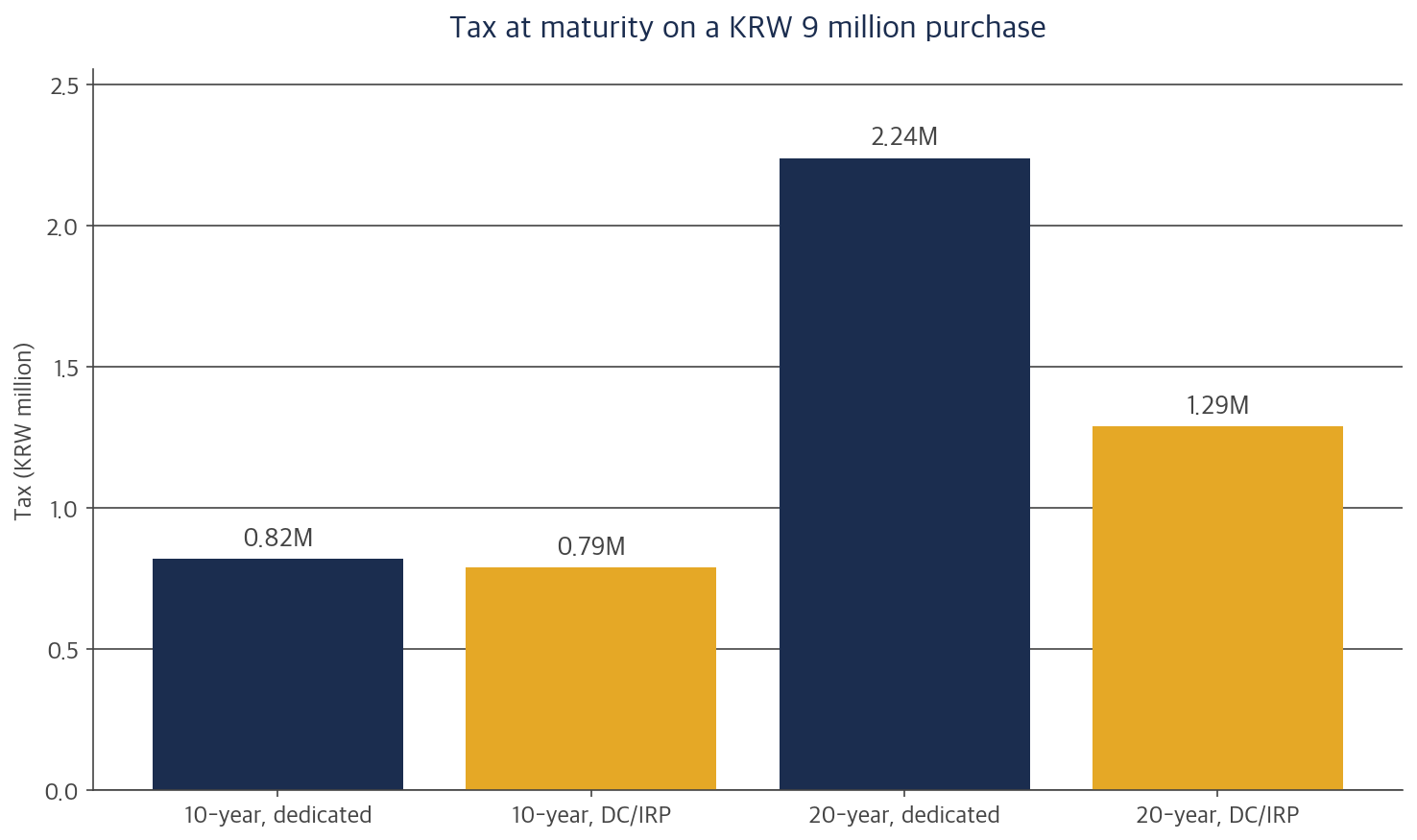
On the 10-year bond the two accounts differ by a little over KRW 30,000. Interest makes up roughly 37% of the maturity amount, so 15.4% on the interest and 5.5% on the whole land in almost the same place. On the 20-year bond the interest share grows to roughly 62%, and the retirement account pays about KRW 0.95 million less.
The dependable advantage of the retirement route sits at the contribution stage. If a fresh KRW 9 million fits within your tax credit limit, an employee with total salary of KRW 55 million or less gets back KRW 1,485,000 in the year-end settlement, and one above that level gets KRW 1,188,000 (National Tax Service, pension account tax credit, in Korean).
That credit comes from paying into the account, not from buying savings bonds. You receive exactly the same credit whether the money then goes into a deposit or a fund. The limits and the differences between account types are covered in Pension Savings vs IRP.
The arithmetic changes in the cases below (National Tax Service, withholding on pension income, in Korean).
- Contributions that did not earn a credit: money paid in above the KRW 9 million credit limit, or without claiming the credit, is not taxed on the principal at withdrawal (National Tax Service, amounts excluded from pension income, in Korean). Only the interest is taxed, so in the 10-year example the tax is about KRW 0.29 million (5.5% of KRW 5.34 million), well below the dedicated account’s KRW 0.82 million.
- Money already in the account: the tax credit was settled when you paid in, and the tax at withdrawal is the same whatever product holds the money. The fair rival to savings bonds is a deposit or bond fund inside the same account, not the dedicated account.
- Money that came from severance pay: the principal, including employer contributions to a DC plan, is charged 70% of the deferred retirement income tax when taken as a pension. The ratio drops to 60% once your actual pension years exceed 10, and to 50% once they exceed 20. Interest earned on that money is charged pension income tax.
- Your age when you draw: pension income tax is 5.5% under 70, 4.4% from 70 to under 80, and 3.3% from 80, all including local income tax.
- Large pensions: if private pension income exceeds KRW 15 million a year, you choose between global taxation and 16.5% separate taxation.
- Withdrawals that are not a pension: taking out tax-credited contributions and gains in any other way triggers 16.5% other income tax.
What early redemption of savings bonds leaves you, and what stays locked
The high maturity return exists only if you hold to the end. The single exit before maturity is early redemption, and the terms are the same in both accounts.
- When: you can apply from one year after purchase.
- What you get: principal plus simple interest at the coupon rate. The bonus spread and compounding are not applied.
- In the dedicated account: the separate taxation benefit is lost as well.
- In a retirement account: the redeemed cash stays inside the account. Moving it out requires one of the statutory reasons for early withdrawal, such as a home purchase or a jeonse deposit for a person who owns no home, or long-term medical care for you or a dependant.
The numbers make the gap plain. Put KRW 9 million into the September 10-year bond and redeem after five years, and a simple calculation gives interest of about KRW 1.99 million (KRW 9 million × 4.415% × 5 years). That is less than half of the KRW 5.34 million earned by holding to maturity. You served half the term, but compounding and the spread are gone.
Inside a retirement account, check the maturity date against the date you plan to start your pension. Money placed in savings bonds cannot be turned into cash before maturity except through early redemption. Buy the 20-year bond at 50 and it matures at 70. If you plan to start drawing a pension in between, first check that the rest of your balance, without the bond, can fund those payments (Bravo My Life, September 18, 2026).
For readers who may leave Korea within the next decade, the same lock-up deserves even more weight than the tax rate.
A savings bonds subscription runs in the order below. The hours and the allocation rule are those of the September plan.
- Check where your account is: your DC or IRP must be at one of the eight institutions. An account held elsewhere cannot subscribe.
- Read the issuance plan: by the last day of the previous month the ministry publishes the issue size by maturity, the rates and the subscription dates.
- Subscribe: on business days during the window, from 9 a.m. to 4 p.m., at a branch, on the website or in the mobile app. The minimum is KRW 100,000 (Asia Economy, September 8, 2026).
- Allocation: if total orders exceed the issue size for a maturity, every subscriber first receives up to KRW 3 million, and the remainder is shared in proportion to order size. Results are announced within two business days after the window closes.
In September, orders from retirement accounts alone exceeded the 10-year issue size, while the 20-year bond fell slightly short (Korea Economic Daily, September 16, 2026). If demand for the 10-year bond holds, a large order may be filled only in part, so decide in advance where the unallocated cash will sit inside your account.
What to decide before the October window if you hold a DC or IRP
I see savings bonds inside a retirement account as one more way to fill the safe-asset slot, not as a tax saver. As the example shows, for tax-credited money the tax gap on the 10-year bond is almost nil, and the tax credit comes from contributing, not from the bond.
A lump sum above the credit limit does pay less tax in the retirement account, because only its interest is taxed at the low rate. In exchange it is locked for 10 or 20 years and is hard to take out of an IRP. So rushing an account transfer for this bond, or moving a lump sum to catch the October window, makes sense only if you can live with that lock-up.
The deciding factor is time, not the tax rate. Can the money stay untouched for 10 or 20 years, and does the maturity line up with the date you expect to start your pension? Once those two answers are clear, find your own case below.
If your account already holds deposits or other principal-guaranteed products
DC and IRP accounts may hold risk assets only up to 70%, so at least 30% of the balance has to sit in safe assets such as deposits or bonds. That safe-asset share is the realistic home for savings bonds. Because tax is identical for anything held inside the account, the comparison is simply the rate on your current deposit against the compounded bond rate (4.765% a year on the September 10-year issue).
A deposit matures quickly, so you can move when rates rise. The bond locks the rate but punishes an early exit. Which turns out better depends on future interest rates, and nobody knows those. Market specialists also advise that, because the purchase-date rate drives the return of an ultra-long product, buying in stages beats a single lump sum (Segye Ilbo, September 9, 2026). Subscribing with part of the safe-asset share, spread over several months, fits that advice.
If you still have tax credit room this year
If part of the combined KRW 9 million limit for pension savings and IRP is unused, paying new money into an IRP earns the credit by itself. Whether that money then goes into savings bonds is a separate decision. You can contribute before year-end and decide on a subscription later, once you have seen the rates, and the credit is unaffected.
Keep in mind that a partial IRP withdrawal requires a statutory reason, and closing the account to cash out triggers 16.5% other income tax on tax-credited money and gains (Financial Supervisory Service (금융감독원) guidance, in Korean). Cash you will need within a few years should stay out no matter how attractive the credit looks. For how this credit ranks among others, see the year-end tax deductions checklist.
If retirement is less than 10 years away
Matching the maturity to your pension start date matters most. If the 10-year bond matures around the time you plan to begin drawing, the lump sum returns to the account as cash right when you need it, and the structure works. With the 20-year bond you are likely to need pension funding before maturity, and an early redemption at that point leaves only simple interest at the coupon rate. At this stage of life, the 20-year bond is safer reserved for money you are sure you will not touch until maturity.
If you buy through a DC plan and expect to change jobs or leave your employer, first ask your pension provider whether the savings bonds you hold can be moved to an IRP as they are.
If you might need the money within 10 years
The retirement-account route does not fit. Only 10-year and 20-year maturities are available, and redeemed cash does not leave the account. If you like the structure of savings bonds, the 3-year or 5-year issue in the dedicated account is closer to your horizon. Note that the 3-year bond gets no separate taxation and carried no bonus spread in September. Money you may need at any moment belongs in deposits and installment savings, not in a bond.
Dates to watch and a common misjudgment
- End of September, the October issuance plan for savings bonds: it sets the coupon rates, the bonus spread, the issue sizes and the subscription dates for the 10-year and 20-year bonds. Selling institutions list the October window as October 8 to 15 (Financial News, September 9, 2026). If the spread moves from September’s 0.35%p, the maturity return moves with it.
- October 22, the Bank of Korea (한국은행) monetary policy meeting: the base rate decision moves Korea Treasury Bond yields, and the coupon follows the previous month’s auction yield. The outcome can change the rates on issues from November onward (Bank of Korea, monetary policy meeting schedule, in Korean).
- More institutions: only eight offer savings bonds in retirement accounts today. If your pension provider is added, you can subscribe without moving your account.
- December 31, 2027: the purchase deadline for separate taxation in the dedicated account. Any extension would require a tax law amendment, so if you plan to build a long-dated position through the dedicated account in stages, plan around this date.
The most common misjudgment is the claim that “buying through a retirement account cuts the tax from 14% to 3.3% to 5.5%.” The two rates apply to different bases and cannot be compared directly. Tax-credited money is taxed on the principal as well, so on the 10-year bond the result is nearly the same.
For tax-credited money, the retirement route wins because of the credit at contribution and the tax deferral, not because of a lower rate, and every product inside the account enjoys those benefits equally, with or without savings bonds. Only money that earned no credit truly pays less tax, because the low rate applies to its interest alone.
Look at the lock-up before the tax rate
Which account should hold your savings bonds is decided by what the money is for, not by a tax table. Retirement money that will stay untouched to maturity and fills the safe-asset share of your plan fits the retirement account. A shorter horizon, or any chance of needing the cash, fits the dedicated account or a deposit.
- The rate on savings bonds is the same in either account. The compounded rate on the September issue was 4.765% a year for the 10-year bond and 4.920% for the 20-year bond.
- For tax-credited money, the 3.3% to 5.5% pension income tax applies to the whole withdrawal including principal, so on the 10-year bond the tax is close to the separate taxation of the dedicated account. Money that earned no credit is taxed on the interest only.
- The tax credit comes from contributing, not from savings bonds, and money already in the account is taxed the same whatever it holds.
- Early redemption leaves only simple interest at the coupon rate, and in a retirement account the redeemed cash stays inside.
- Rates and issue sizes for the October savings bonds appear in the ministry’s issuance plan at the end of September.
Related reading
- Pension Savings vs IRP: 5 Essential Differences You Must Know
- 15 Essential Tax Deductions You Can’t Afford to Miss: Year-End Checklist
- Savings Deposit vs Installment Savings Korea: A Complete Comparison Guide
Disclaimer: This article is for information only. It does not recommend any specific product and is not individual tax advice. Rates and issue terms of the savings bonds are those of the September 2026 issue, and tax rates and credit limits follow Korean law and National Tax Service guidance as of September 22, 2026. They can change with each monthly issuance plan and with legal amendments. The tax figures are examples based on the stated assumptions, and your actual tax depends on the source of your contributions, your age at withdrawal, your residency status and your other income. Before subscribing, check the ministry’s issuance plan, your financial institution’s notice and National Tax Service materials yourself.