In June 2026, with the AI-memory boom in full swing, SK Hynix (KRX 000660) is knocking on Nasdaq’s door. On June 24 its board approved the issuance of American Depositary Receipts (ADRs) and a Nasdaq listing, putting the company on track to begin trading under the ticker “SKHY” on July 10. The new-share offering aims to raise up to roughly ₩45 trillion, which would make it one of the largest ADR offerings on record.
But to answer questions like “Why would a Korean company list in the US again?” and “What happens to the SK Hynix shares I already own?”, a few things need to be laid out clearly. This guide walks through the key facts of the SK Hynix ADR listing and what investors should actually weigh. (※ Based on the June 24, 2026 board resolution and disclosure · Target Nasdaq listing date July 10, 2026 · Still at the “planned” stage)
Here’s the bottom line: this is not SK Hynix’s first-ever stock-market debut (an IPO). SK Hynix is already listed on the Korea Exchange, and what’s happening now is the issuance of new ADRs so its shares can also trade in the US — combined with a new-share offering that raises up to about ₩45 trillion. In other words, behind the flashy “US listing” headline, this SK Hynix ADR listing is really two things: (1) a large capital raise and (2) wider access for US investors. For existing shareholders, it brings both the promise of growth funding and the burden of dilution from new shares. And as of today, it’s still a plan rather than a done deal.
What Is an ADR — and Why This Isn’t a New IPO
An ADR (American Depositary Receipt) is a certificate that lets US investors buy and sell a foreign company’s shares on a US market in dollars. To be precise about the structure: the underlying SK Hynix common shares are deposited with a custodian in Korea, and an overseas depositary bank issues the ADRs (whose unit of ownership is the ADS) that trade in the US on top of them. Think of it as a “receipt that repackages a Korean share for the US market” — you buy the ADR, but behind it sits a real common share held in custody back home.
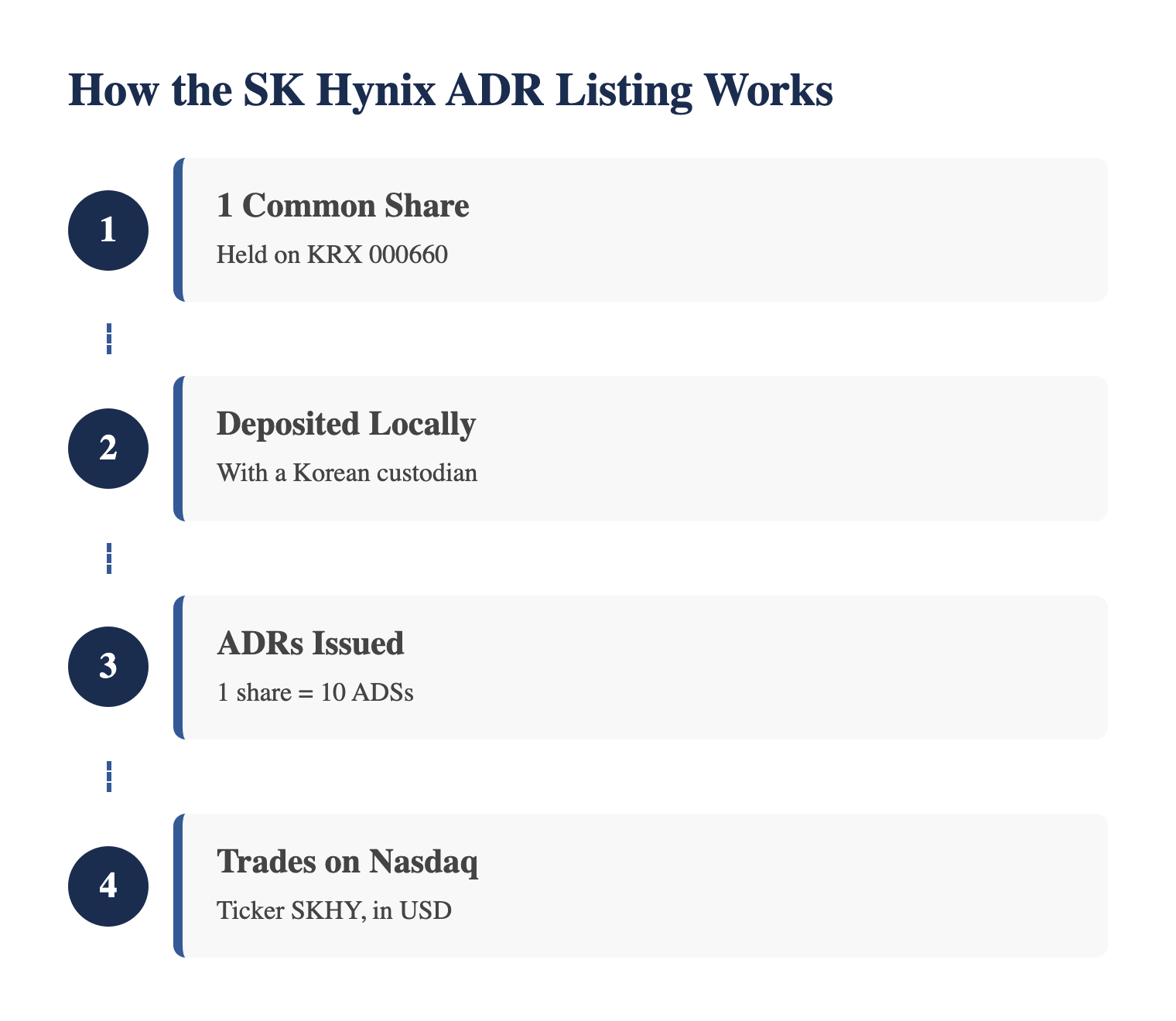
The key point is that an ADR is not a separate, new company from the underlying share. In this structure, one SK Hynix common share is split into 10 ADSs (ADRs). So a Nasdaq listing does not make SK Hynix a “US company,” nor does it remove the Korean listing. KRX-listed 000660 keeps trading as before, and in the US the same company’s equity simply trades in one additional layer under the name SKHY. Not mistaking “SK Hynix US listing” for a “new US IPO” is the starting point of this guide.
So what happens if you already hold SK Hynix shares? Your existing common shares are not automatically converted into ADRs or moved to a Nasdaq account. They keep trading as KRX 000660. That said, because new shares are being issued, the total share count rises — so existing shareholders’ ownership percentage can be diluted accordingly.
SK Hynix ADR Listing: The Key Facts
Based on the June 24, 2026 board resolution and disclosure, here are the key facts of the SK Hynix ADR listing so far. Some figures will be finalized during the offering process and may change.
| Item | Details |
|---|---|
| Company | SK Hynix (Korea Exchange 000660) |
| What’s happening | New ADR issuance + Nasdaq listing (not a new IPO) |
| Exchange · ticker | Nasdaq, SKHY |
| Board resolution | June 24, 2026 |
| Target listing date | July 10, 2026 (tentative — subject to SEC process) |
| Offering size | Up to 17.79M new shares (~2.5% of shares outstanding) · up to ~₩45.45T (~$29B, at reference price) |
| ADR structure | 1 common share = 10 ADSs (ADRs), i.e. 1 ADR = 0.1 share · third-party allotment of new shares |
| Lead underwriters | Bank of America, Citi, Goldman Sachs, JPMorgan |
| Use of proceeds | Yongin cluster phase-1 fab, Cheongju P&T7 advanced packaging, EUV tools, and other facility investments |
※ The offering size above is a provisional maximum based on the June 23 closing price; the final offer price and actual proceeds will depend on the bookbuilding (demand forecast) results.
On pricing: based on the June 23 closing price (the trading day before the board resolution), the reference price is about ₩2,555,000 per common share. Since one ADR represents 0.1 share, the reference price per ADR is about ₩255,500 (roughly $16–17). This is only a reference figure — the final offer price and total proceeds will be confirmed after a bookbuilding among overseas institutional investors. Check the final SEC prospectus and company filings for exact terms.
Here is the broad timeline as well. All dates are tentative and may change with regulatory approvals in Korea and the US and with market conditions.
| Stage | Target date |
|---|---|
| Bookbuilding (demand forecast) begins | July 6, 2026 (tentative) |
| Final offer price set | July 9, 2026 (US local time, tentative) |
| ADR trading begins on Nasdaq | July 10, 2026 (US local time, tentative) |
| Subscription · payment | July 14, 2026 (tentative) |
| Domestic new-share listing (KRX) | July 29, 2026 (tentative) |
The SK Hynix ADR Listing: Why List in the US?
Why would a company already listed in Korea bother issuing ADRs in the US? Two main reasons. First, large-scale fundraising. The proceeds are earmarked entirely for facility investment — chiefly the Yongin semiconductor cluster’s phase-1 fab, the Cheongju P&T7 advanced-packaging facility, and EUV (extreme ultraviolet) tools. Note that each project’s total investment and the amount raised through this ADR offering are not the same thing, and any shortfall may be covered by internal funds. With demand for HBM (high-bandwidth memory) — the heart of AI accelerators — surging, the company is loading up on ammunition for the capacity race.
Second, access to global investors. A dollar-denominated trading venue on Nasdaq makes it easier for US and global institutions and individuals — who previously found it hard to enter the Korean market directly — to invest in SK Hynix. It’s a strategic move to broaden both the company’s standing as a flagship AI/semiconductor name and its funding base. Indeed, by size this is being described as one of the largest ADR offerings ever. Of course, such expectations don’t guarantee an immediate share-price gain, and it takes time for capacity investments to translate into results.
SK Hynix ADR Listing: Three Things to Weigh
Before getting swept up in the size of the headline, here are three things to weigh about the SK Hynix ADR listing from an investor’s point of view.
- If you already own SK Hynix (000660) — dilution vs. growth. Because this is a new-share offering, the share count rises by about 2.5% and existing stakes are diluted by that much. On the other hand, the fact that the proceeds fund growth — HBM expansion and the like — is a medium-to-long-term positive. The crux is whether you weigh the near-term dilution or the long-term growth funding more heavily.
- Should you buy SKHY ADRs — for most, the ordinary share is simpler. After listing you can buy SKHY through a foreign-stock account, but a Korea-based investor can buy the same company’s ordinary share (000660) on the Korea Exchange in won more simply. ADRs add currency conversion, US trading hours, and foreign-stock taxes, and unlike ordinary shares they may incur depositary fees. These fees can be deducted from dividends or charged separately by your broker, so before buying SKHY it’s wise to check the ADR fees, dividend handling, and FX charges. That said, ADRs can be convenient for investors who want to hold dollar assets, need to trade during US hours, or want the position inside a US-based portfolio.
- It’s not final yet — timeline, price, and industry variables. The July 10 trading start and the offer price can change with the SEC process and the bookbuilding outcome. Add to that the won-dollar exchange rate and the memory-chip cycle (HBM prices and demand). Judge on the premise that this is “in progress,” not “done.”
For reference, selling a US-listed ADR at a gain is — unlike domestic Korean shares — subject to foreign-stock capital gains tax. After the annual ₩2.5M basic deduction, the remaining gain is taxed at 22% (20% capital gains tax + 2% local income tax), self-reported and paid during the May capital-gains filing period the following year.
Remember that the tax treatment differs depending on whether you buy the Korean ordinary share or the US ADR of the same company. Note, too, that domestic ordinary shares can also be taxed depending on major-shareholder status, off-exchange transactions, and future tax-law changes — so for large trades, check with the National Tax Service or a tax professional. The detailed math is covered in our guide to foreign stock taxes in Korea.
SK Hynix ADR Listing: Look at the “Why”
The SK Hynix ADR listing is undeniably a meaningful event. But the excitement the words “US listing” evoke and the reality behind them — “a large new-share offering plus a wider US trading window” — should be kept apart. Once you understand why the company wants to raise this much money now (the HBM expansion race) and what it means for existing shareholders (dilution vs. growth), you can judge on your own terms instead of being swayed by the headline.
- This is not a new IPO but an ADR issuance + Nasdaq listing (SKHY) of the already-listed SK Hynix.
- 1 common share = 10 ADSs (ADRs). The Korean listing (000660) stays in place.
- Up to ~₩45T new-share offering → ~2.5% dilution vs. growth funding for HBM and the Yongin cluster.
- Korean investors can buy the same company more simply as the ordinary share (000660) — ADRs add FX, fees, and taxes.
- The July 10 listing and offer price are not final. Watch the SEC process, FX, and the chip cycle.
Frequently Asked Questions (FAQ)
Is SK Hynix listing on a US exchange for the first time?
No. SK Hynix is already listed on the Korea Exchange (000660). What’s happening now is the issuance of new ADRs so its shares can also trade in the US, listed on Nasdaq — it is not a first-time stock-market debut (IPO). The Korean listing stays in place, and in the US the same company’s equity trades in one extra layer under the ticker SKHY.
Can investors in Korea buy SKHY ADRs?
After the listing, you can buy SKHY through a foreign-stock brokerage account. But a Korea-based investor can buy the same company’s ordinary share (000660) on the Korea Exchange in won more simply, so the ADR — which adds currency conversion, US trading hours, foreign-stock taxes, and possible depositary fees — may offer little extra benefit unless you have a specific reason. Note that brokers also differ in when they register newly listed tickers for trading.
Is a new-share offering bad for existing shareholders?
It has two sides. Issuing new shares raises the share count by about 2.5%, diluting existing stakes — that’s a burden. On the other hand, the proceeds fund growth investments such as HBM expansion and the Yongin cluster, which is a medium-to-long-term positive. Views differ depending on whether you weigh the near-term dilution or the long-term growth funding more heavily.
Are the listing date and offer price final?
No. The July 10, 2026 Nasdaq trading start is a target, and the final offer price will be set through bookbuilding beforehand (around July 9, US local time). The schedule and price can change with the SEC process, market conditions, and FX, so check the final SEC prospectus and company filings before making any decision.
Next step — if you’re curious about another big US listing from the same period, read our complete guide to the SpaceX listing, and if you want to understand the taxes that come with trading US stocks, see our guide to foreign stock taxes in Korea.
Disclaimer: This article is for information and education only and does not recommend buying or selling any security. Figures such as the schedule, offering size, offer price, and use of proceeds are based on the June 24, 2026 board resolution and disclosure, and items such as the listing date and final offer price may change with the SEC process and the progress of the offering. This event is not a new IPO but a planned ADR issuance and Nasdaq listing of the already-listed SK Hynix. Before investing, please check primary sources directly, including the prospectus filed with the SEC and the company’s regulatory filings on Korea’s DART system. All investment decisions are your own responsibility.