When the Chuseok (추석) holiday ends, most children in Korea are left holding a few envelopes. The KRW 100,000 from a grandmother or the KRW 50,000 from an uncle has nothing to do with tax when it changes hands. The question starts when a parent deposits that cash in the child’s account to grow it in savings or an ETF. Does gift tax in Korea suddenly apply to the same money just because its purpose changed? (As of September 2026 · Last updated 2026-09-21)
Bottom line: holiday cash that a child simply spends is exempt, but once it is pooled into deposits, installment savings or stock purchases it can fall within the scope of gift tax. Even so, a resident minor can deduct KRW 20 million over ten years for money from parents and grandparents combined, plus KRW 10 million for money from relatives such as uncles and aunts, so most families owe nothing. Two decisions remain: noting who gave what, and whether to file a return even when the tax due is zero.
Gift tax depends on how the money is used, not on the envelope
Korean law does not tax living and education expenses for a dependant, or congratulatory money of a customary size, when they are reasonable by social norms (Inheritance Tax and Gift Tax Act, Article 46, National Tax Service item guide). Holiday cash sits inside that exemption. The National Tax Service (국세청, NTS) looks at actual spending rather than the label on the transfer (Korea Policy Briefing on the 2026 NTS guide).
- Stays exempt: money a child with no income receives and spends directly on food, tuition, books and similar needs.
- Can become taxable: money that is not spent but placed in deposits or savings, or used to buy stocks, real estate or other assets.
The deduction depends on who gave the money
If you intend to move the cash into an account and invest it, the safe approach is to treat it as a gift and manage it within the deduction. The limit is set by the giver’s relationship to the child, grouped into classes, and it is aggregated over ten years from the recipient’s side (Article 53 of the Act). That is why it helps to sort the envelopes by giver from the very first day.
| Who gave the money | Legal group | Ten-year deduction | What to know |
|---|---|---|---|
| Parents, paternal and maternal grandparents | Lineal ascendants (직계존속) | KRW 20 million for a minor (KRW 50 million for an adult child) | One shared limit for all of them together, not one limit each |
| Uncles, aunts, cousins and similar relatives | Other relatives (기타친족): blood relatives within the fourth degree, in-laws within the third degree (NTS guide, in Korean) | KRW 10 million | One shared limit for money from all such relatives |
| More distant relatives, family friends | None | No deduction | Whoever the giver is, no gift tax is charged when the tax base is under KRW 500,000 (Article 55) |
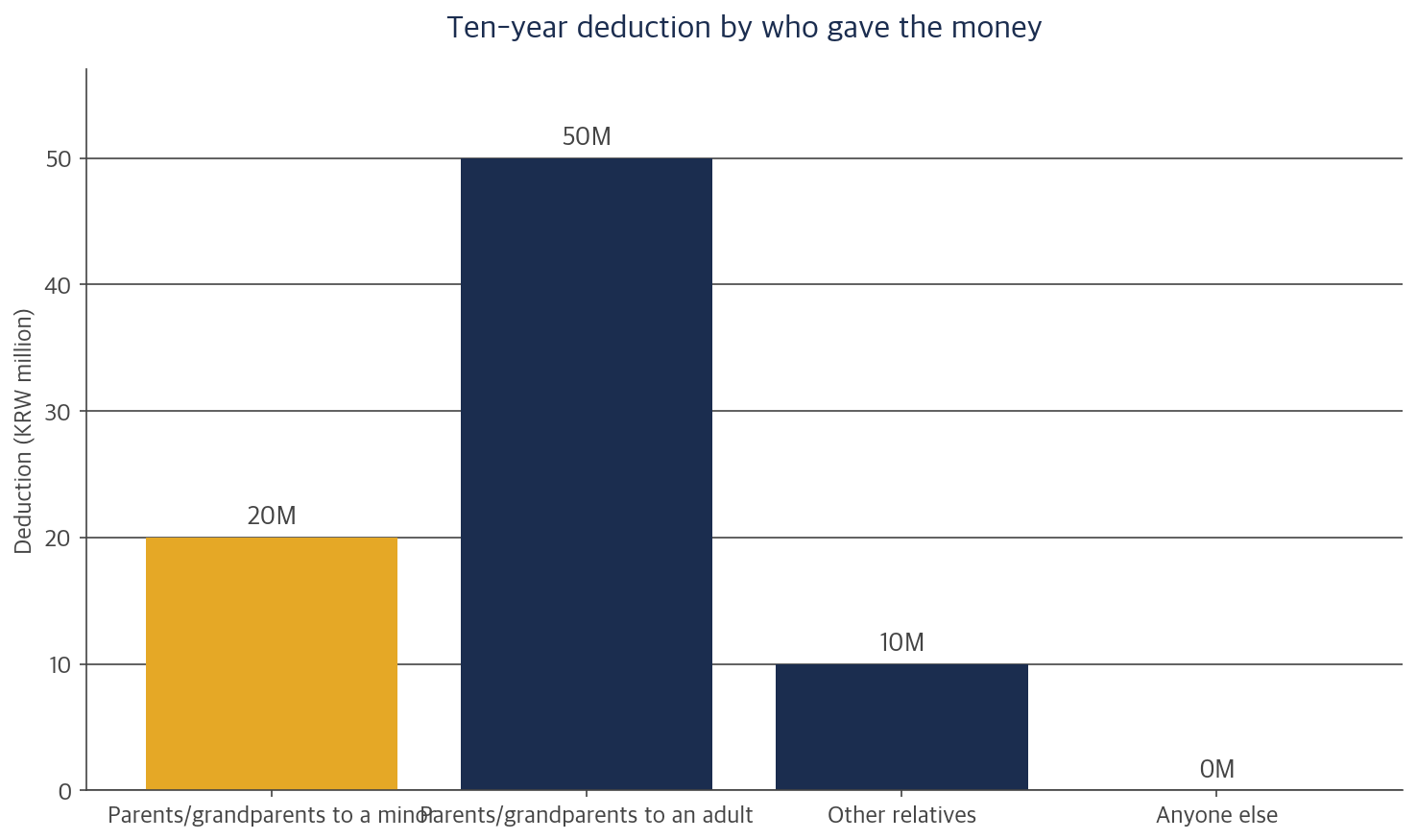
The first row is where families most often go wrong. It is not KRW 20 million from the father and a separate KRW 20 million from the grandfather. The NTS consultation centre explains that gifts from lineal ascendants are accumulated over ten years on the recipient’s side, and the deduction is used up in the order the gifts were received (NTS consultation centre Q&A on gift deductions, in Korean). If the parents have already used the full limit, nothing is left for money added by the grandparents.
Money that goes straight from a grandparent to a grandchild carries one more rule. A generation-skipping gift adds 30% to the calculated tax, and 40% when a minor grandchild receives more than KRW 2 billion (Article 57).
Inside the deduction the calculated tax is zero, so the surcharge is zero too. Once the limit is exceeded, gift tax on a grandparent’s money is heavier than on the same amount from a parent. The surcharge does not apply when the child’s parent has already died and the grandchild receives the gift directly from the grandparent (proviso to Article 57).
The deduction applies only when the recipient is a resident of Korea. The NTS states that it is not available when the child is a non-resident living abroad (NTS consultation centre Q&A, in Korean). The statute frames this by residence, not nationality: a resident is a person with a domicile in Korea or a place of residence here for 183 days or more (Article 2). A minor means under 19. After that, the KRW 50 million limit applies, reduced by any deduction already used within the previous ten years.
How much gift tax is due once the limit is exceeded
Few households exceed the limit with holiday cash alone. The calculation matters when a grandparent or parent adds a lump sum on top. The rate is 10% on a tax base of up to KRW 100 million, and filing on time reduces the tax by 3% (NTS gift tax item guide, Article 69). Assume a resident minor receives KRW 30 million and has had no other gift from the same group in the previous ten years.
| Step | Parents give KRW 30 million | Grandparents give KRW 30 million |
|---|---|---|
| Gift deduction | KRW 20 million | KRW 20 million |
| Tax base | KRW 10 million | KRW 10 million |
| Calculated tax (10% rate) | KRW 1,000,000 | KRW 1,000,000 |
| Generation-skipping surcharge (30%) | None | KRW 300,000 |
| Timely filing credit (3%) | KRW 30,000 | KRW 39,000 |
| Tax payable | KRW 970,000 | KRW 1,261,000 |
Skipping the return and being assessed later costs more. The ordinary penalty for failing to file is 20% of the tax that should have been paid, and the late-payment penalty accrues at 22 per 100,000 of the unpaid tax per day (NTS guide to gift tax penalties). If the parents’ case in the table went unfiled for one year, the numbers change as follows.
- Base tax: KRW 1,000,000. The KRW 30,000 timely filing credit is lost because the return was not filed by the deadline.
- Failure-to-file penalty: 20% of KRW 1,000,000, which is KRW 200,000.
- Late-payment penalty: 0.022% per day on KRW 1,000,000 for 365 days, which is KRW 80,300.
- Total: KRW 1,280,300, which is KRW 310,300 more than the KRW 970,000 owed with a timely return.
How the gift tax return works for money in a child’s account
The duty to file sits with the child who received the money, not with the person who gave it. The deadline is three months from the last day of the month in which the gift was received (Article 68; the same deadline appears on the NTS English filing page). For Chuseok cash received in September, that means December 31, 2026. The date cash was handed over is hard to prove, so depositing it within the same month lets the bank record serve as evidence of timing.
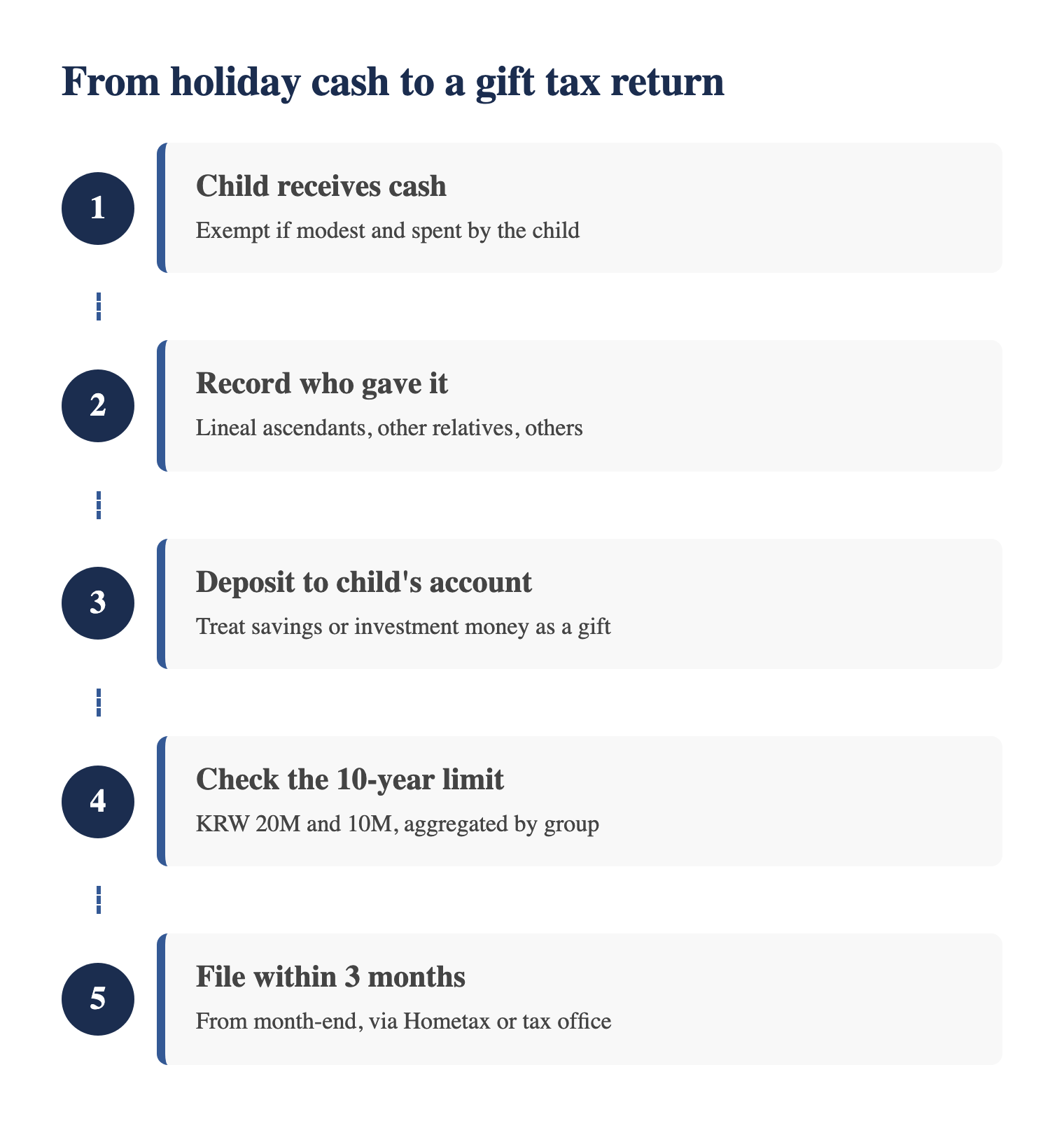
- Sort by date and giver: write down who gave how much and when, and move the cash into the account within the month it was received. Adding the giver’s name to the transfer memo makes the group totals easy to rebuild later.
- Where to file: on Hometax (홈택스), go to the filing and payment menu, then tax returns, then gift tax to file electronically, or submit the paper return to the tax office that covers the child’s address (NTS notes on filing gift tax, in Korean).
- What to submit: the gift tax base return with the self-assessment statement, and the schedule of gifted property and its valuation. The Act also asks for documents that prove the deductions claimed, so keep proof of the family relationship and the deposit record at hand.
- Keep the record: store the filing receipt even when the tax due is zero.
The reason to file when no gift tax is due comes from the NTS itself. A return on record can later be accepted as the source of funds when the child buys property or repays a debt (Financial News, February 19, 2026, in Korean). Brokerage paperwork for opening a minor’s account is covered separately in the child account guide.
There is also a rule for what happens after the deposit. If a parent trades stocks continuously and repeatedly through the child’s account and builds up the gains, the NTS says those gains can be treated as a benefit created by the parent’s contribution and taxed as an additional gift (Financial News citing NTS material, in Korean).
Holding for the long term fits the tax rules better than frequent trading in a child’s account. If the products are unfamiliar, start with the ETF beginner’s guide and the comparison of savings deposits and installment savings.
What to do if your child came home with Chuseok cash
My view is that a family planning to move holiday cash into a child’s account should record it by giver, bundle the deposit into a single moment such as right after the holiday, and file once for it within three months from the end of that month, even when the tax is zero. Money deposited after Seollal and after Chuseok means two returns, each on its own deadline.
Filing costs nothing, no gift tax arises inside the deduction, and what you gain is a record that proves where the money came from. On the other hand, there is no reason to worry about returns for pocket money a child spends as it comes. The dividing line is use rather than amount.
Families who let the child spend the money
There is nothing to do. Holiday cash of a customary size that a child spends on snacks, books and school supplies stays within the exemption. No record is needed and no return has to be considered. Keep in mind that the law sets no won figure for what counts as socially acceptable, and each case is judged on its facts. A sum too large to be called holiday cash is better handled under the branches below.
Families who plan to move the cash into the child’s account
Most households belong here, and their running total is far below the limit. The point in this case is the record, not gift tax. Each time you deposit, note the share from lineal ascendants and the share from other relatives, and bundle deposits at fixed moments such as right after a holiday so that fewer returns are needed. The deadline still runs three months from the end of the month of each deposit, so saving everything up for one year-end return does not work.
Once a group’s running total gets close to its limit, start tracking the remaining deduction as a number.
Families where grandparents want to add a lump sum
First check what the parents have already given. Parents and grandparents share the lineal ascendant limit, so if the parents have used the full KRW 20 million, the whole of the grandparents’ money becomes the tax base with no deduction, and the tax calculated on that base is increased by 30% (no gift tax is charged when the tax base is under KRW 500,000). While deduction remains, no gift tax arises whoever gives the money. Above the limit, the gap between a parent’s gift and a grandparent’s gift is the difference shown in the table.
Families with someone living outside Korea
This branch matters most for international families. If the child is a Korean resident, money sent by grandparents who live abroad is also within Korean gift tax, because a resident recipient is liable for all gifted property (Article 4-2). The deduction is tied to the recipient’s residence, so it applies in the same way.
In the opposite case, a child who becomes a non-resident, for example by studying overseas, loses the KRW 20 million deduction altogether. Families expecting a long stay abroad should confirm the child’s residence status at the time of the gift, and check the giver’s home-country rules separately.
Dates to watch and a common mistake
- Year-end tax legislation: the deduction is written into Article 53 as a won amount, so it changes only if the Act is amended. In the tax reform plan announced on August 3, 2026, the inheritance and gift tax items were a new valuation method for listed shares and wider access to records held by virtual asset service providers (Shin & Kim newsletter, in Korean). After the public notice period, the plan was finalized as the government’s proposal at the Cabinet meeting on September 1 (Ministry of Finance and Economy release, in Korean) and still has to go through the regular session of the National Assembly. Nothing in it is law until it passes, so it is enough to check whether Article 53 appears in the bills passed at year-end.
- Ten years from the first deduction: once the aggregation period passes, the limit becomes available again. Writing down the date of the first filed gift makes the next one easier to time.
- The child’s 19th birthday: the lineal ascendant limit becomes KRW 50 million, less any deduction used in the previous ten years.
The most common mistake is believing that writing “allowance” or “living expenses” in the transfer memo makes the money exempt. The NTS describes exempt living expenses as money given to a family member with no income that is spent directly on that purpose and does not flow into savings or investment.
Its long-standing interpretation is that money received as living or education expenses is not treated as exempt once it goes into deposits or savings or funds the purchase of stocks, land or housing (NTS written reply Seomyeon 4 Team-2163, in Korean).
A memo is only a record. The judgment follows where the money actually went.
Separate the cash to spend from the cash to grow
Holiday cash has nothing to do with gift tax when it is received, but from the day you decide to grow it in a child’s account it is safer to follow the rules for gifts. The rules are not complicated. Sort the money by giver, compare it with the ten-year limit, and file on time so that a record exists.
- Pocket money a child spends is exempt. Money moved into savings or investments should be managed as a gift.
- A resident minor’s ten-year deduction is KRW 20 million for parents and grandparents combined, and KRW 10 million for blood relatives within the fourth degree and in-laws within the third degree combined.
- A grandparent’s gift above the limit carries a surcharge of 30% of the calculated gift tax.
- The filing deadline is three months from the end of the month of the gift, and a return is proof of the source of funds even when the tax is zero.
Related reading
- Child Account in Korea 2026: Essential ISA & Zero Gift Tax Guide
- ETF Investing for Beginners: Your Easiest First Investment
- Savings Deposit vs Installment Savings Korea: A Complete Comparison Guide
Disclaimer: This article is for general information only. It is not individual tax advice and does not recommend any specific product. Deduction limits, tax rates, penalty rates and filing deadlines reflect Korean law and National Tax Service guidance as of September 21, 2026 and may change if the law is amended. The exemption for socially acceptable gifts has no fixed won threshold and is judged case by case, so confirm your own situation through Hometax, the NTS consultation centre or a tax professional before making or reporting a gift.